CSIRO Health & Biosecurity and CSIRO Land & Water, Floreat, WA, Australia.
School of Biological Sciences, University of Western Australia, Crawley, WA, Australia.
Mol Ecol. 2023 Dec;32(23):6345-6362. doi: 10.1111/mec.16689. Epub 2022 Sep 26.
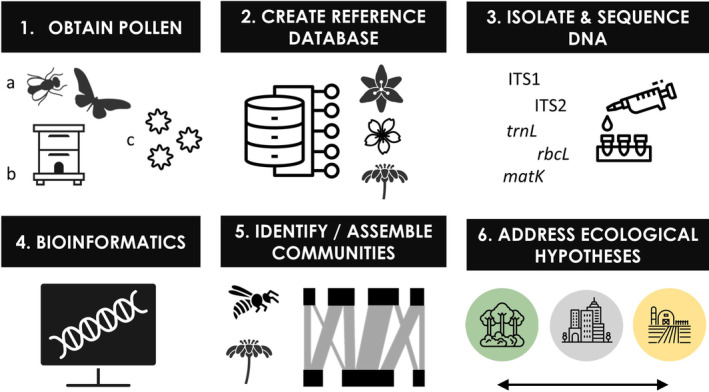
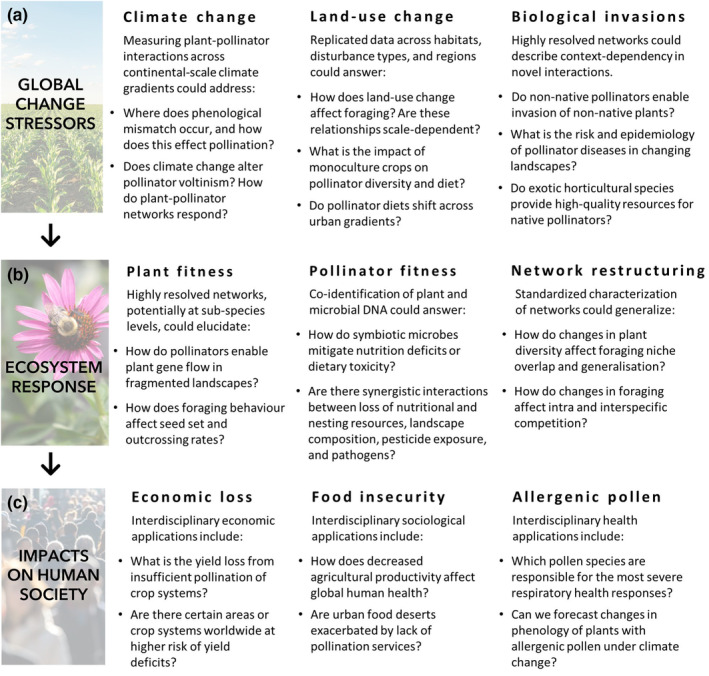
Anthropogenic activities are triggering global changes in the environment, causing entire communities of plants, pollinators and their interactions to restructure, and ultimately leading to species declines. To understand the mechanisms behind community shifts and declines, as well as monitoring and managing impacts, a global effort must be made to characterize plant-pollinator communities in detail, across different habitat types, latitudes, elevations, and levels and types of disturbances. Generating data of this scale will only be feasible with rapid, high-throughput methods. Pollen DNA metabarcoding provides advantages in throughput, efficiency and taxonomic resolution over traditional methods, such as microscopic pollen identification and visual observation of plant-pollinator interactions. This makes it ideal for understanding complex ecological networks and their responses to change. Pollen DNA metabarcoding is currently being applied to assess plant-pollinator interactions, survey ecosystem change and model the spatiotemporal distribution of allergenic pollen. Where samples are available from past collections, pollen DNA metabarcoding has been used to compare contemporary and past ecosystems. New avenues of research are possible with the expansion of pollen DNA metabarcoding to intraspecific identification, analysis of DNA in ancient pollen samples, and increased use of museum and herbarium specimens. Ongoing developments in sequencing technologies can accelerate progress towards these goals. Global ecological change is happening rapidly, and we anticipate that high-throughput methods such as pollen DNA metabarcoding are critical for understanding the evolutionary and ecological processes that support biodiversity, and predicting and responding to the impacts of change.
人为活动正在引发环境的全球性变化,导致植物、传粉者及其相互作用的整个群落发生重组,最终导致物种减少。为了了解群落转移和减少的机制,以及监测和管理影响,必须在全球范围内努力详细描述不同生境类型、纬度、海拔以及干扰水平和类型的植物-传粉者群落。只有通过快速、高通量的方法才能生成这种规模的数据。与传统方法(如花粉的微观鉴定和对植物-传粉者相互作用的视觉观察)相比,花粉 DNA metabarcoding 在通量、效率和分类分辨率方面具有优势。这使其成为理解复杂生态网络及其对变化的响应的理想方法。花粉 DNA metabarcoding 目前正被用于评估植物-传粉者相互作用、调查生态系统变化以及模拟过敏原花粉的时空分布。在过去的样本中,花粉 DNA metabarcoding 已被用于比较当代和过去的生态系统。随着花粉 DNA metabarcoding 向种内鉴定、分析古花粉样本中的 DNA 以及增加对博物馆和标本馆标本的利用,新的研究途径是可能的。测序技术的不断发展可以加速实现这些目标。全球生态变化正在迅速发生,我们预计,高通量方法如花粉 DNA metabarcoding 对于理解支持生物多样性的进化和生态过程以及预测和应对变化的影响至关重要。