Naturalis Biodiversity Center, Leiden, the Netherlands; Natural History Museum, University of Oslo, Norway.
Naturalis Biodiversity Center, Leiden, the Netherlands.
Sci Total Environ. 2022 Feb 1;806(Pt 1):150468. doi: 10.1016/j.scitotenv.2021.150468. Epub 2021 Sep 21.
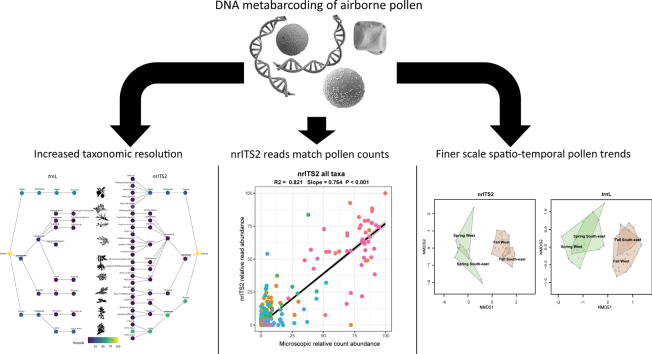
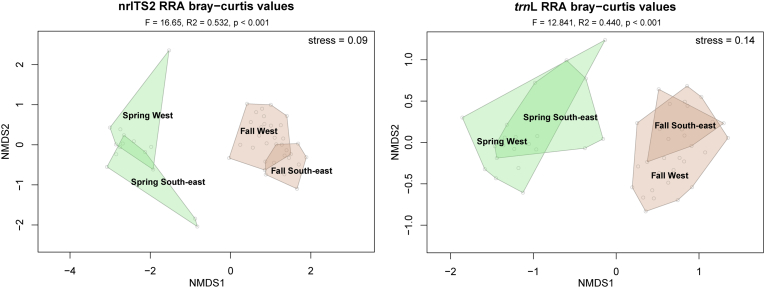
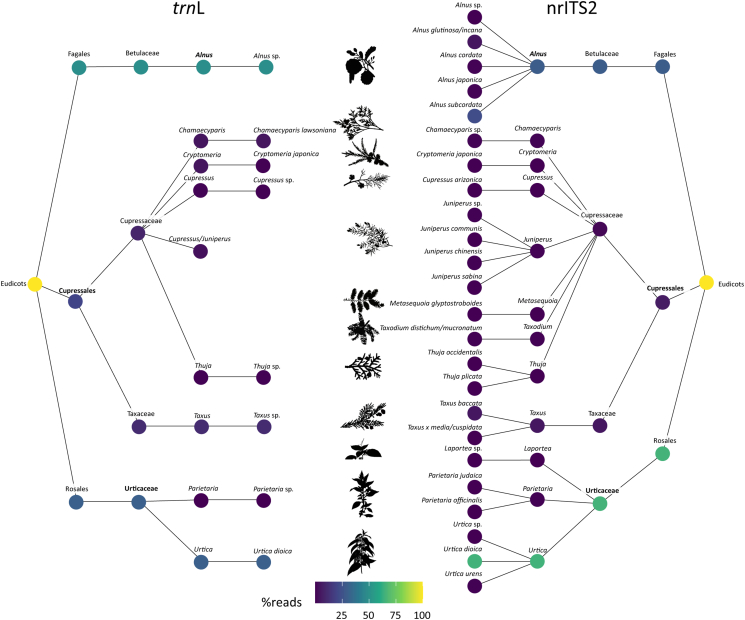
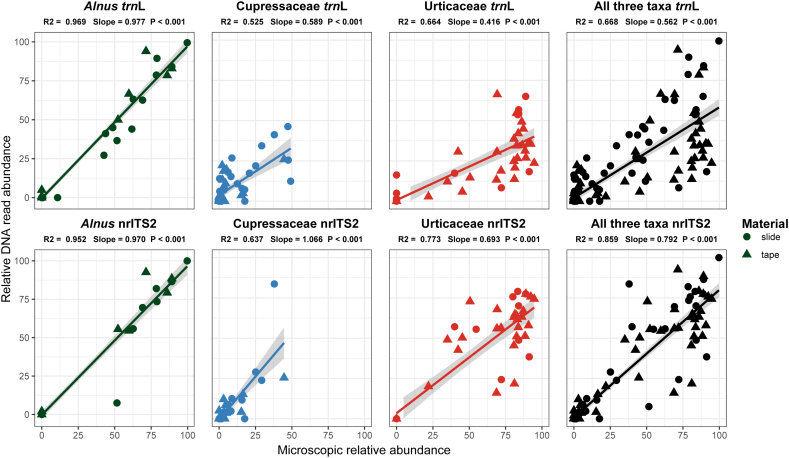
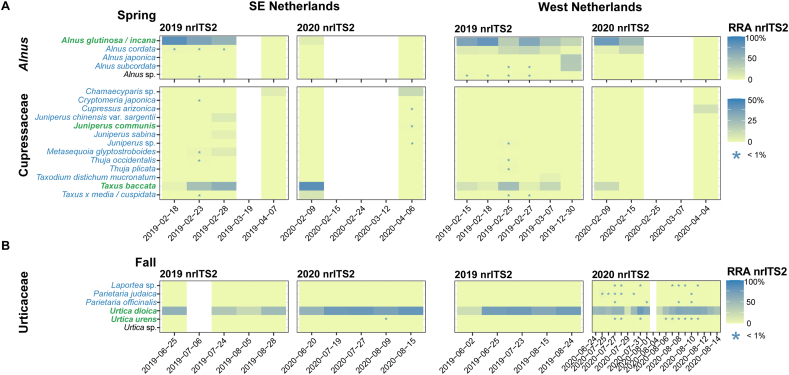
Airborne pollen monitoring is of global socio-economic importance as it provides information on presence and prevalence of allergenic pollen in ambient air. Traditionally, this task has been performed by microscopic investigation, but novel techniques are being developed to automate this process. Among these, DNA metabarcoding has the highest potential of increasing the taxonomic resolution, but uncertainty exists about whether the results can be used to quantify pollen abundance. In this study, it is shown that DNA metabarcoding using trnL and nrITS2 provides highly improved taxonomic resolution for pollen from aerobiological samples from the Netherlands. A total of 168 species from 143 genera and 56 plant families were detected, while using a microscope only 23 genera and 22 plant families were identified. NrITS2 produced almost double the number of OTUs and a much higher percentage of identifications to species level (80.1%) than trnL (27.6%). Furthermore, regressing relative read abundances against the relative abundances of microscopically obtained pollen concentrations showed a better correlation for nrITS2 (R = 0.821) than for trnL (R = 0.620). Using three target taxa commonly encountered in early spring and fall in the Netherlands (Alnus sp., Cupressaceae/Taxaceae and Urticaceae) the nrITS2 results showed that all three taxa were dominated by one or two species (Alnus glutinosa/incana, Taxus baccata and Urtica dioica). Highly allergenic as well as artificial hybrid species were found using nrITS2 that could not be identified using trnL or microscopic investigation (Alnus × spaethii, Cupressus arizonica, Parietaria spp.). Furthermore, perMANOVA analysis indicated spatiotemporal patterns in airborne pollen trends that could be more clearly distinguished for all taxa using nrITS2 rather than trnL. All results indicate that nrITS2 should be the preferred marker of choice for molecular airborne pollen monitoring.
空气中花粉监测具有全球社会经济重要性,因为它提供了有关环境空气中过敏原花粉存在和流行的信息。传统上,这项任务是通过显微镜检查来完成的,但正在开发新的技术来实现这一过程的自动化。在这些技术中,DNA 代谢组学具有提高分类分辨率的最大潜力,但对于结果是否可用于定量花粉丰度仍存在不确定性。在这项研究中,表明使用 trnL 和 nrITS2 的 DNA 代谢组学为来自荷兰空气生物学样本的花粉提供了高度改进的分类分辨率。总共检测到 143 属和 56 个植物科的 168 种,而使用显微镜仅鉴定出 23 属和 22 个植物科。nrITS2 产生的 OTU 数量几乎是 trnL 的两倍,并且鉴定到种水平的比例(80.1%)也远高于 trnL(27.6%)。此外,相对读取丰度与显微镜获得的花粉浓度的相对丰度的回归表明,nrITS2 的相关性更好(R=0.821),而 trnL 的相关性较差(R=0.620)。使用在荷兰早春和秋季常见的三个目标分类群(桤木属、柏科/紫杉科和荨麻科),nrITS2 结果表明,所有三个分类群都由一个或两个物种主导(桤木属 glutinosa/incana、Taxus baccata 和 Urtica dioica)。使用 nrITS2 发现了高度致敏和人工杂交物种,这些物种无法使用 trnL 或显微镜检查来识别(Alnus × spaethii、Cupressus arizonica、Parietaria spp.)。此外,PERMANOVA 分析表明,空气中花粉趋势的时空模式可以使用 nrITS2 比 trnL 更清楚地区分。所有结果表明,nrITS2 应该是分子空气花粉监测的首选标记物。