Department of Health Sciences, Faculty of Science, Vrije Universiteit Amsterdam, Amsterdam Public Health Research Institute, Amsterdam, the Netherlands.
Sarphati Amsterdam, Public Health Service (GGD), City of Amsterdam, Amsterdam, the Netherlands.
Sleep. 2022 Nov 9;45(11). doi: 10.1093/sleep/zsac215.
This review aimed to summarize instruments that measure one or more domains of sleep health (i.e. duration, quality, efficiency, timing, daytime sleepiness and sleep-related behaviors) in a general population of 4-12-year old children, and to assess these instruments' content validity. Other measurement properties were evaluated for instruments with indications of sufficient content validity.
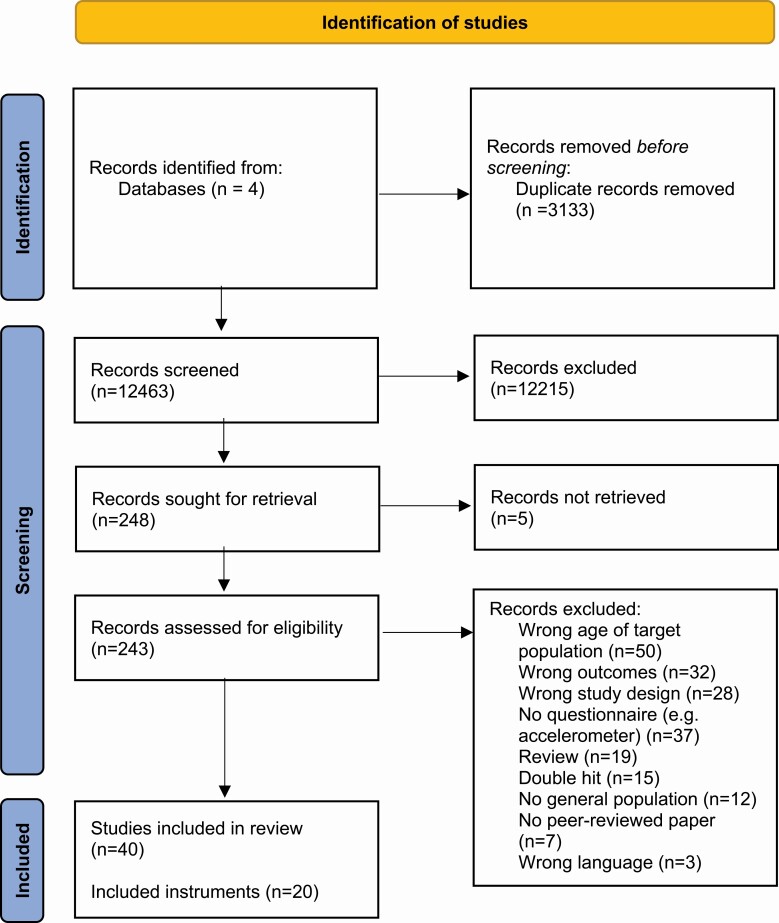
A systematic literature search was performed in PubMed, PsycINFO, Web of Science, and EmBase. Methodological quality, content validity, and other measurement properties were assessed via the COnsensus-based Standards for the selection of health Measurement INstruments (COSMIN) methodology. Instruments with indications of sufficient content validity (i.e. relevance, comprehensiveness and comprehensibility) were further evaluated on other measurement properties (i.e. other aspects of validity, reliability, responsiveness). A modified GRADE approach was applied to determine the quality of evidence.
Twenty instruments, containing 36 subscales, were included. None of the instruments measured all sleep health domains. For five (subscales of) instruments sufficient relevance and comprehensibility was found. The quality of evidence ranged from very low to moderate. For these five instruments all additional measurement properties were assessed. Sufficient results were found for structural validity (n = 1), internal consistency (n = 1), and construct validity (n = 1), with quality of evidence ranging from very low to high.
Several (subscales of) instruments measuring domains of child sleep health showed good promise, demonstrating sufficient relevance, comprehensibility, and some also sufficient results on other measurement properties. However, more high quality studies on instrument development and the evaluation of measurement properties are required.PROSPERO registration number: CRD42021224109.
本综述旨在总结用于测量 4-12 岁普通儿童睡眠健康(即持续时间、质量、效率、时间、日间嗜睡和与睡眠相关的行为)一个或多个领域的工具,并评估这些工具的内容效度。对于具有足够内容效度的工具,还评估了其他测量特性。
在 PubMed、PsycINFO、Web of Science 和 EmBase 中进行了系统的文献检索。使用共识基础的健康测量仪器选择标准(COSMIN)方法学评估方法学质量、内容效度和其他测量特性。具有足够内容效度(即相关性、全面性和可理解性)迹象的工具进一步评估了其他测量特性(即其他有效性、可靠性、反应性方面)。应用改良的 GRADE 方法来确定证据质量。
共纳入 20 项工具,包含 36 个分量表。没有一个工具测量所有的睡眠健康领域。对于五个(分量表的)工具,发现了足够的相关性和全面性。证据质量从极低到中等不等。对于这五个工具,评估了所有其他测量特性。对于结构有效性(n=1)、内部一致性(n=1)和构念有效性(n=1),均得到了足够的结果,证据质量从极低到高不等。
一些(分量表的)测量儿童睡眠健康领域的工具显示出良好的前景,表现出足够的相关性、全面性,并且在其他测量特性方面也有足够的结果。然而,需要更多关于工具开发和测量特性评估的高质量研究。
PROSPERO 注册号:CRD42021224109。