Mi Wei, Hu Zhiyong, Xu Lanlan, Bian Xiangyu, Lian Wu, Yin Shuying, Zhao Shuying, Gao Weina, Guo Changjiang, Shi Tala
Department of Nutrition and Food Hygiene, School of Public Health and Management, Binzhou Medical University, Yantai, China.
Tianjin Institute of Environmental and Operational Medicine, Tianjin, China.
Front Microbiol. 2022 Aug 25;13:983358. doi: 10.3389/fmicb.2022.983358. eCollection 2022.
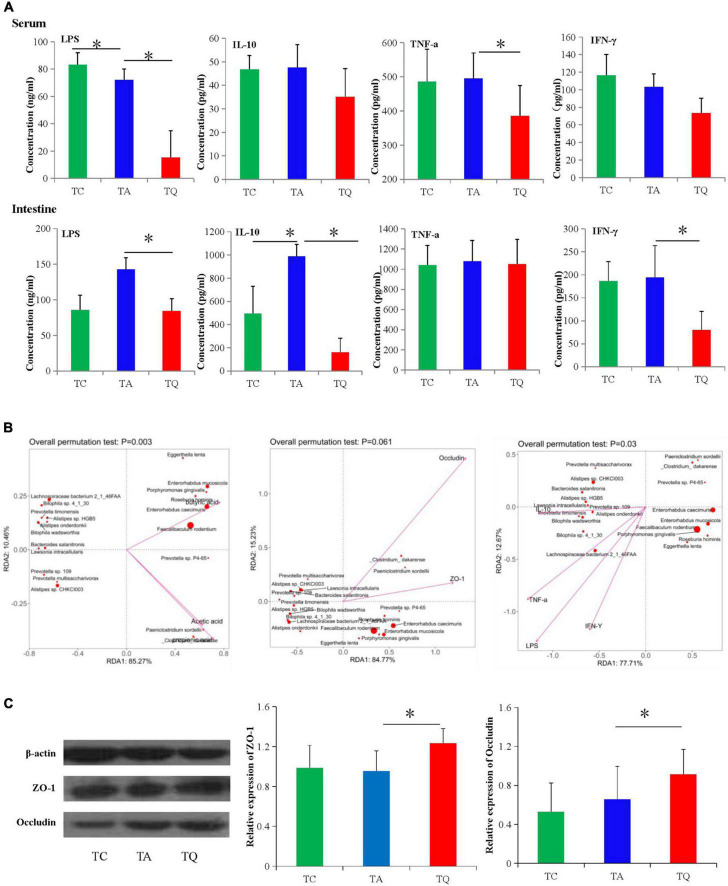
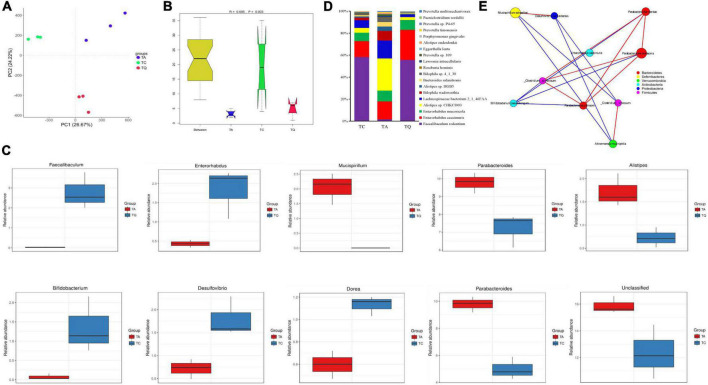
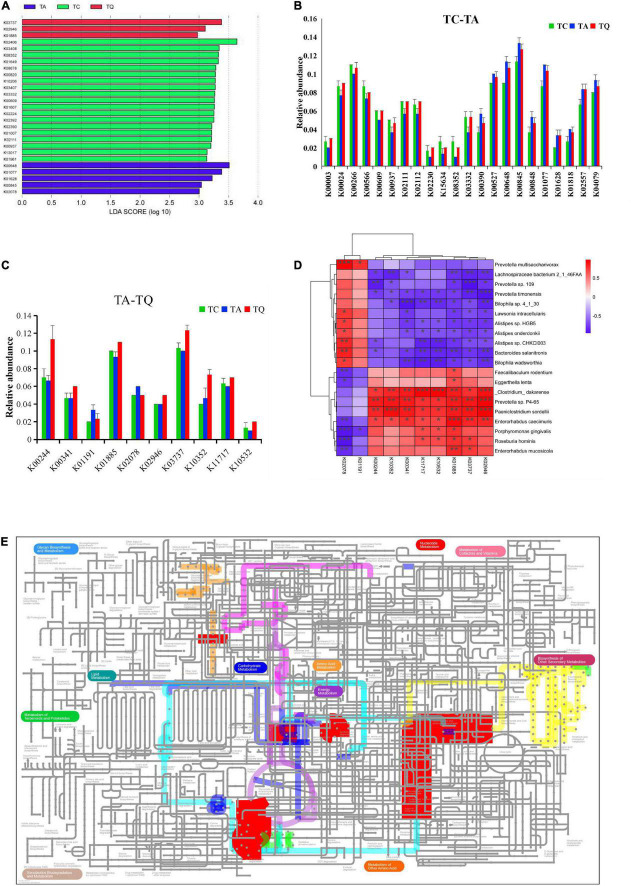
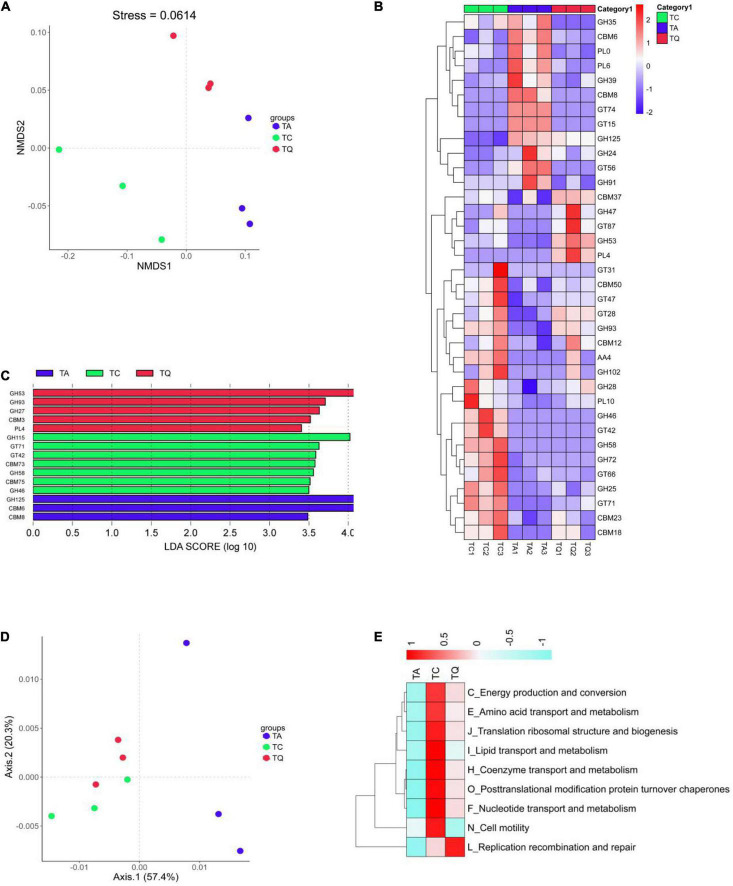
Quercetin has a wide range of biological properties that can be used to prevent or decrease particular inflammatory diseases. In this study, we aimed to investigate the gene expression profile and metabolic pathway of the gut microbiota of an antibiotic-treated mouse model administered quercetin. Blood, feces, and intestinal tissue samples were collected and metagenomic sequencing, enzyme-linked immunosorbent assay, and western blot analysis were used to detect variations. The results showed that the quercetin-treated group exhibited increased levels of health beneficial bacterial species, including (103.13%), (4.13%), (4%), (1.33%), and (1.79%), compared with the model group. These bacterial species were positively related to butyrate, propionate, and intestinal tight junction proteins (zonula occludens-1 and occludin) expression, but negatively related to serum lipopolysaccharide and tumor necrosis factor-α level. In addition, the metabolic pathway analysis showed that dietary quercetin significantly enhanced spliceosomes (111.11%), tight junctions (62.96%), the citrate cycle (10.41%), pyruvate metabolism (6.95%), and lysine biosynthesis (5.06%), but decreasing fatty acid biosynthesis (23.91%) and -glycan (7.37%) biosynthesis. Furthermore, these metabolic pathway changes were related to relative changes in the abundance of 10 Kyoto Encyclopedia of Genes and Genomes genes (K00244, K00341, K02946, K03737, K01885, k10352, k11717, k10532, K02078, K01191). In conclusion, dietary quercetin increased butyrate-producing bacterial species, and the acetyl-CoA-mediated increased butyrate accelerated carbohydrate, energy metabolism, reduced cell motility and endotoxemia, and increased the gut barrier function, thereby leading to healthy colonic conditions for the host.
槲皮素具有广泛的生物学特性,可用于预防或减轻特定的炎症性疾病。在本研究中,我们旨在调查给予槲皮素的抗生素处理小鼠模型肠道微生物群的基因表达谱和代谢途径。收集血液、粪便和肠道组织样本,并使用宏基因组测序、酶联免疫吸附测定和蛋白质印迹分析来检测变化。结果表明,与模型组相比,槲皮素处理组中有益健康的细菌种类水平有所增加,包括(103.13%)、(4.13%)、(4%)、(1.33%)和(1.79%)。这些细菌种类与丁酸盐、丙酸盐和肠道紧密连接蛋白(闭合蛋白-1和闭合蛋白)的表达呈正相关,但与血清脂多糖和肿瘤坏死因子-α水平呈负相关。此外,代谢途径分析表明,膳食槲皮素显著增强了剪接体(111.11%)、紧密连接(62.96%)、柠檬酸循环(10.41%)、丙酮酸代谢(6.95%)和赖氨酸生物合成(5.06%),但降低了脂肪酸生物合成(23.91%)和聚糖(7.37%)生物合成。此外,这些代谢途径变化与10个京都基因与基因组百科全书基因(K00244、K00341、K02946、K03737、K01885、k10352、k11717、k10532、K02078、K01191)丰度的相对变化有关。总之,膳食槲皮素增加了产生丁酸盐的细菌种类,乙酰辅酶A介导的丁酸盐增加加速了碳水化合物、能量代谢,降低了细胞运动性和内毒素血症,并增加了肠道屏障功能,从而为宿主带来健康的结肠状况。