Nurmala Ira, Nadhiroh Siti Rahayu, Pramukti Iqbal, Tyas Laila Wahyuning, Zari Afina Puspita, Griffiths Mark D, Lin Chung-Ying
Department of Epidemiology Population Biostatistics and Health Promotion Behavioral Sciences, Faculty of Public Health, Universitas Airlangga, Indonesia.
Department of Nutrition, Faculty of Public Health, Universitas Airlangga, Indonesia.
Heliyon. 2022 Aug 24;8(8):e10403. doi: 10.1016/j.heliyon.2022.e10403. eCollection 2022 Aug.
BACKGROUND/OBJECTIVE: Smartphone addiction, smartphone dependence, and compulsive smartphone use all describe similar phenomena that can cause problems in everyday daily life in many countries worldwide. Most scholars agree that it is the applications on smartphones that individuals have problems with rather than the smartphone itself. For this reason, smartphone application-based addiction is an issue of concern and one instrument has been specifically developed to assess this risk, namely, the Smartphone Application-Based Addiction Scale (SABAS). Although the SABAS has been translated into a number of languages, it has not been translated or validated into Indonesian.
The SABAS was translated into Bahasa Indonesian utilizing a cross-cultural method to ensure its linguistic validity. The linguistic validity of the Indonesian SABAS was ensured using international standard translation guidelines. Moreover, reliability and validity testing of the translated Indonesian SABAS were carried out using Cronbach's α, McDonald's ω, confirmatory factor analysis (CFA), and correlations with psychometric scales assessing psychological distress and nomophobia.
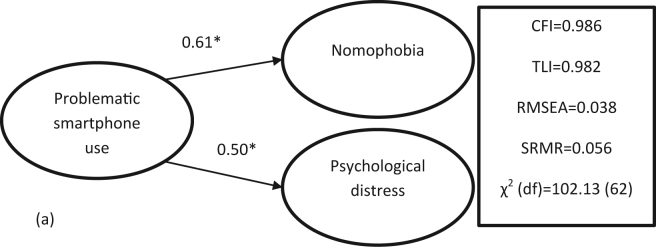
Using a sample of 458 participants (mean age = 22.46 years), reliability tests showed that the Indonesian SABAS was acceptable (Cronbach α = 0.74; McDonald's ω = 0.79). Construct validity of the Indonesian SABAS was supported by satisfactory CFA fit indices; concurrent validity supported by good correlations with psychological distress (r = 0.50) and nomophobia (r = 0.61).
The Indonesian version of SABAS is valid and reliable to be used for assessing the risk of smartphone application-based addiction in college students.
背景/目的:智能手机成瘾、智能手机依赖和强迫性智能手机使用都描述了类似的现象,这些现象在全球许多国家的日常生活中都会引发问题。大多数学者认为,个人出现问题的是智能手机上的应用程序,而非智能手机本身。因此,基于智能手机应用程序的成瘾是一个值得关注的问题,并且专门开发了一种工具来评估这种风险,即基于智能手机应用程序的成瘾量表(SABAS)。尽管SABAS已被翻译成多种语言,但尚未被翻译成印尼语或在印尼语环境中进行验证。
采用跨文化方法将SABAS翻译成印尼语,以确保其语言效度。使用国际标准翻译指南确保印尼语SABAS的语言效度。此外,使用克朗巴哈α系数、麦克唐纳ω系数、验证性因子分析(CFA)以及与评估心理困扰和无手机恐惧症的心理测量量表的相关性,对翻译后的印尼语SABAS进行信度和效度测试。
以458名参与者(平均年龄 = 22.46岁)为样本,信度测试表明印尼语SABAS是可接受的(克朗巴哈α系数 = 0.74;麦克唐纳ω系数 = 0.79)。令人满意的CFA拟合指数支持了印尼语SABAS的结构效度;与心理困扰(r = 0.50)和无手机恐惧症(r = 0.61)的良好相关性支持了同时效度。
印尼语版的SABAS在评估大学生基于智能手机应用程序成瘾风险方面是有效且可靠的。