Bégin Catherine, Berthod Jeanne, Martinez Lizette Zamora, Truchon Manon
Université Laval, Québec, QC Canada.
J Technol Behav Sci. 2022;7(4):477-515. doi: 10.1007/s41347-022-00267-1. Epub 2022 Sep 6.
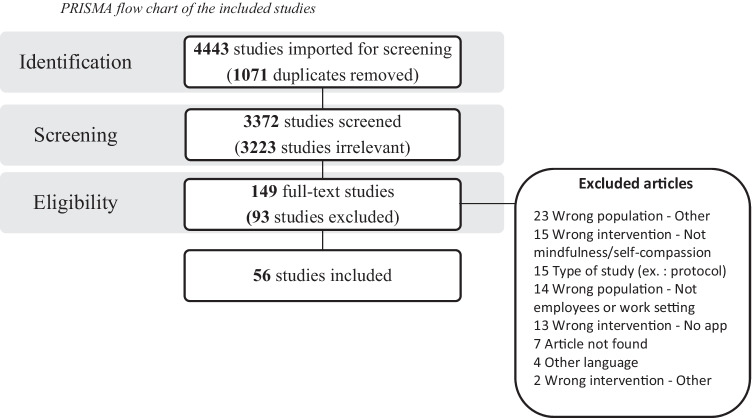
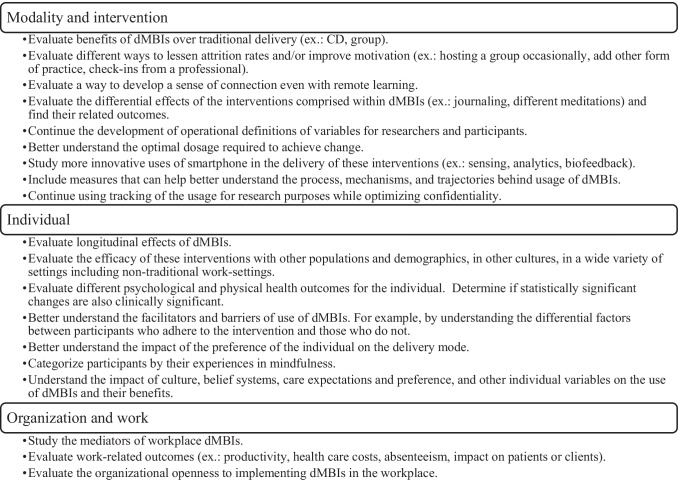
Mindfulness and self-compassion interventions are two strategies helpful in preventing and reducing burnout and work stress. However, professionals with overburdened schedules can experience obstacles in learning and practicing these interventions, originally taught with lengthy programs. The use of digital technologies could make these interventions more accessible to workers, as studied in a recent, growing body of evidence. The evidence available is diverse in terms of interventions, designs, outcomes, and populations. This calls for a review that can take into consideration this diversity while still rigorously synthesize it. Scoping reviews are designed to examine emerging evidence and summarize the evidence on a specific topic of interest. The present scoping review aims to assess the current state of the literature on the use of online programs and mobile applications of self-compassion, mindfulness, and meditation (digital mindfulness-based interventions; dMBIs) by workers. More specifically, information on the type of intervention, population, advantages, and disadvantages, measured outcomes, and advice for future research are gathered. MEDLINE (PubMed; Ovid), PsychInfo (Ovid), and Web of Science (Clarivate) were searched to identify all relevant articles. The screening process resulted in 56 articles being included in this scoping review. Inclusion criteria were (1) participants are workers; (2) the intervention is individual, digital, and mindfulness/self-compassion/meditation-based; and (3) articles were available in French or English language at the time of the review. Interventions used were mostly mindfulness-based, equally categorized under web-based and app-based interventions. Most interventions included information on mindfulness, meditation or self-compassion, meditation exercises, other types of exercises, instructions on how to use, and reminders. dMBIs are often studied in the healthcare population and predominantly in female samples. Although dMBIs present advantages (low cost, accessibility, practicality, feasibility), obstacles can arise in their implementation (low engagement and motivation, concerns about confidentiality). Included articles measured outcomes related to work, mindfulness or self-compassion, and other psychological variables (stress/anxiety, depression, resilience, wellbeing). Articles provided important directions to further research on dMBIs regarding methodological aspects, modality and intervention, and individual and organizational questions. dMBIs are becoming more popular and interventions are diverse. Although not without limitations, this scoping provided a synthesis on different aspects of the use of dMBIs within workers and highlighted pertinent future research directions.
正念和自我同情干预是有助于预防和减轻职业倦怠及工作压力的两种策略。然而,日程安排负担过重的专业人员在学习和实践这些原本通过冗长课程传授的干预措施时可能会遇到障碍。正如最近越来越多的证据所表明的那样,数字技术的使用可以使这些干预措施更容易被员工接受。现有证据在干预措施、设计、结果和人群方面各不相同。这就需要进行一项综述,既能考虑到这种多样性,又能对其进行严格的综合。范围综述旨在审视新出现的证据,并总结关于特定感兴趣主题的证据。本范围综述旨在评估关于员工使用自我同情、正念和冥想的在线课程及移动应用程序(基于数字正念的干预措施;dMBIs)的文献现状。更具体地说,收集了关于干预类型、人群、优点和缺点、测量结果以及未来研究建议的信息。检索了MEDLINE(PubMed;Ovid)、PsychInfo(Ovid)和科学网(Clarivate)以识别所有相关文章。筛选过程导致56篇文章被纳入本范围综述。纳入标准为:(1)参与者为员工;(2)干预是基于个体、数字且以正念/自我同情/冥想为基础的;(3)在综述时文章有法语或英语版本。所使用的干预措施大多基于正念,在基于网络和基于应用程序的干预措施中分类相同。大多数干预措施包括关于正念、冥想或自我同情的信息、冥想练习、其他类型的练习、使用说明和提醒。dMBIs通常在医疗保健人群中进行研究,且主要以女性样本为主。尽管dMBIs具有优点(低成本、可及性、实用性、可行性),但其实施过程中可能会出现障碍(参与度和动机低、对保密性的担忧)。纳入的文章测量了与工作、正念或自我同情以及其他心理变量(压力/焦虑、抑郁、复原力、幸福感)相关的结果。文章为dMBIs在方法学方面、方式和干预以及个体和组织问题上的进一步研究提供了重要方向。dMBIs越来越受欢迎,干预措施多种多样。尽管并非没有局限性,但本范围综述对员工使用dMBIs的不同方面进行了综合,并突出了相关的未来研究方向。