Shi Yan, Zou Ying, Liu Jihua, Wang Yuanyuan, Chen Yingbin, Sun Fang, Yang Zhi, Cui Guanghe, Zhu Xijun, Cui Xu, Liu Feifei
Binzhou Medical University Hospital, Binzhou, China.
First Teaching Hospital of Tianjin University of Traditional Chinese Medicine, Tianjin, China.
Front Oncol. 2022 Aug 26;12:897596. doi: 10.3389/fonc.2022.897596. eCollection 2022.
A radiomics-based explainable eXtreme Gradient Boosting (XGBoost) model was developed to predict central cervical lymph node metastasis (CCLNM) in patients with papillary thyroid carcinoma (PTC), including positive and negative effects.
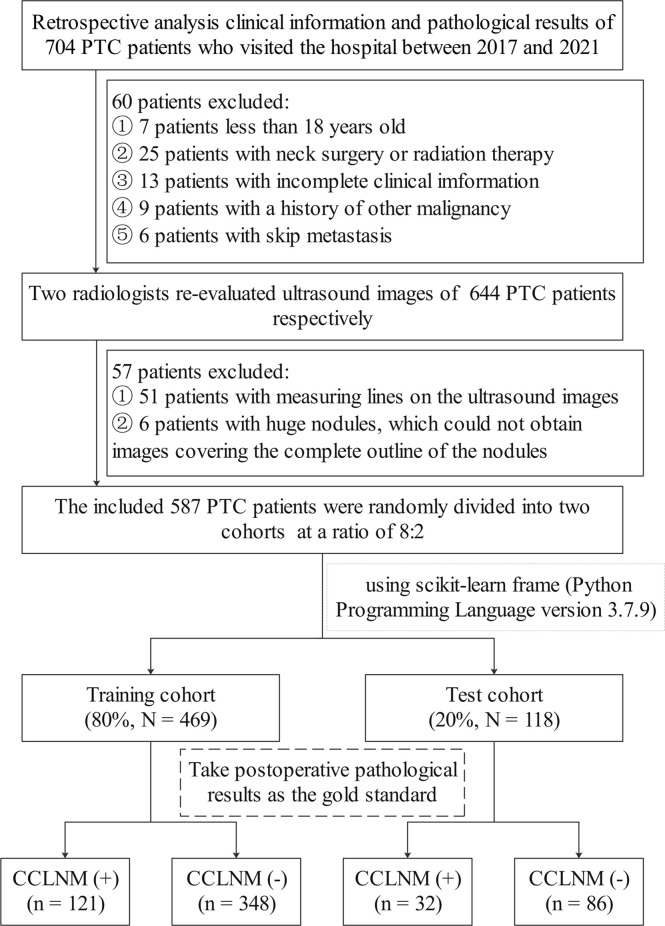
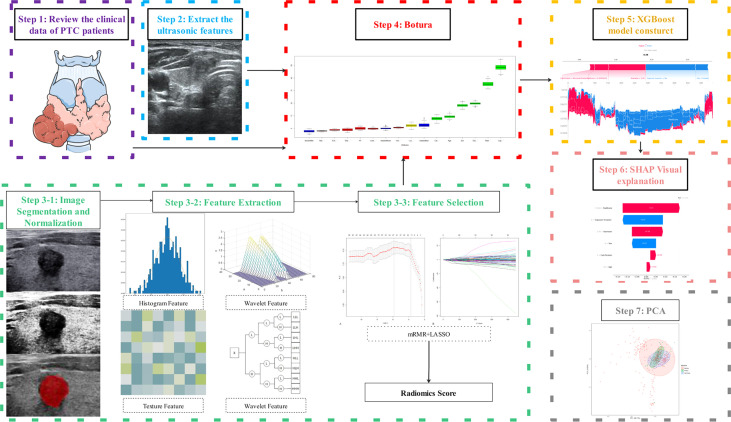
A total of 587 PTC patients admitted at Binzhou Medical University Hospital from 2017 to 2021 were analyzed retrospectively. The patients were randomized into the training and test cohorts with an 8:2 ratio. Radiomics features were extracted from ultrasound images of the primary PTC lesions. The minimum redundancy maximum relevance algorithm and the least absolute shrinkage and selection operator regression were used to select CCLNM positively-related features and radiomics scores were constructed. Clinical features, ultrasound features, and radiomics score were screened out by the Boruta algorithm, and the XGBoost model was constructed from these characteristics. SHapley Additive exPlanations (SHAP) was used for individualized and visualized interpretation. SHAP addressed the cognitive opacity of machine learning models.
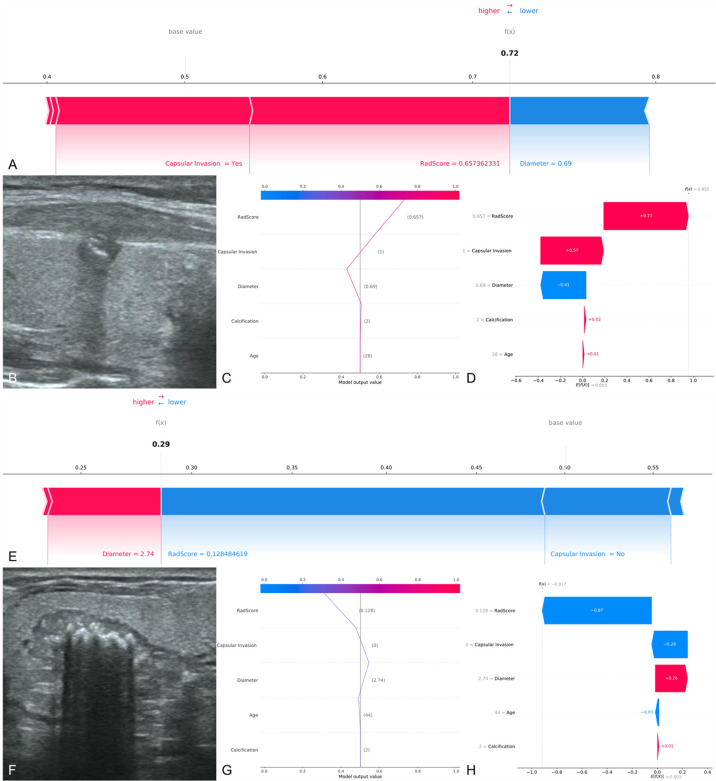
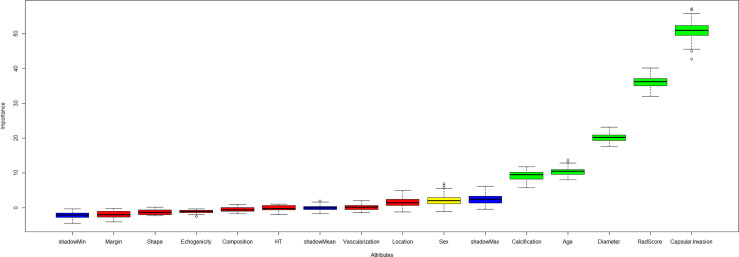
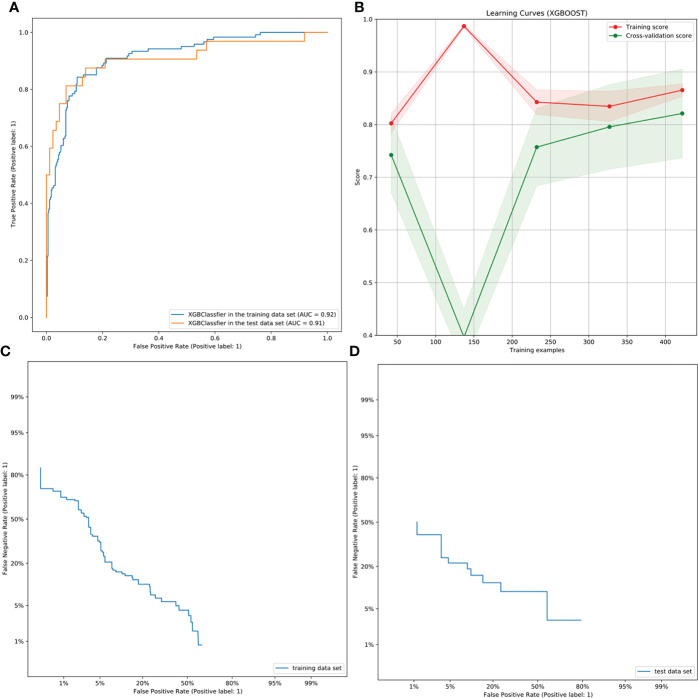
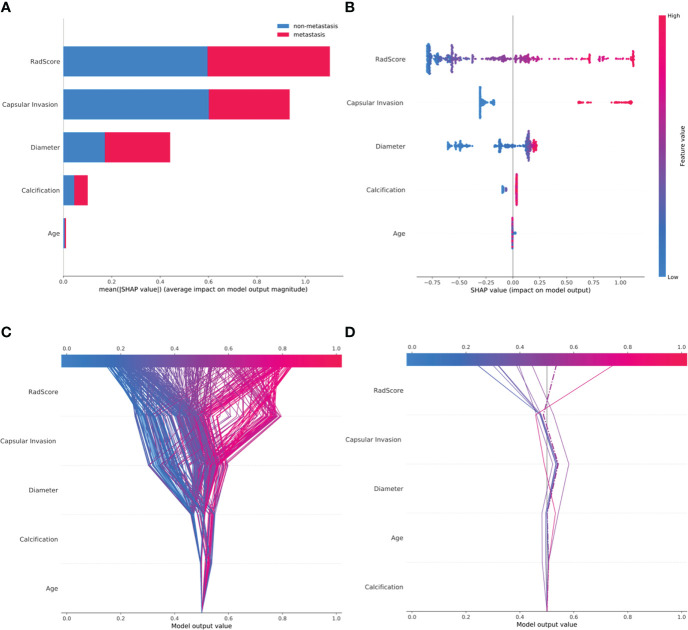
Eleven radiomics features were used to calculate the radiomics score. Five critical elements were used to build the XGBoost model: capsular invasion, radiomics score, diameter, age, and calcification. The area under the curve was 91.53% and 90.88% in the training and test cohorts, respectively. SHAP plots showed the influence of each parameter on the XGBoost model, including positive (i.e., capsular invasion, radiomics score, diameter, and calcification) and negative (i.e., age) impacts. The XGBoost model outperformed the radiologist, increasing the AUC by 44%.
The radiomics-based XGBoost model predicted CCLNM in PTC patients. Visual interpretation using SHAP made the model an effective tool for preoperative guidance of clinical procedures, including positive and negative impacts.
开发一种基于放射组学的可解释极端梯度提升(XGBoost)模型,用于预测甲状腺乳头状癌(PTC)患者的中央区颈淋巴结转移(CCLNM),包括其正负影响。
回顾性分析2017年至2021年在滨州医学院附属医院收治的587例PTC患者。患者按8:2的比例随机分为训练组和测试组。从原发性PTC病变的超声图像中提取放射组学特征。采用最小冗余最大相关算法和最小绝对收缩与选择算子回归来选择与CCLNM呈正相关的特征,并构建放射组学评分。通过Boruta算法筛选出临床特征、超声特征和放射组学评分,并基于这些特征构建XGBoost模型。使用SHapley加性解释(SHAP)进行个性化和可视化解释。SHAP解决了机器学习模型的认知不透明问题。
使用11个放射组学特征计算放射组学评分。使用5个关键因素构建XGBoost模型:包膜侵犯、放射组学评分、直径、年龄和钙化。训练组和测试组的曲线下面积分别为91.53%和90.88%。SHAP图显示了每个参数对XGBoost模型的影响,包括正向影响(即包膜侵犯、放射组学评分、直径和钙化)和负向影响(即年龄)。XGBoost模型的表现优于放射科医生,AUC提高了44%。
基于放射组学的XGBoost模型可预测PTC患者的CCLNM。使用SHAP进行可视化解释使该模型成为临床手术术前指导的有效工具,包括正负影响。