Tan Fan, Yang Xubo, Fan Yuchen, Liao Yongchuan
Department of Ophthalmology, West China Hospital, Sichuan University, Chengdu, China.
Department of Ophthalmology, West China-Guang'an Hospital, Sichuan University, Guang'an, Sichuan, China.
J Ophthalmol. 2022 Sep 1;2022:2826724. doi: 10.1155/2022/2826724. eCollection 2022.
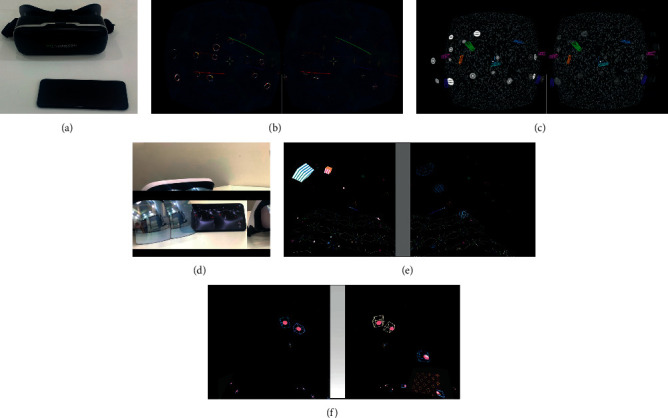
The treatment for amblyopia can have a substantial impact on quality of life. Conventional treatments for amblyopia have some limitations, then we try to explore a new and effective method to treat amblyopia. This study aimed to determine the potential effect of short-term plastic visual perceptual training based on VR and AR platforms in amblyopic patients.
All observers were blinded to patient groupings. A total of 145 amblyopic children were randomly assigned into 2 groups: VR group (71 patients) and AR group (74 patients). In the VR group, each subject underwent a 20-min short-term plastic visual perceptual training based on a VR platform, and in the AR group, based on an AR platform. The best-corrected visual acuity (BCVA), fine stereopsis, and contrast sensitivity function (CSF) were measured before and after training.
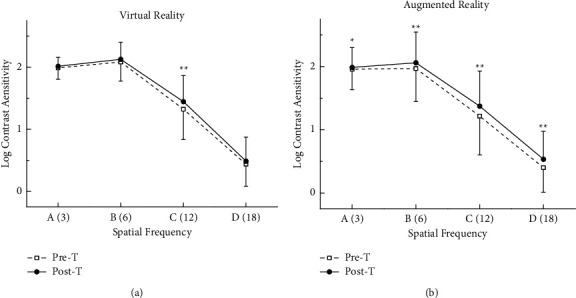
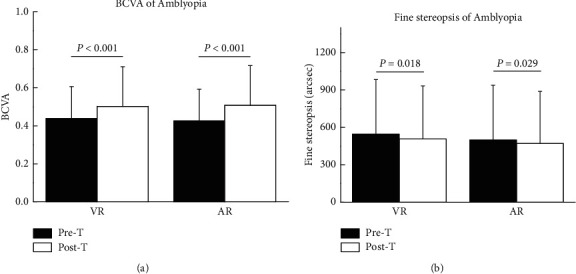
The BCVA ( < 0.001) and fine stereopsis ( < 0.05) were improved significantly both in VR and AR group after training. Moreover, in the AR group, the CSF showed the value of all spatial frequencies had a statistically significant improvement after training ( < 0.05), while in the VR group, only the value of spatial frequency 12 improved significantly ( = 0.008).
This study showed that the short-term plastic visual perceptual training based on VR and AR technology can improve BCVA, fine stereopsis and CSF of refractive amblyopia. It was suggested that the visual perceptual training based on the VR and AR platforms may be potentially applied in treatment for amblyopia and provided a high-immersing alternative.
弱视治疗会对生活质量产生重大影响。传统的弱视治疗方法存在一些局限性,因此我们试图探索一种新的有效治疗弱视的方法。本研究旨在确定基于虚拟现实(VR)和增强现实(AR)平台的短期可塑性视觉感知训练对弱视患者的潜在效果。
所有观察者均对患者分组情况不知情。145名弱视儿童被随机分为两组:VR组(71例患者)和AR组(74例患者)。VR组中,每位受试者在VR平台上接受20分钟的短期可塑性视觉感知训练;AR组中,受试者在AR平台上接受训练。在训练前后分别测量最佳矫正视力(BCVA)、精细立体视觉和对比敏感度函数(CSF)。
训练后,VR组和AR组的BCVA(<0.001)和精细立体视觉(<0.05)均有显著改善。此外,AR组训练后所有空间频率的CSF值均有统计学显著改善(<0.05),而VR组仅空间频率12的值有显著改善(=0.008)。
本研究表明,基于VR和AR技术的短期可塑性视觉感知训练可改善屈光性弱视的BCVA、精细立体视觉和CSF。提示基于VR和AR平台的视觉感知训练可能有潜力应用于弱视治疗,并提供一种高沉浸度的替代方法。