Lee Eun Hye, Kim Hyun Tae, Chun So Young, Chung Jae-Wook, Choi Seock Hwan, Lee Jun Nyung, Kim Bum Soo, Yoo Eun Sang, Kwon Tae Gyun, Kim Tae-Hwan, Ha Yun-Sok
Joint Institution of Regenerative Medicine, Kyungpook National University, Daegu, Korea.
Department of Urology, School of Medicine, Kyungpook National University, Daegu, Korea.
Onco Targets Ther. 2022 Sep 5;15:963-971. doi: 10.2147/OTT.S374908. eCollection 2022.
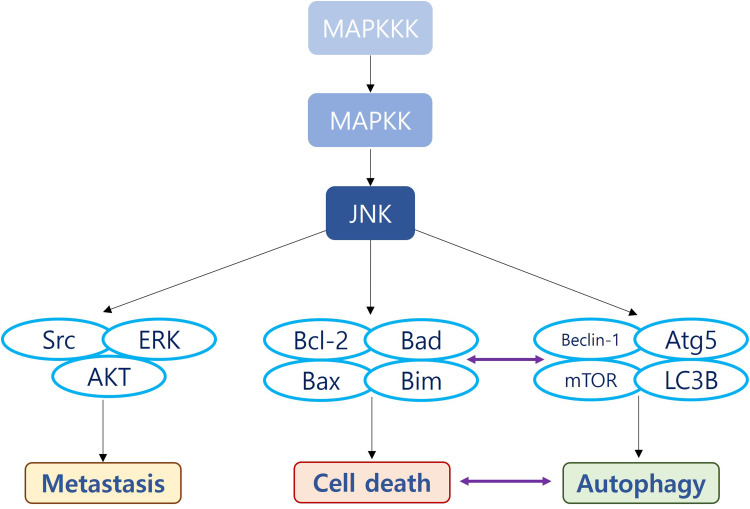
Bladder cancer, one of the most frequently diagnosed cancers worldwide, is associated with high morbidity and mortality and a poor prognosis. The bladder cancer types include 1) non-muscle invasive bladder cancer (NMIBC) and 2) muscle invasive bladder cancer (MIBC). Metastases and chemoresistance in MIBC patients are the leading causes of the high death rate. c-Jun N-terminal kinase (JNK) is an important factor for the undifferentiated state of cancer cells. JNK belongs to the mitogen-activated protein kinases (MAPKs) family; it is activated by various extracellular stimuli, such as stress, radiation, and growth factors and mediates diverse cellular functions, such as apoptosis, autophagy, proliferation, invasion, and migration by mediating AKT (Ak strain transforming), ATG (Autophagy related), mTOR (Mammalian target of rapamycin), and caspases 3, 8, and 9. This review describes the JNK-related functions, mechanisms, and signaling in bladder cancer.
膀胱癌是全球最常被诊断出的癌症之一,其发病率和死亡率高,预后较差。膀胱癌类型包括1)非肌层浸润性膀胱癌(NMIBC)和2)肌层浸润性膀胱癌(MIBC)。MIBC患者的转移和化疗耐药是高死亡率的主要原因。c-Jun氨基末端激酶(JNK)是癌细胞未分化状态的一个重要因素。JNK属于丝裂原活化蛋白激酶(MAPKs)家族;它被各种细胞外刺激激活,如应激、辐射和生长因子,并通过介导AKT(Ak株转化)、ATG(自噬相关)、mTOR(雷帕霉素哺乳动物靶点)以及半胱天冬酶3、8和9来介导多种细胞功能,如凋亡、自噬、增殖、侵袭和迁移。本综述描述了JNK在膀胱癌中的相关功能、机制和信号传导。