Giauque David, Renard Karine, Cornu Frédéric, Emery Yves
University of Lausanne, Switzerland.
Public Pers Manage. 2022 Sep;51(3):263-290. doi: 10.1177/00910260211073154. Epub 2022 Jan 29.
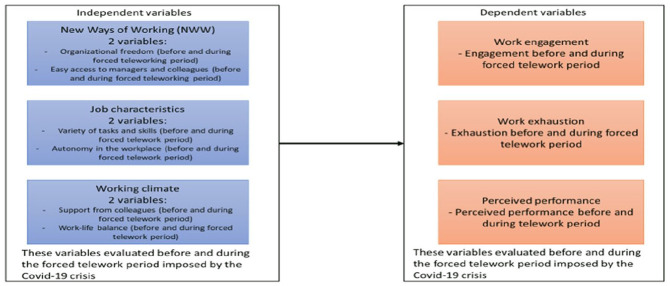
At the outset of the COVID-19 pandemic, the Swiss federal government implemented a lockdown that prompted a majority of private and public organizations to implement teleworking solutions for their employees. This study aimed to examine the impact of work modalities, job-related, relational, and organizational climate variables on employees' engagement, exhaustion, and perceived performance both before and during the forced teleworking period. Based on the job demands-resources framework, a survey was conducted ( = 1,373) in a Swiss Cantonal public administration. Results show that while the forced telework period positively influenced employees' work autonomy and work-life balance, it negatively influenced their degree of collaboration and perceived job strain but did not affect their engagement levels. The freedom to organize ones' own work and collaboration with colleagues were identified as the main resources that positively influence employees' engagement and perceived performance while limiting exhaustion.
在新冠疫情初期,瑞士联邦政府实施了封锁措施,促使大多数私营和公共组织为员工实施远程工作解决方案。本研究旨在考察工作模式、与工作相关的、人际关系的以及组织氛围变量在强制远程工作期之前和期间对员工敬业度、倦怠感和感知绩效的影响。基于工作需求-资源框架,在瑞士一个州的公共行政部门进行了一项调查(n = 1373)。结果表明,虽然强制远程工作期对员工的工作自主性和工作-生活平衡产生了积极影响,但对他们的协作程度和感知到的工作压力产生了负面影响,不过并未影响他们的敬业度水平。自主安排工作的自由以及与同事的协作被确定为在限制倦怠感的同时对员工敬业度和感知绩效产生积极影响的主要资源。