Department of Cardiology, University Medical Center Hamburg-Eppendorf, University Heart & Vascular Center Hamburg, Martinistrasse 52, 20246, Hamburg, Germany.
German Center of Cardiovascular Research (DZHK), Partner Site Hamburg/Kiel/Lübeck, Hamburg, Germany.
Clin Res Cardiol. 2024 Feb;113(2):205-215. doi: 10.1007/s00392-022-02100-4. Epub 2022 Sep 12.
Infective endocarditis (IE) is characterized by high morbidity and mortality rates, despite recent improvements in diagnostics and treatment. We aimed to investigate incidence, clinical characteristics, and in-hospital mortality in a large-scale nationwide cohort.
Using data from the German Federal Bureau of Statistics, all IE cases in Germany between 2007 and 2019 were analyzed. Logistic regression models were fitted to assess associations between clinical factors and in-hospital mortality.
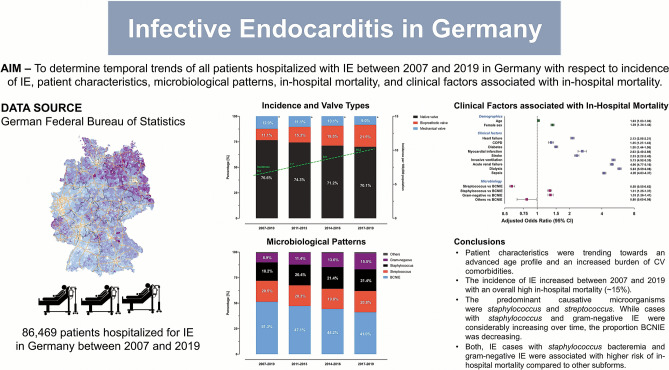
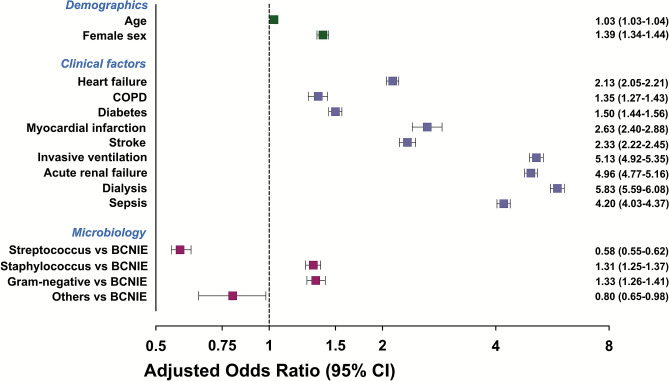
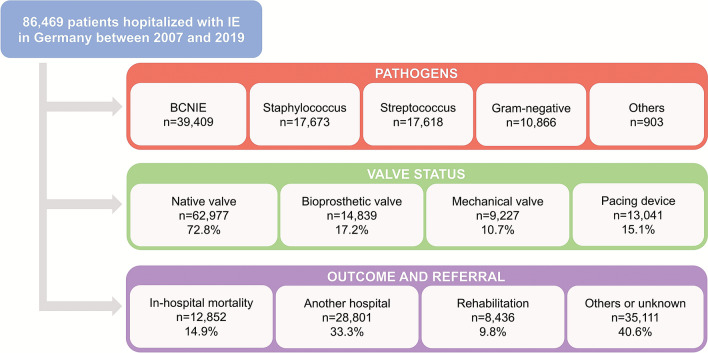
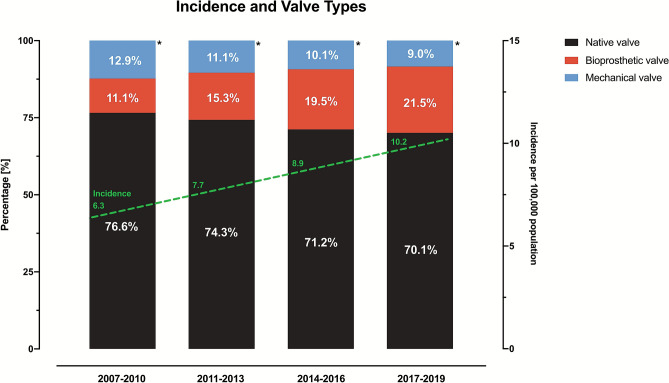
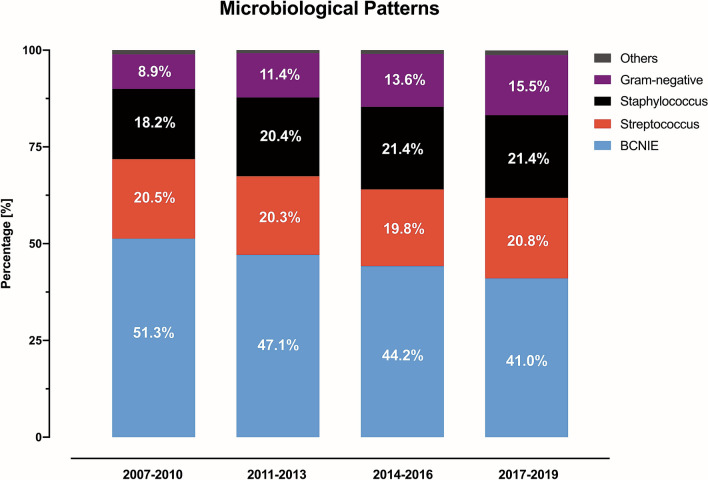
In total, 86,469 patients were hospitalized with IE between 2007 and 2019. The mean age was 66.5 ± 14.7 years and 31.8% (n = 27,534/86,469) were female. Cardiovascular (CV) comorbidities were common. The incidence of IE in the German population increased from 6.3/100,000 to 10.2/100,000 between 2007 and 2019. Staphylococcus (n = 17,673/86,469; 20.4%) and streptococcus (n = 17,618/86,469; 20.4%) were the most common IE-causing bacteria. The prevalence of staphylococcus gradually increased over time, whereas blood culture-negative IE (BCNIE) cases decreased. In-hospital mortality in patients with IE was 14.9%. Compared to BCNIE, staphylococcus and Gram-negative pathogens were associated with higher in-hospital mortality. In multivariable analysis, factors associated with higher likelihood of in-hospital mortality were advanced age, female sex, CV comorbidities (e.g., heart failure, COPD, diabetes, stroke), need for dialysis or invasive ventilation, and sepsis.
In this contemporary cohort, incidence of IE increased over time and in-hospital mortality remained high (~ 15%). While staphylococcus and streptococcus were the predominant microorganisms, bacteremia with staphylococcus and Gram-negative pathogens were associated with higher likelihood of in-hospital mortality. Our results highlight the need for new preventive strategies and interventions in patients with IE.
感染性心内膜炎(IE)的发病率和死亡率仍然很高,尽管近年来在诊断和治疗方面有所改善。我们旨在调查一个大规模全国性队列中发病率、临床特征和住院死亡率。
使用德国联邦统计局的数据,分析了 2007 年至 2019 年期间德国所有 IE 病例。使用逻辑回归模型评估临床因素与住院死亡率之间的关联。
在 2007 年至 2019 年间,共有 86469 例患者因 IE 住院。平均年龄为 66.5±14.7 岁,31.8%(n=27534/86469)为女性。心血管(CV)合并症很常见。德国人群中 IE 的发病率从 2007 年的 6.3/100,000 增加到 2019 年的 10.2/100,000。葡萄球菌(n=17673/86469;20.4%)和链球菌(n=17618/86469;20.4%)是最常见的引起 IE 的细菌。葡萄球菌的患病率随着时间的推移逐渐增加,而血培养阴性 IE(BCNIE)病例减少。IE 患者的住院死亡率为 14.9%。与 BCNIE 相比,葡萄球菌和革兰氏阴性病原体与更高的住院死亡率相关。多变量分析显示,与住院死亡率增加相关的因素是年龄较大、女性、CV 合并症(如心力衰竭、COPD、糖尿病、中风)、需要透析或有创通气以及败血症。
在本当代队列中,IE 的发病率随时间增加,住院死亡率仍然很高(约 15%)。虽然葡萄球菌和链球菌是主要的微生物,但葡萄球菌和革兰氏阴性病原体引起的菌血症与更高的住院死亡率相关。我们的研究结果强调了在 IE 患者中需要新的预防策略和干预措施。