Department of Internal Medicine and Radboud Center for Infectious Diseases (RCI), Radboud Institute for Molecular Life Sciences (RIMLS), Radboud University Medical Center, Nijmegen, the Netherlands.
Department of Computational Biology for Individualised Infection Medicine, Centre for Individualised Infection Medicine (CiiM), a joint venture between the Helmholtz-Centre for Infection Research (HZI) and the Hannover Medical School (MHH), Hannover, Germany.
PLoS Biol. 2022 Sep 12;20(9):e3001765. doi: 10.1371/journal.pbio.3001765. eCollection 2022 Sep.
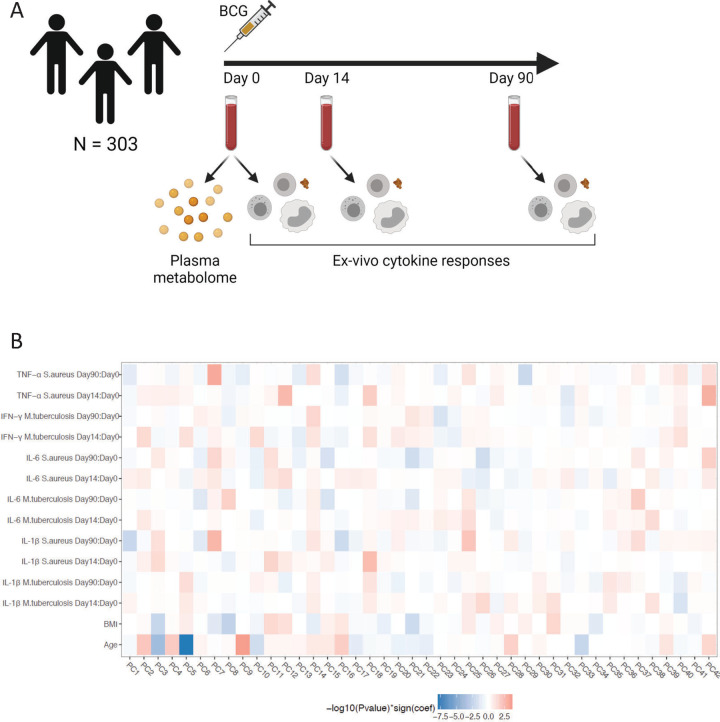
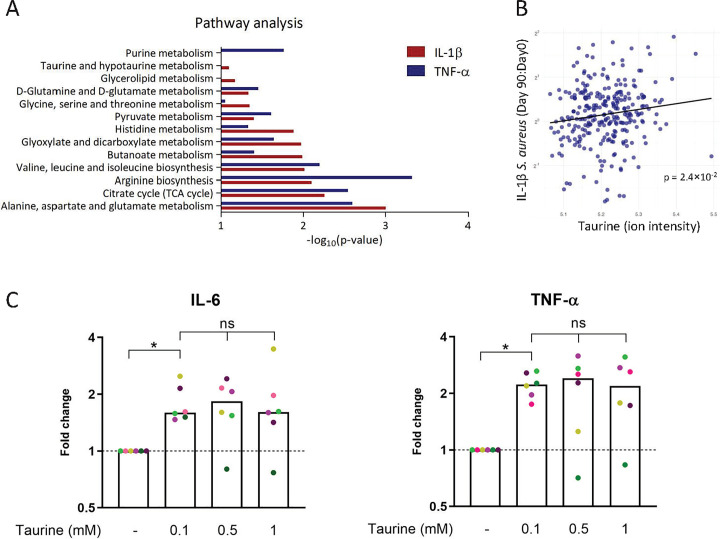
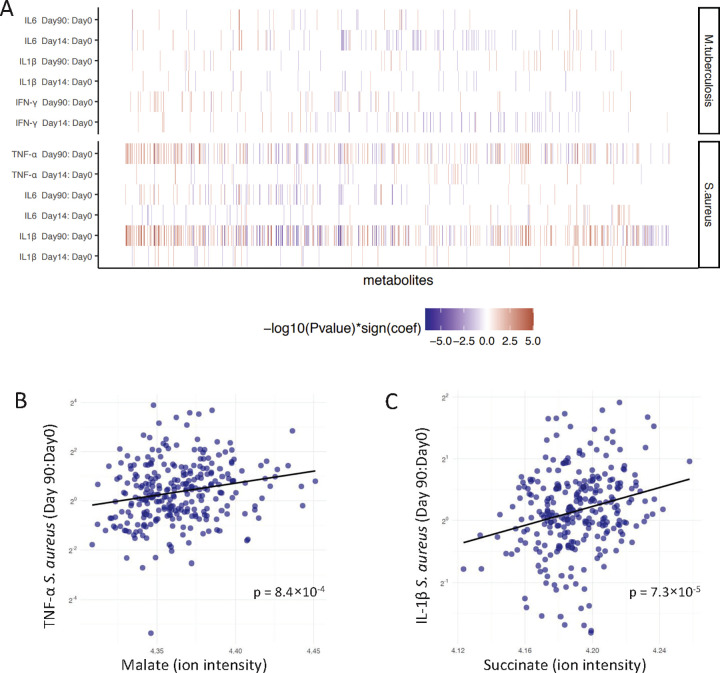
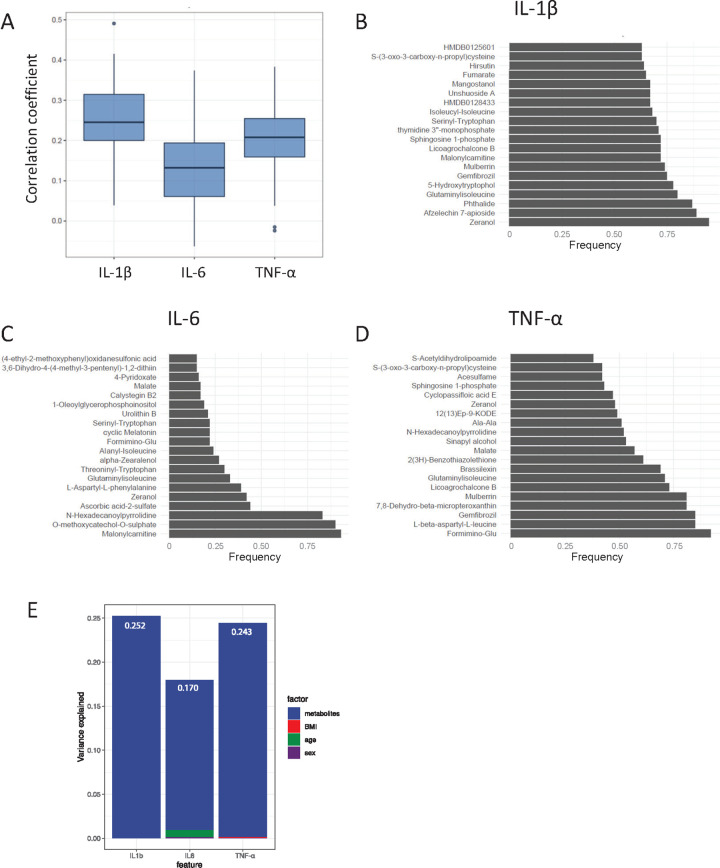
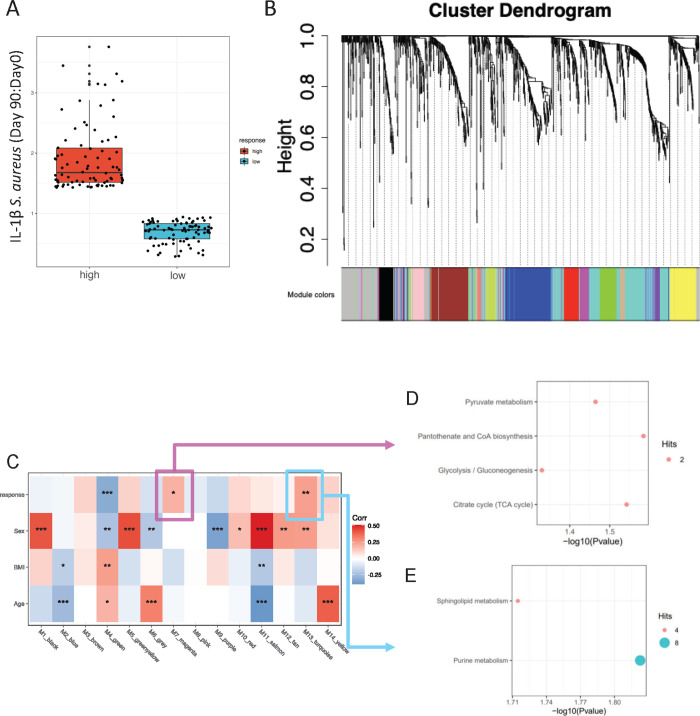
The antituberculosis vaccine Bacillus Calmette-Guérin (BCG) induces nonspecific protection against heterologous infections, at least partly through induction of innate immune memory (trained immunity). The amplitude of the response to BCG is variable, but the factors that influence this response are poorly understood. Metabolites, either released by cells or absorbed from the gut, are known to influence immune responses, but whether they impact BCG responses is not known. We vaccinated 325 healthy individuals with BCG, and collected blood before, 2 weeks and 3 months after vaccination, to assess the influence of circulating metabolites on the immune responses induced by BCG. Circulating metabolite concentrations after BCG vaccination were found to have a more pronounced impact on trained immunity responses, such as the increase in IL-1β and TNF-α production upon Staphylococcus aureus stimulation, than on specific adaptive immune memory, assessed as IFN-γ production in response to Mycobacterium tuberculosis. Circulating metabolites at baseline were able to predict trained immunity responses at 3 months after vaccination and enrichment analysis based on the metabolites positively associated with trained immunity revealed enrichment of the tricarboxylic acid (TCA) cycle and glutamine metabolism, both of which were previously found to be important for trained immunity. Several new metabolic pathways that influence trained immunity were identified, among which taurine metabolism associated with BCG-induced trained immunity, a finding validated in functional experiments. In conclusion, circulating metabolites are important factors influencing BCG-induced trained immunity in humans. Modulation of metabolic pathways may be a novel strategy to improve vaccine and trained immunity responses.
卡介苗(BCG)作为一种抗结核疫苗,可诱导针对异源感染的非特异性保护,至少部分是通过诱导固有免疫记忆(训练免疫)实现的。BCG 反应的幅度是可变的,但影响这种反应的因素知之甚少。细胞释放或从肠道吸收的代谢物已知会影响免疫反应,但它们是否会影响 BCG 反应尚不清楚。我们用 BCG 对 325 名健康个体进行了疫苗接种,并在接种前、接种后 2 周和 3 个月采集血液,以评估循环代谢物对 BCG 诱导的免疫反应的影响。我们发现,BCG 接种后循环代谢物浓度对训练免疫反应的影响更为显著,例如金黄色葡萄球菌刺激后 IL-1β 和 TNF-α 产生的增加,而对特异性适应性免疫记忆的影响较小,这是通过对结核分枝杆菌的 IFN-γ 产生来评估的。接种前的循环代谢物能够预测接种后 3 个月的训练免疫反应,并且基于与训练免疫呈正相关的代谢物的富集分析揭示了三羧酸(TCA)循环和谷氨酰胺代谢的富集,这两者之前都被发现对训练免疫很重要。还确定了一些影响训练免疫的新代谢途径,其中牛磺酸代谢与 BCG 诱导的训练免疫有关,这一发现通过功能实验得到了验证。总之,循环代谢物是影响人类 BCG 诱导的训练免疫的重要因素。代谢途径的调节可能是提高疫苗和训练免疫反应的新策略。