
葡萄植物整体微生物组:植物健康的关键组成部分。
The microbiota of the grapevine holobiont: A key component of plant health.
机构信息
Agroécologie, AgroSup Dijon, CNRS, Université de Bourgogne, INRAE, Université de Bourgogne Franche-Comté, Dijon, France; Université de Reims Champagne-Ardenne, Unité Résistance Induite et Bioprotection des Plantes EA 4707 USC INRAE 1488, SFR Condorcet FR CNRS 3417, Reims, France.
Agroécologie, AgroSup Dijon, CNRS, Université de Bourgogne, INRAE, Université de Bourgogne Franche-Comté, Dijon, France.
出版信息
J Adv Res. 2022 Sep;40:1-15. doi: 10.1016/j.jare.2021.12.008. Epub 2021 Dec 22.
BACKGROUND
Grapevine is a woody, perennial plant of high economic importance worldwide. Like other plants, it lives in close association with large numbers of microorganisms. Bacteria, fungi and viruses are structured in communities, and each individual can be beneficial, neutral or harmful to the plant. In this sense, microorganisms can interact with each other and regulate plant functions (including immunity) and even provide new ones. Thus, the grapevine associated with its microbial communities constitutes a supra-organism, also called a holobiont, whose functioning is linked to established plant-microorganism interactions.
AIM OF REVIEW
The overall health of the plant may be conditioned by the diversity and structure of microbial communities. Consequently, an optimal microbial composition will consist of a microbial balance allowing the plant to be healthy. Conversely, an imbalance of microbial populations could lead to (or be generated by) a decline of the plant. The microbiome is an active component of the host also responsive to biotic and abiotic changes; in that respect, a better understanding of the most important drivers of the composition of plant microbiomes is needed.
KEY SCIENTIFIC CONCEPTS OF REVIEW
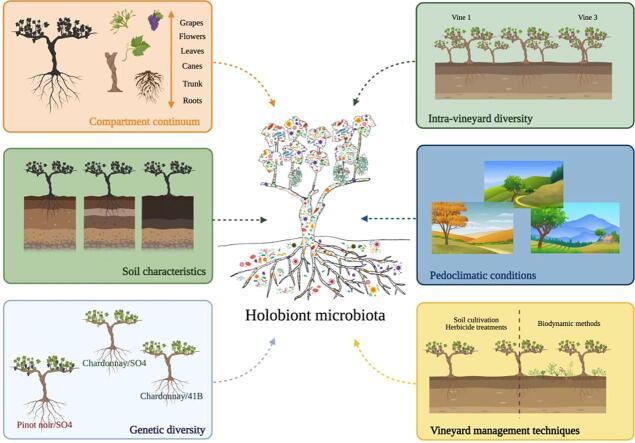
This article presents the current state of the art about the grapevine microbiota and its composition according to the plant compartments and the influencing factors. We also focus on situations of imbalance, in particular during plant disease or decline. Finally, we discuss the possible interest of microbial engineering in an agrosystem such as viticulture.
背景
葡萄是一种木质、多年生植物,在全球范围内具有重要的经济价值。与其他植物一样,它与大量微生物密切相关。细菌、真菌和病毒构成了群落,每个个体对植物都可能有益、中性或有害。从这个意义上说,微生物可以相互作用,调节植物功能(包括免疫),甚至提供新的功能。因此,与微生物群落相关联的葡萄藤构成了一个超生物体,也称为整体生物体,其功能与已建立的植物-微生物相互作用有关。
综述目的
植物的整体健康状况可能受到微生物群落多样性和结构的影响。因此,最佳微生物组成将由允许植物保持健康的微生物平衡组成。相反,微生物种群的失衡可能导致(或由)植物的衰退。微生物组是宿主的一个活跃组成部分,也对生物和非生物变化作出反应;在这方面,需要更好地了解影响植物微生物组组成的最重要驱动因素。
综述的关键科学概念
本文介绍了根据植物区室和影响因素,葡萄藤微生物组及其组成的最新研究进展。我们还重点介绍了失衡的情况,特别是在植物疾病或衰退期间。最后,我们讨论了在农业系统(如葡萄栽培)中进行微生物工程的可能意义。



 Zotero 插件