Nara Institute of Science and Technology (NAIST), Nara, Japan.
Yahoo Japan Corporation, Tokyo, Japan.
Sci Rep. 2020 Oct 29;10(1):18680. doi: 10.1038/s41598-020-75771-6.
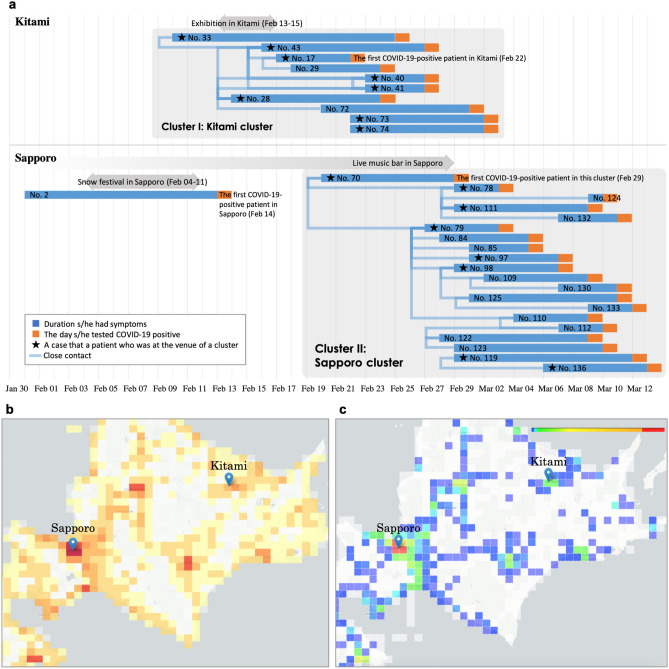
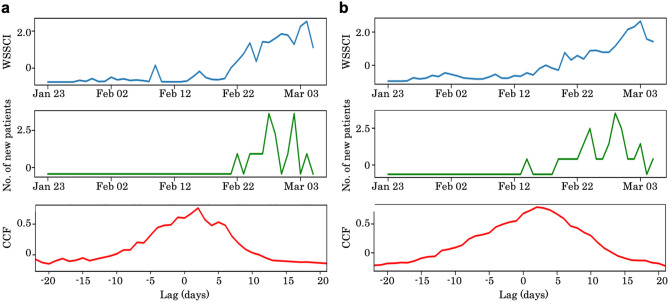
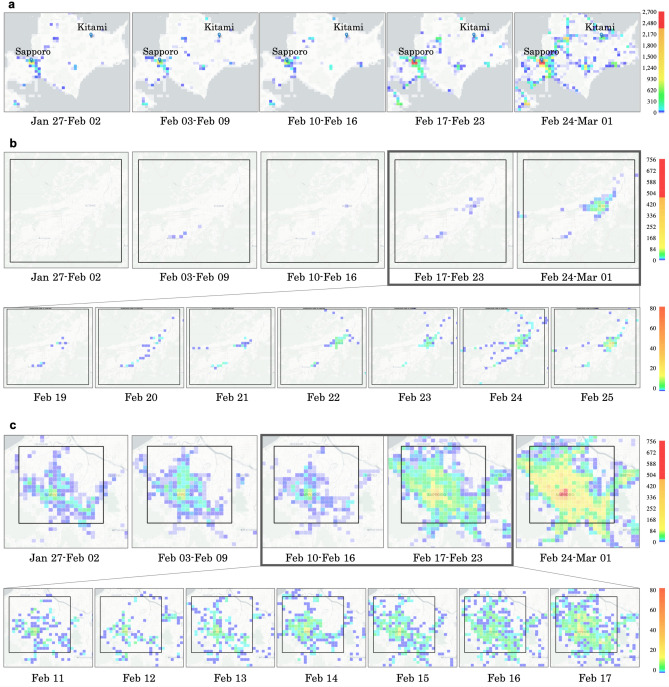
Two clusters of the coronavirus disease 2019 (COVID-19) were confirmed in Hokkaido, Japan, in February 2020. To identify these clusters, this study employed web search query logs of multiple devices and user location information from location-aware mobile devices. We anonymously identified users who used a web search engine (i.e., Yahoo! JAPAN) to search for COVID-19 or its symptoms. We regarded them as web searchers who were suspicious of their own COVID-19 infection (WSSCI). We extracted the location of WSSCI via a mobile operating system application and compared the spatio-temporal distribution of WSSCI with the actual location of the two known clusters. In the early stage of cluster development, we confirmed several WSSCI. Our approach was accurate in this stage and became biased after a public announcement of the cluster development. When other cluster-related resources, such as detailed population statistics, are not available, the proposed metric can capture hints of emerging clusters.
2020 年 2 月,在日本北海道确认了两群 2019 年冠状病毒病(COVID-19)。为了确定这些集群,本研究利用了多个设备的网络搜索查询日志和位置感知移动设备的用户位置信息。我们匿名确定了使用网络搜索引擎(即雅虎!日本)搜索 COVID-19 或其症状的用户。我们将他们视为对自己 COVID-19 感染有怀疑的网络搜索者(WSSCI)。我们通过移动操作系统应用程序提取 WSSCI 的位置,并将 WSSCI 的时空分布与两个已知集群的实际位置进行比较。在集群发展的早期阶段,我们确认了几个 WSSCI。在这个阶段,我们的方法是准确的,在集群发展的公开宣布后变得有偏差。当没有其他与集群相关的资源(如详细的人口统计数据)时,所提出的指标可以捕捉到新集群的线索。