Zhu Yalin, Deng Linyuan, Wan Kun
Faculty of Education, Beijing Normal University, Beijing, China.
Nanhai Middle School of Nanshan Experimental Educational Group, Shenzhen, China.
Front Psychol. 2022 Aug 29;13:885819. doi: 10.3389/fpsyg.2022.885819. eCollection 2022.
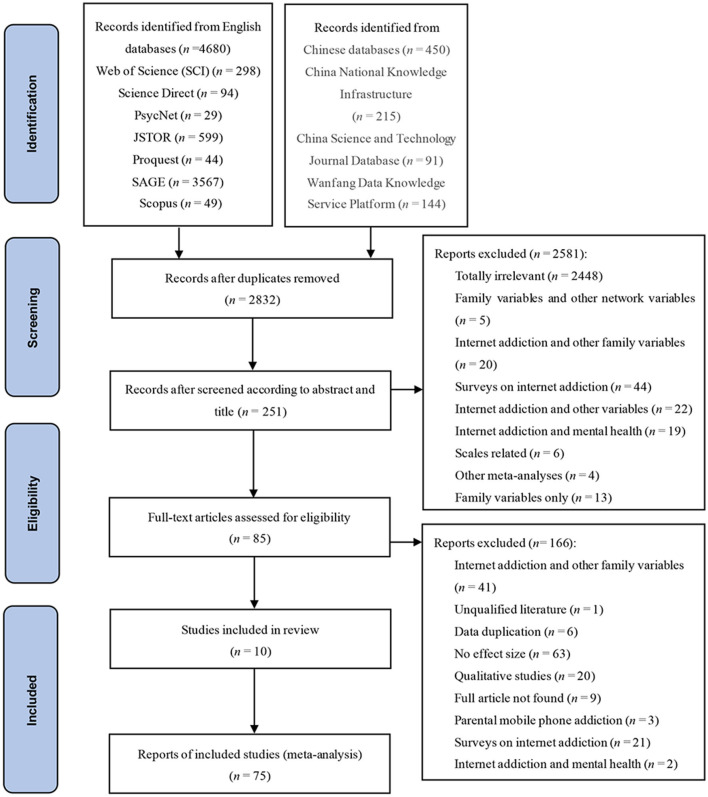
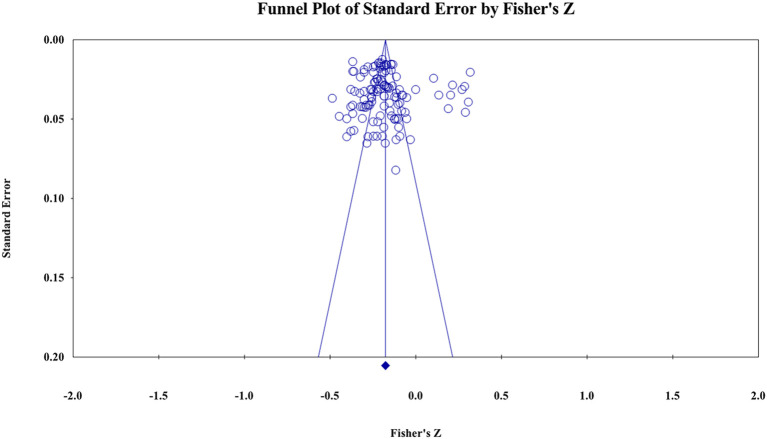
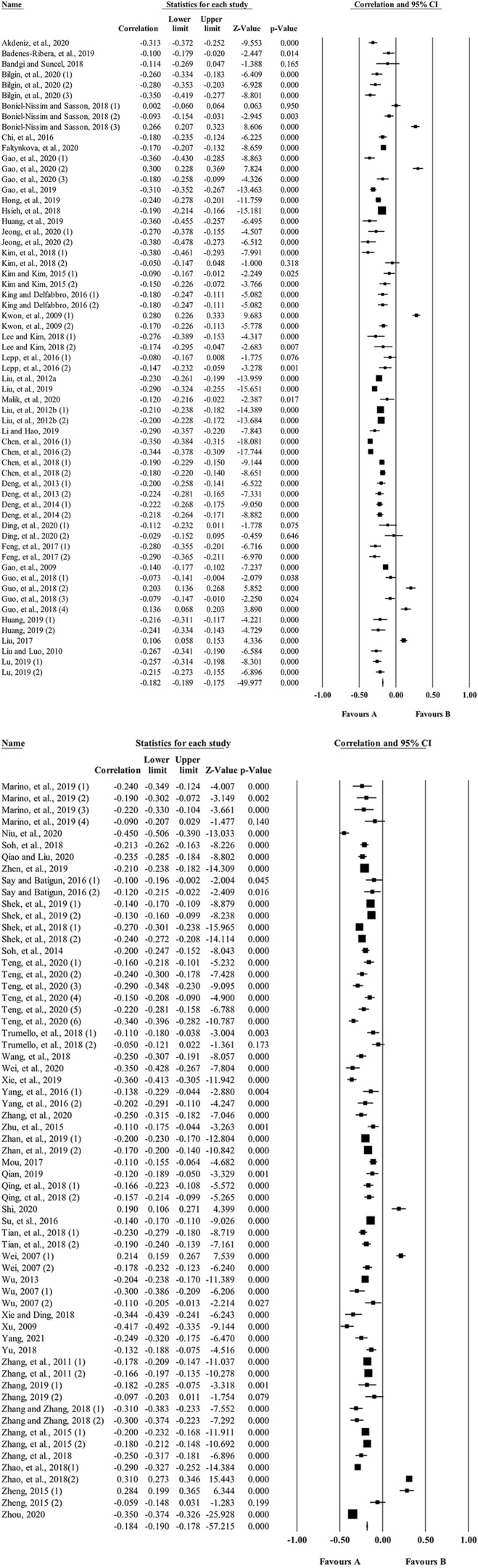
As past studies of the association between parent-child relationship and problematic internet use show mixed results and are influenced by many factors, this meta-analysis of 75 primary Chinese and English language studies from 1990 to 2021 with 110,601 participants (aged 6-25 years) explored (a) the overall association between parent-child relationship and problematic internet use, and (b) whether the association is affected by their types, country, measures, objects of the parent-child relationship, gender, age, year and publication types. We used funnel plots, and to test for publication bias and for moderation with the homogeneity tests. The results showed a negative association between quality of parent-child relationship and problematic internet use ( = -0.18, 95% CI = [-0.20, -0.15]). The moderation analysis found that compared with internet addiction tendency, the association between social media addiction and parent-child relationship was stronger. Moreover, the association between the parent-child relationship and problematic internet use of emerging adults (18-25 years old) was stronger than that of adolescents (12-18 years old). Furthermore, the negative association between parent-child relationship and problematic internet use was weaker (a) in Italy than those in Turkey and China, (b) when using CPS (Closeness to Parents Scale), IPPA (Inventory of Parent and Peer Attachment), or PARQ (Parent-Child Relationship Questionnaire) measuring parent-child relationship than using PCCS (Parent-Child Communication Scale), (c) when using IAT measuring problematic internet use rather than using IGDS or APIUS. Hence, these results indicate a negative association between parent-child relationships and problematic internet use, and the association is moderated by types of problematic internet use, age, country, scales of both parent-child relationship and problematic internet use.
既往关于亲子关系与网络使用问题之间关联的研究结果不一,且受到多种因素影响。本荟萃分析纳入了1990年至2021年间的75项中英文主要研究,涉及110,601名参与者(年龄在6至25岁之间),旨在探讨:(a) 亲子关系与网络使用问题之间的总体关联;(b) 这种关联是否受到其类型、国家、测量方法、亲子关系对象、性别、年龄、年份及出版物类型的影响。我们使用漏斗图以及进行发表偏倚检验和同质性检验以进行调节分析。结果显示,亲子关系质量与网络使用问题之间呈负相关( = -0.18,95% CI = [-0.20, -0.15])。调节分析发现,与网络成瘾倾向相比,社交媒体成瘾与亲子关系之间的关联更强。此外,新兴成年人(18至25岁)的亲子关系与网络使用问题之间的关联比青少年(12至18岁)更强。此外,亲子关系与网络使用问题之间的负相关在以下情况中较弱:(a) 在意大利比在土耳其和中国弱;(b) 使用父母亲密感量表(CPS)、父母与同伴依恋量表(IPPA)或亲子关系问卷(PARQ)测量亲子关系时,比使用亲子沟通量表(PCCS)时弱;(c) 使用网络成瘾测试(IAT)测量网络使用问题时,比使用网络成瘾诊断量表(IGDS)或青少年病理性互联网使用量表(APIUS)时弱。因此,这些结果表明亲子关系与网络使用问题之间存在负相关,且这种关联受到网络使用问题类型、年龄、国家、亲子关系量表及网络使用问题量表的调节。