Jeong Hyunsuk, Yim Hyeon Woo, Lee Seung-Yup, Lee Hae Kook, Potenza Marc N, Jo Sun-Jin, Son Hye Jung
Department of Preventive Medicine, College of Medicine, The Catholic University of Korea, 222 Banpodero, Seochogu, Seoul, South Korea.
Department of Psychiatry, College of Medicine, The Catholic University of Korea, Seoul, South Korea.
BMC Public Health. 2020 Apr 15;20(1):484. doi: 10.1186/s12889-020-08615-7.
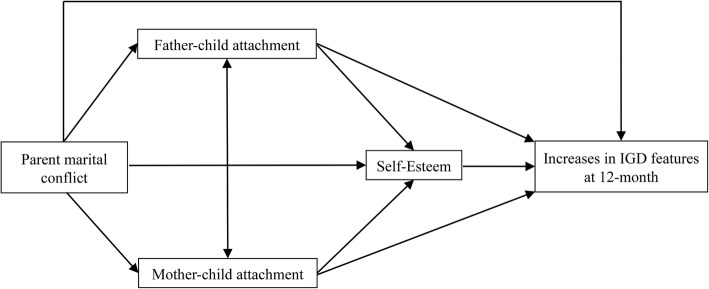
This study evaluated whether parent-child attachment and self-esteem may mediate the relationship between parental marital conflict and increases in features of internet gaming disorder (IGD) in children at 1 year.
The baseline and one-year follow-up data for 268 pre-teens aged between 9 and 10 from the Internet User Cohort for Unbiased Recognition of Gaming Disorder in Early Adolescence (iCURE) study were collected. The students were children at low risk for IGD in the initial self-reported assessment, anyone living with both parents, current game user at baseline, and those who completed a 12-month follow-up assessment. The Internet Game Use-Elicited Symptom Screen (IGUESS) was used to identify increases in IGD features at 12 months. To examine a potential mediation effect, structural equation modeling was performed.
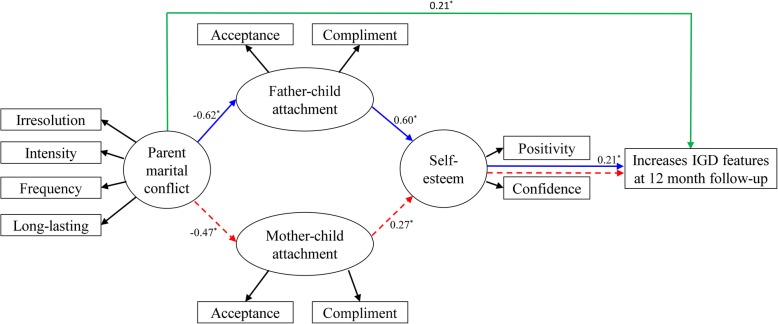
The direct effect was statistically significant, and parental marital conflict at baseline significantly predicted the increases in IGD features in children at the 12-month follow-up after adjusting for gender, sex, socioeconomic status, and baseline IGUESS score (ß = 0.206, P = 0.003). The indirect effect showed that attachment to fathers through self-esteem was a significant mediating effect (ß = 0.078, P = 0.045). Parental marital conflicts were associated with increases in IGD features in children through poor father-child attachment, and in turn, the lower levels of self-esteem in the children.
Parents, especially fathers, should make an effort to bond with their children to reduce the risk of their children's developing the IGD features.
本研究评估亲子依恋和自尊是否可能介导父母婚姻冲突与儿童1年后网络游戏障碍(IGD)特征增加之间的关系。
收集了来自青少年早期网络游戏障碍无偏识别互联网用户队列(iCURE)研究的268名9至10岁的青少年前期儿童的基线和一年随访数据。这些学生在最初的自我报告评估中为IGD低风险儿童,父母双全,基线时为当前游戏用户,且完成了12个月的随访评估。使用网络游戏使用引发症状筛查(IGUESS)来识别12个月时IGD特征的增加。为了检验潜在的中介效应,进行了结构方程模型分析。
直接效应具有统计学意义,在调整性别、社会经济地位和基线IGUESS分数后,基线时的父母婚姻冲突显著预测了12个月随访时儿童IGD特征的增加(β = 0.206,P = 0.003)。间接效应表明,通过自尊对父亲的依恋是一个显著的中介效应(β = 0.078,P = 0.045)。父母婚姻冲突通过不良的父子依恋以及儿童较低的自尊水平与儿童IGD特征的增加相关。
父母,尤其是父亲,应努力与孩子建立亲密关系,以降低孩子出现IGD特征的风险。