Qiao Jianping, Wang Rong, Liu Hongjia, Xu Guangrun, Wang Zhishun
Shandong Province Key Laboratory of Medical Physics and Image Processing Technology, School of Physics and Electronics, Shandong Normal University, Jinan, China.
Department of Neurology, Qilu Hospital of Shandong University, Jinan, China.
Front Aging Neurosci. 2022 Aug 30;14:912895. doi: 10.3389/fnagi.2022.912895. eCollection 2022.
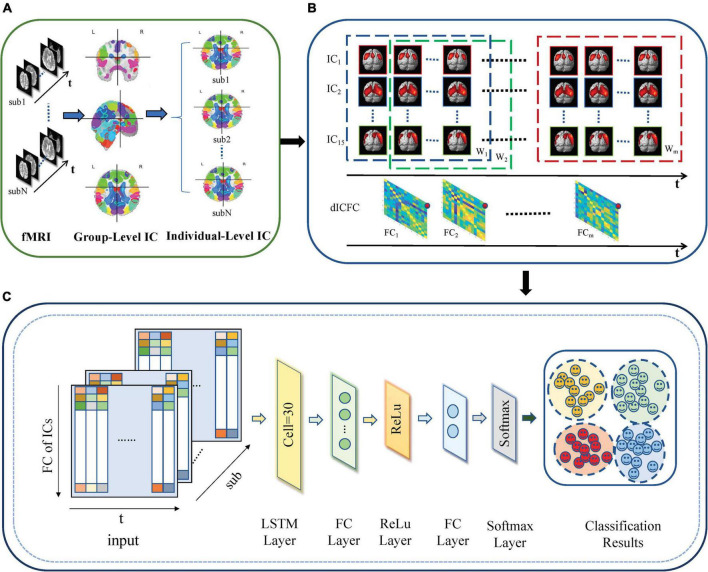
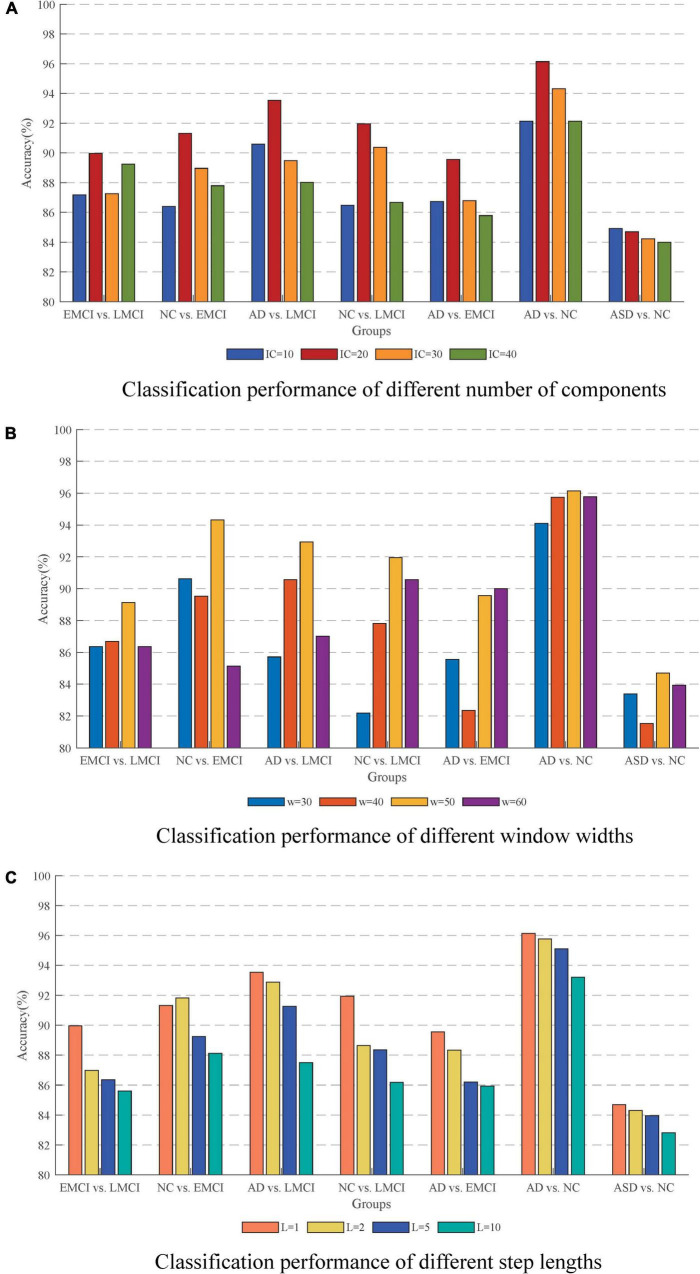
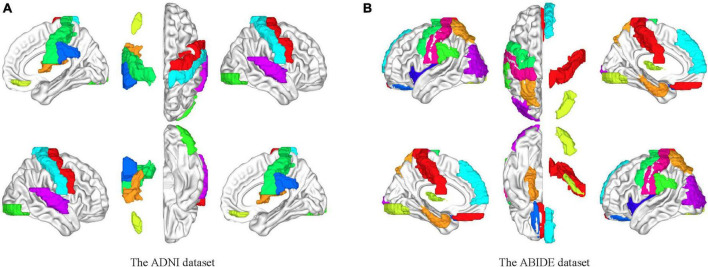
The dynamic functional connectivity (dFC) in functional magnetic resonance imaging (fMRI) is beneficial for the analysis and diagnosis of neurological brain diseases. The dFCs between regions of interest (ROIs) are generally delineated by a specific template and clustered into multiple different states. However, these models inevitably fell into the model-driven self-contained system which ignored the diversity at spatial level and the dynamics at time level of the data. In this study, we proposed a spatial and time domain feature extraction approach for Alzheimer's disease (AD) and autism spectrum disorder (ASD)-assisted diagnosis which exploited the dynamic connectivity among independent functional sub networks in brain. Briefly, independent sub networks were obtained by applying spatial independent component analysis (SICA) to the preprocessed fMRI data. Then, a sliding window approach was used to segment the time series of the spatial components. After that, the functional connections within the window were obtained sequentially. Finally, a temporal signal-sensitive long short-term memory (LSTM) network was used for classification. The experimental results on Alzheimer's Disease Neuroimaging Initiative (ADNI) and Autism Brain Imaging Data Exchange (ABIDE) datasets showed that the proposed method effectively predicted the disease at the early stage and outperformed the existing algorithms. The dFCs between the different components of the brain could be used as biomarkers for the diagnosis of diseases such as AD and ASD, providing a reliable basis for the study of brain connectomics.
功能磁共振成像(fMRI)中的动态功能连接性(dFC)有助于神经脑部疾病的分析与诊断。感兴趣区域(ROI)之间的dFC通常由特定模板描绘,并聚类为多种不同状态。然而,这些模型不可避免地陷入了模型驱动的自包含系统,该系统忽略了数据在空间层面的多样性和时间层面的动态性。在本研究中,我们提出了一种用于阿尔茨海默病(AD)和自闭症谱系障碍(ASD)辅助诊断的时空域特征提取方法,该方法利用了大脑中独立功能子网之间的动态连接性。简而言之,通过对预处理后的fMRI数据应用空间独立成分分析(SICA)来获得独立子网。然后,使用滑动窗口方法对空间成分的时间序列进行分割。之后,依次获取窗口内的功能连接。最后,使用时间信号敏感的长短期记忆(LSTM)网络进行分类。在阿尔茨海默病神经影像倡议(ADNI)和自闭症大脑影像数据交换(ABIDE)数据集上的实验结果表明,该方法能够在疾病早期有效地进行预测,并且优于现有算法。大脑不同成分之间의 dFC可用作AD和ASD等疾病诊断的生物标志物,为脑连接组学研究提供可靠依据。