Janssen L M, den Dekker B M, Gilhuijs K G A, van Diest P J, van der Wall E, Elias S G
Image Sciences Institute, University Medical Center Utrecht, Utrecht University, Utrecht, The Netherlands.
Department of Radiology, University Medical Center Utrecht, Utrecht University, Utrecht, The Netherlands.
NPJ Breast Cancer. 2022 Sep 19;8(1):107. doi: 10.1038/s41523-022-00475-1.
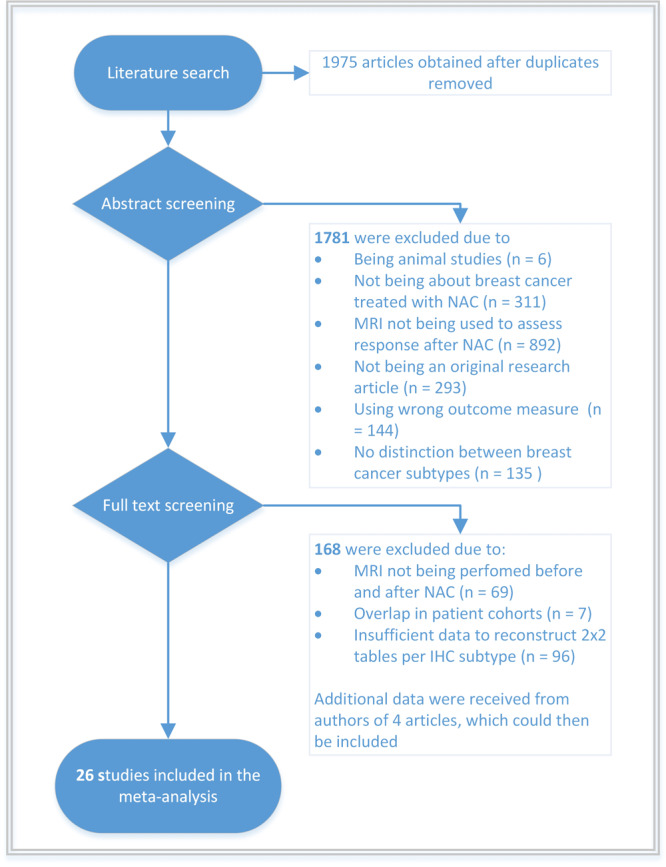
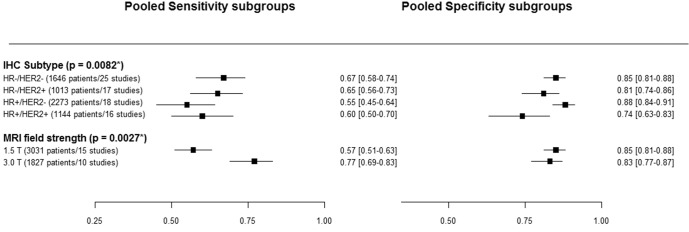
This meta-analysis aimed to estimate and compare sensitivity, specificity, positive- (PPV) and negative predictive value (NPV) of magnetic resonance imaging (MRI) for predicting pathological complete remission (pCR) after neoadjuvant chemotherapy (NAC) in patients with early-stage breast cancer. We stratified for molecular subtype by immunohistochemistry (IHC) and explored the impact of other factors. Two researchers systematically searched PUBMED and EMBASE to select relevant studies and extract data. For meta-analysis of sensitivity and specificity, we used bivariate random-effects models. Twenty-six included studies contained 4497 patients. There was a significant impact of IHC subtype on post-NAC MRI accuracy (p = 0.0082) for pCR. The pooled sensitivity was 0.67 [95% CI 0.58-0.74] for the HR-/HER2-, 0.65 [95% CI 0.56-0.73] for the HR-/HER2+, 0.55 [95% CI 0.45-0.64] for the HR+/HER2- and 0.60 [95% CI 0.50-0.70] for the HR+/HER2+ subtype. The pooled specificity was 0.85 [95% CI 0.81-0.88] for the HR-/HER2-, 0.81 [95% CI 0.74-0.86] for the HR-/HER2+, 0.88[95% CI 0.84-0.91] for the HR+/HER2- and 0.74 [95% CI 0.63-0.83] for the HR+/HER2+ subtype. The PPV was highest in the HR-/HER2- subtype and lowest in the HR+/HER2- subtype. MRI field strength of 3.0 T was associated with a higher sensitivity compared to 1.5 T (p = 0.00063). The accuracy of MRI for predicting pCR depends on molecular subtype, which should be taken into account in clinical practice. Higher MRI field strength positively impacts accuracy. When intervention trials based on MRI response evaluation are designed, the impact of IHC subtype and field strength on MR accuracy should be considered.
本荟萃分析旨在评估和比较磁共振成像(MRI)在预测早期乳腺癌患者新辅助化疗(NAC)后病理完全缓解(pCR)方面的敏感性、特异性、阳性预测值(PPV)和阴性预测值(NPV)。我们通过免疫组织化学(IHC)对分子亚型进行分层,并探讨其他因素的影响。两名研究人员系统检索了PUBMED和EMBASE以选择相关研究并提取数据。对于敏感性和特异性的荟萃分析,我们使用了双变量随机效应模型。纳入的26项研究共包含4497例患者。IHC亚型对NAC后MRI预测pCR的准确性有显著影响(p = 0.0082)。HR-/HER2-亚型的合并敏感性为0.67 [95%可信区间0.58 - 0.74],HR-/HER2+亚型为0.65 [95%可信区间0.56 - 0.73],HR+/HER2-亚型为0.55 [95%可信区间0.45 - 0.64],HR+/HER2+亚型为0.60 [95%可信区间0.50 - 0.70]。HR-/HER2-亚型的合并特异性为0.85 [95%可信区间0.81 - 0.88],HR-/HER2+亚型为0.81 [95%可信区间0.74 - 0.86],HR+/HER2-亚型为0.88[95%可信区间0.84 - 0.91],HR+/HER2+亚型为0.74 [95%可信区间0.63 - 0.83]。PPV在HR-/HER2-亚型中最高,在HR+/HER2-亚型中最低。与1.5 T相比,3.0 T的MRI场强与更高的敏感性相关(p = 0.00063)。MRI预测pCR的准确性取决于分子亚型,临床实践中应予以考虑。更高的MRI场强对准确性有积极影响。在设计基于MRI反应评估的干预试验时,应考虑IHC亚型和场强对MR准确性的影响。