• 文献检索
  • 文档翻译
  • 深度研究
  • 学术资讯
  • Suppr Zotero 插件Zotero 插件
  • 邀请有礼
  • 套餐&价格
  • 历史记录
应用&插件
Suppr Zotero 插件Zotero 插件浏览器插件Mac 客户端Windows 客户端微信小程序
定价
高级版会员购买积分包购买API积分包
服务
文献检索文档翻译深度研究API 文档MCP 服务
关于我们
关于 Suppr公司介绍联系我们用户协议隐私条款
关注我们

Suppr 超能文献

核心技术专利:CN118964589B侵权必究
粤ICP备2023148730 号-1Suppr @ 2026

文献检索

告别复杂PubMed语法,用中文像聊天一样搜索,搜遍4000万医学文献。AI智能推荐,让科研检索更轻松。

立即免费搜索

文件翻译

保留排版,准确专业,支持PDF/Word/PPT等文件格式,支持 12+语言互译。

免费翻译文档

深度研究

AI帮你快速写综述,25分钟生成高质量综述,智能提取关键信息,辅助科研写作。

立即免费体验

社交媒体使用与女同性恋、男同性恋、双性恋、跨性别和酷儿青年的健康和幸福感:系统评价。

Social Media Use and Health and Well-being of Lesbian, Gay, Bisexual, Transgender, and Queer Youth: Systematic Review.

机构信息

Specialty of Child and Adolescent Health, The Children's Hospital at Westmead Clinical School, Faculty of Medicine and Health, The University of Sydney, Westmead, Australia.

Centre for Population Health, Western Sydney Public Health Unit, North Parramatta, Australia.

出版信息

J Med Internet Res. 2022 Sep 21;24(9):e38449. doi: 10.2196/38449.

DOI:10.2196/38449
PMID:36129741
原文链接:https://pmc.ncbi.nlm.nih.gov/articles/PMC9536523/
Abstract

BACKGROUND

Lesbian, gay, bisexual, transgender, and queer (LGBTQ) individuals are at higher risk of poor mental health and well-being. Social media platforms can provide LGBTQ youths with a space that counters heteronormative environments and potentially supports mental health and well-being. Mental health includes an individual's state of psychological and emotional well-being and not merely the absence of mental disorders.

OBJECTIVE

We sought to identify how LGBTQ youths and adolescents use social media for connection with other LGBTQ peers and groups, identity development, and social support and how these affect mental health and well-being.

METHODS

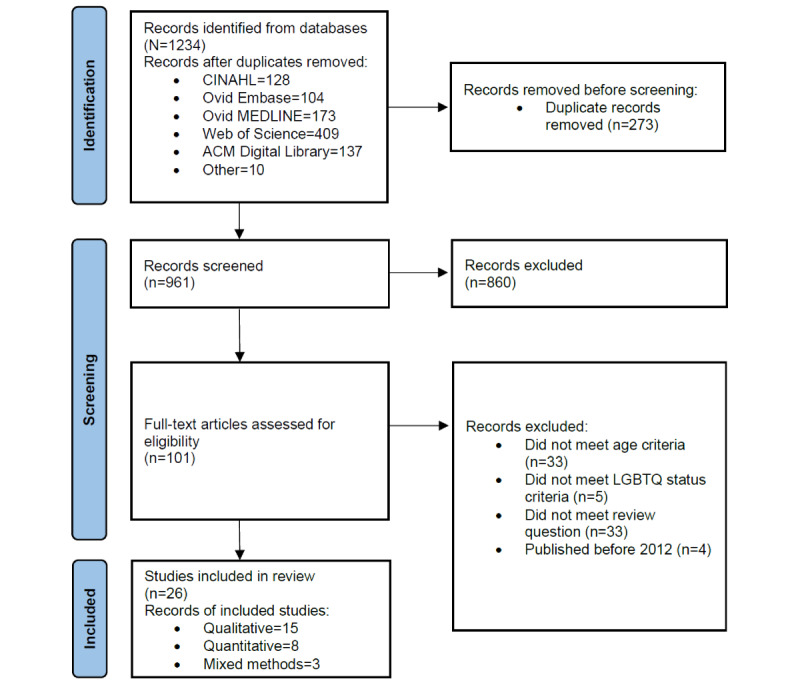
PRISMA (Preferred Reporting Items for Systematic Reviews and Meta-Analyses) procedures were used to guide this review. Searches were conducted in ACM Digital Library, CINAHL, Ovid Embase, Ovid MEDLINE, and Web of Science in March 2021. This review focused on LGBTQ youths aged 10 to 24 years. Included peer-reviewed studies must comprise social media; explore peer connection, identity development, or social support; and be published from 2012 onward. In total, 2 researchers extracted data and performed quality assessments independently using the Newcastle-Ottawa Scale for quantitative articles and the Critical Appraisal Skills Programme for qualitative articles. Qualitative synthesis was performed on articles that satisfied the eligibility criteria.

RESULTS

A total of 26 studies (n=15, 58% qualitative; n=8, 31% quantitative; n=3, 12% mixed methods) met the inclusion criteria. Of the 8 quantitative studies, 6 (75%) were cross-sectional, and 2 (25%) were cohort studies. All studies ranged from moderate to high quality. Social media was a popular tool used by LGBTQ youths to connect with LGBTQ communities. In qualitative data, we found that LGBTQ youths negotiated and explored identity and obtained support from peers on social media. Instagram, Tumblr, and Twitter were commonly used to access LGBTQ content owing to ease of anonymity. Identity management was the most studied social media affordance, important to LGBTQ youths for strategic disclosure. Key strategies for managing identities included being anonymous, censoring locations or content, restricting audiences, and using multiple accounts. Quantitative studies (3/8, 38%) showed that social media was associated with reduced mental health concerns and increased well-being among LGBTQ youths. Mental health concerns arising from social media use were attributed to discrimination, victimization, and policies that did not accommodate changed identities.

CONCLUSIONS

We found that social media may support the mental health and well-being of LGBTQ youths through peer connection, identity management, and social support, but findings were limited by weaknesses in the evidence. More robust and longitudinal studies are needed to determine the relationship between social media use and LGBTQ mental health, particularly among adolescents. The findings may inform interventions to promote social media health literacy and the mental health and well-being of this vulnerable group.

TRIAL REGISTRATION

PROSPERO CRD42020222535; https://www.crd.york.ac.uk/prospero/display_record.php?RecordID=222535.
https://cdn.ncbi.nlm.nih.gov/pmc/blobs/4473/9536523/538f19c3cffb/jmir_v24i9e38449_fig1.jpg
摘要

背景

女同性恋、男同性恋、双性恋、跨性别和酷儿(LGBTQ)群体面临更高的心理健康和福祉风险。社交媒体平台可以为 LGBTQ 青年提供一个反对异性恋规范环境的空间,并可能支持心理健康和福祉。心理健康包括个人的心理和情感健康状况,而不仅仅是没有精神障碍。

目的

我们旨在确定 LGBTQ 青年和青少年如何使用社交媒体与其他 LGBTQ 同龄人建立联系、发展身份认同以及获得社会支持,以及这些如何影响心理健康和福祉。

方法

采用 PRISMA(系统评价和荟萃分析的首选报告项目)程序指导本综述。2021 年 3 月在 ACM 数字图书馆、CINAHL、Ovid Embase、Ovid MEDLINE 和 Web of Science 中进行了搜索。本综述重点关注 10 至 24 岁的 LGBTQ 青年。纳入的同行评议研究必须包含社交媒体;探索同伴联系、身份发展或社会支持;并于 2012 年以后发表。共有 2 名研究人员独立使用纽卡斯尔-渥太华量表(Newcastle-Ottawa Scale)对定量文章和批判性评估技能计划(Critical Appraisal Skills Programme)对定性文章进行数据提取和质量评估。对符合入选标准的文章进行定性综合分析。

结果

共有 26 项研究(n=15,定性研究占 58%;n=8,定量研究占 31%;n=3,混合方法研究占 12%)符合纳入标准。8 项定量研究中,有 6 项(75%)为横断面研究,2 项(25%)为队列研究。所有研究的质量均为中等到高度。社交媒体是 LGBTQ 青年与 LGBTQ 社区建立联系的流行工具。在定性数据中,我们发现 LGBTQ 青年在社交媒体上协商和探索身份,并从同龄人那里获得支持。由于匿名性,Instagram、Tumblr 和 Twitter 是常用来获取 LGBTQ 内容的平台。身份管理是研究最多的社交媒体功能,对 LGBTQ 青年来说,这是战略披露的重要途径。管理身份的关键策略包括匿名、屏蔽位置或内容、限制受众和使用多个账户。3 项定量研究(38%)表明,社交媒体与 LGBTQ 青年的心理健康问题减少和幸福感增加有关。社交媒体使用带来的心理健康问题归因于歧视、受害和不适应身份变化的政策。

结论

我们发现,社交媒体通过同伴联系、身份管理和社会支持可能支持 LGBTQ 青年的心理健康和福祉,但研究结果受到证据薄弱的限制。需要更强大和更长期的研究来确定社交媒体使用与 LGBTQ 心理健康之间的关系,特别是在青少年中。研究结果可能为促进社交媒体健康素养以及促进这一弱势群体的心理健康提供信息。

试验注册

PROSPERO CRD42020222535; https://www.crd.york.ac.uk/prospero/display_record.php?RecordID=222535.

相似文献

1
Social Media Use and Health and Well-being of Lesbian, Gay, Bisexual, Transgender, and Queer Youth: Systematic Review.社交媒体使用与女同性恋、男同性恋、双性恋、跨性别和酷儿青年的健康和幸福感:系统评价。
J Med Internet Res. 2022 Sep 21;24(9):e38449. doi: 10.2196/38449.
2
Survivor, family and professional experiences of psychosocial interventions for sexual abuse and violence: a qualitative evidence synthesis.性虐待和暴力的心理社会干预的幸存者、家庭和专业人员的经验:定性证据综合。
Cochrane Database Syst Rev. 2022 Oct 4;10(10):CD013648. doi: 10.1002/14651858.CD013648.pub2.
3
The Influence of Web-Based Tools on Maternal and Neonatal Outcomes in Pregnant Adolescents or Adolescent Mothers: Mixed Methods Systematic Review.基于网络的工具对青少年孕妇或未成年母亲的母婴结局的影响:混合方法系统评价。
J Med Internet Res. 2021 Aug 26;23(8):e26786. doi: 10.2196/26786.
4
Home treatment for mental health problems: a systematic review.心理健康问题的居家治疗:一项系统综述
Health Technol Assess. 2001;5(15):1-139. doi: 10.3310/hta5150.
5
How lived experiences of illness trajectories, burdens of treatment, and social inequalities shape service user and caregiver participation in health and social care: a theory-informed qualitative evidence synthesis.疾病轨迹的生活经历、治疗负担和社会不平等如何影响服务使用者和照顾者参与健康和社会护理:一项基于理论的定性证据综合分析
Health Soc Care Deliv Res. 2025 Jun;13(24):1-120. doi: 10.3310/HGTQ8159.
6
Eliciting adverse effects data from participants in clinical trials.从临床试验参与者中获取不良反应数据。
Cochrane Database Syst Rev. 2018 Jan 16;1(1):MR000039. doi: 10.1002/14651858.MR000039.pub2.
7
Control interventions in randomised trials among people with mental health disorders.精神障碍患者随机试验中的对照干预措施。
Cochrane Database Syst Rev. 2022 Apr 4;4(4):MR000050. doi: 10.1002/14651858.MR000050.pub2.
8
Peer support interventions for parents and carers of children with complex needs.针对有复杂需求的儿童的父母和照顾者的同伴支持干预。
Cochrane Database Syst Rev. 2021 Dec 20;12(12):CD010618. doi: 10.1002/14651858.CD010618.pub2.
9
Feasibility study of Learning Together for Mental Health: fidelity, reach and acceptability of a whole-school intervention aiming to promote health and wellbeing in secondary schools.“共同学习促进心理健康”可行性研究:一项旨在促进中学健康与幸福的全校性干预措施的保真度、覆盖面和可接受性。
Public Health Res (Southampt). 2025 Jun 18:1-36. doi: 10.3310/RTRT0202.
10
Understanding Engagement in Digital Mental Health and Well-being Programs for Women in the Perinatal Period: Systematic Review Without Meta-analysis.理解围产期女性参与数字心理健康和幸福计划:系统评价而不进行荟萃分析。
J Med Internet Res. 2022 Aug 9;24(8):e36620. doi: 10.2196/36620.

引用本文的文献

1
Medical Information Provided by Transgender and Gender-Diverse Content Creators on YouTube: Descriptive Content Analysis.YouTube上跨性别和性别多样化内容创作者提供的医学信息:描述性内容分析。
JMIR Form Res. 2025 Aug 29;9:e75787. doi: 10.2196/75787.
2
Social Media and Youth Mental Health: Scoping Review of Platform and Policy Recommendations.社交媒体与青少年心理健康:平台及政策建议的范围综述
J Med Internet Res. 2025 Jun 20;27:e72061. doi: 10.2196/72061.
3
Social epidemiology of bedtime screen use behaviors and sleep outcomes in early adolescence.

本文引用的文献

1
Sexual Orientation Identity Development Milestones Among Lesbian, Gay, Bisexual, and Queer People: A Systematic Review and Meta-Analysis.女同性恋、男同性恋、双性恋和酷儿群体的性取向认同发展里程碑:一项系统评价与荟萃分析
Front Psychol. 2021 Oct 21;12:753954. doi: 10.3389/fpsyg.2021.753954. eCollection 2021.
2
Social media's role in support networks among LGBTQ adolescents: a qualitative study.社交媒体在 LGBTQ 青少年支持网络中的作用:一项定性研究。
Sex Health. 2021 Nov;18(5):421-431. doi: 10.1071/SH21110.
3
On the Psychology of TikTok Use: A First Glimpse From Empirical Findings.
青少年早期睡前屏幕使用行为与睡眠结果的社会流行病学
Sleep Health. 2025 Jun 9. doi: 10.1016/j.sleh.2025.05.005.
4
The Effectiveness of Social Media Campaigns in Improving Knowledge and Attitudes Toward Mental Health and Help-Seeking in High-Income Countries: Scoping Review.社交媒体活动在高收入国家改善心理健康知识和态度以及求助行为方面的有效性:范围综述
J Med Internet Res. 2025 May 23;27:e68124. doi: 10.2196/68124.
5
The role of technology and screen media use in treatment outcomes of children participating in a digital mental health intervention: a retrospective analysis of Bend Health.技术和屏幕媒体使用在参与数字心理健康干预的儿童治疗结果中的作用:对本德健康的回顾性分析
Front Digit Health. 2025 May 2;7:1556468. doi: 10.3389/fdgth.2025.1556468. eCollection 2025.
6
Physical Features Contributing to Gender Dysphoria: The Role of Voice.导致性别焦虑的身体特征:嗓音的作用。
Otolaryngol Head Neck Surg. 2025 Jun;172(6):2018-2025. doi: 10.1002/ohn.1207. Epub 2025 Mar 19.
7
The Role of Online Social Support in Mental Health: Comparing Rural and Urban Youth.在线社交支持在心理健康中的作用:农村与城市青少年的比较
Children (Basel). 2025 Jan 21;12(2):113. doi: 10.3390/children12020113.
8
Smartphone screen time reduction improves mental health: a randomized controlled trial.减少智能手机屏幕使用时间可改善心理健康:一项随机对照试验。
BMC Med. 2025 Feb 21;23(1):107. doi: 10.1186/s12916-025-03944-z.
9
Frequency of probable social media addiction and correlates of problematic social networking sites use in a sample of transgender adults.跨性别成年人样本中可能存在的社交媒体成瘾频率及社交网站使用问题的相关因素。
Heliyon. 2025 Jan 2;11(1):e41674. doi: 10.1016/j.heliyon.2025.e41674. eCollection 2025 Jan 15.
10
Relationships between structural stigma, societal stigma, and minority stress among gender minority people.性别少数群体中结构性污名、社会污名与少数群体压力之间的关系。
Sci Rep. 2025 Jan 23;15(1):2996. doi: 10.1038/s41598-024-85013-8.
TikTok 使用的心理学研究:来自实证研究的初步发现。
Front Public Health. 2021 Mar 16;9:641673. doi: 10.3389/fpubh.2021.641673. eCollection 2021.
4
The PRISMA 2020 statement: an updated guideline for reporting systematic reviews.PRISMA 2020 声明:系统评价报告的更新指南。
BMJ. 2021 Mar 29;372:n71. doi: 10.1136/bmj.n71.
5
Not your unicorn: trans dating app users' negotiations of personal safety and sexual health.非你所想:跨性别约会应用程序用户对个人安全和性健康的权衡
Health Sociol Rev. 2021 Mar;30(1):72-86. doi: 10.1080/14461242.2020.1851610. Epub 2020 Nov 22.
6
What adolescents think of relationship portrayals on social media: a qualitative study.青少年对社交媒体中人际关系描绘的看法:一项定性研究。
Sex Health. 2020 Nov;17(5):467-474. doi: 10.1071/SH20056.
7
Association of Coming Out as Lesbian, Gay, and Bisexual+ and Risk of Cigarette Smoking in a Nationally Representative Sample of Youth and Young Adults.出柜为女同性恋、男同性恋和双性恋与青年和年轻成年人全国代表性样本中吸烟风险的关联。
JAMA Pediatr. 2021 Jan 1;175(1):56-63. doi: 10.1001/jamapediatrics.2020.3565.
8
"It just feels right": Perceptions of the effects of community connectedness among trans individuals.“感觉很对”:跨性别者对社区联系影响的看法。
PLoS One. 2020 Oct 5;15(10):e0240295. doi: 10.1371/journal.pone.0240295. eCollection 2020.
9
"Sometimes You Get Married on Facebook": The Use of Social Media Among Nonmetropolitan Sexual and Gender Minority Youth.《有时你会在 Facebook 上结婚》:非都市地区性少数和性别少数青年对社交媒体的使用。
J Homosex. 2022 Jan 2;69(1):41-60. doi: 10.1080/00918369.2020.1813508. Epub 2020 Sep 2.
10
Cyberbullying and LGBTQ Youth: A Systematic Literature Review and Recommendations for Prevention and Intervention.网络欺凌与 LGBTQ 青年:系统文献综述及预防与干预建议
J Child Adolesc Trauma. 2017 Jul 24;11(1):81-97. doi: 10.1007/s40653-017-0175-7. eCollection 2018 Mar.