Kucherenko I S, Soldatkin O O, Kucherenko D Yu, Soldatkina O V, Dzyadevych S V
Department of Biomolecular Electronics, Institute of Molecular Biology and Genetics of the National Academy of Sciences of Ukraine Zabolotnogo Street 150 Kyiv 03143 Ukraine
Department of Mechanical Engineering, Iowa State University Ames Iowa 50011 USA.
Nanoscale Adv. 2019 Oct 31;1(12):4560-4577. doi: 10.1039/c9na00491b. eCollection 2019 Dec 3.
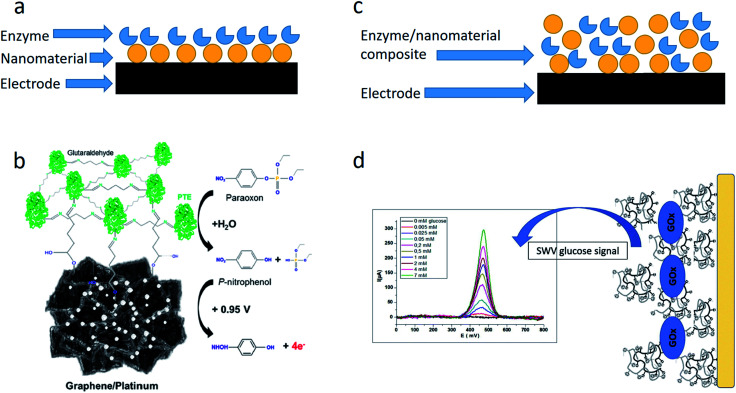
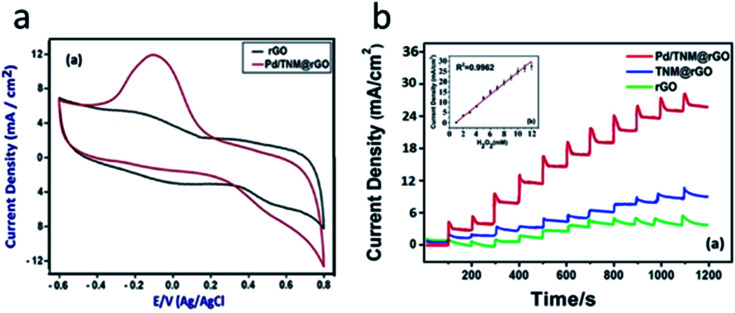
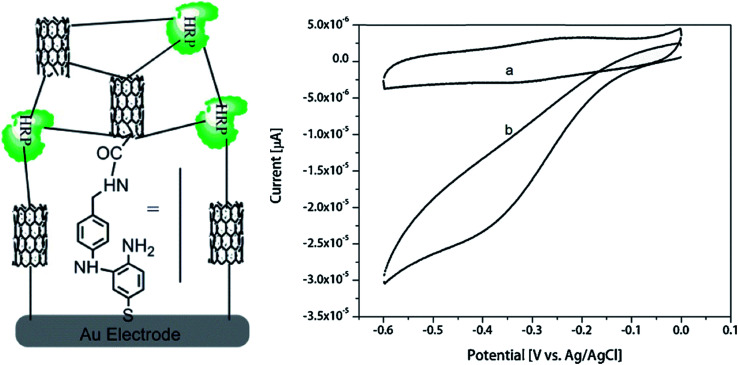
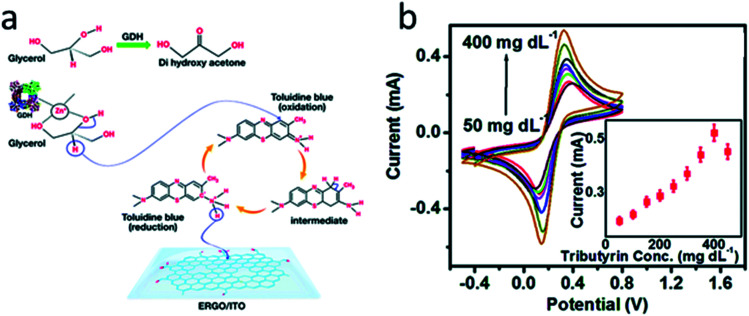
Electrochemical enzyme-based biosensors are one of the largest and commercially successful groups of biosensors. Integration of nanomaterials in the biosensors results in significant improvement of biosensor sensitivity, limit of detection, stability, response rate and other analytical characteristics. Thus, new functional nanomaterials are key components of numerous biosensors. However, due to the great variety of available nanomaterials, they should be carefully selected according to the desired effects. The present review covers the recent applications of various types of nanomaterials in electrochemical enzyme-based biosensors for the detection of small biomolecules, environmental pollutants, food contaminants, and clinical biomarkers. Benefits and limitations of using nanomaterials for analytical purposes are discussed. Furthermore, we highlight specific properties of different nanomaterials, which are relevant to electrochemical biosensors. The review is structured according to the types of nanomaterials. We describe the application of inorganic nanomaterials, such as gold nanoparticles (AuNPs), platinum nanoparticles (PtNPs), silver nanoparticles (AgNPs), and palladium nanoparticles (PdNPs), zeolites, inorganic quantum dots, and organic nanomaterials, such as single-walled carbon nanotubes (SWCNTs), multi-walled carbon nanotubes (MWCNTs), carbon and graphene quantum dots, graphene, fullerenes, and calixarenes. Usage of composite nanomaterials is also presented.
基于电化学酶的生物传感器是最大且商业上成功的生物传感器类别之一。将纳米材料整合到生物传感器中可显著提高生物传感器的灵敏度、检测限、稳定性、响应速率及其他分析特性。因此,新型功能纳米材料是众多生物传感器的关键组成部分。然而,由于可用纳米材料种类繁多,应根据预期效果仔细选择。本综述涵盖了各类纳米材料在基于电化学酶的生物传感器中用于检测小分子生物分子、环境污染物、食品污染物和临床生物标志物的最新应用。讨论了将纳米材料用于分析目的的优点和局限性。此外,我们强调了与电化学生物传感器相关的不同纳米材料的特定特性。本综述根据纳米材料的类型进行结构安排。我们描述了无机纳米材料的应用,如金纳米颗粒(AuNPs)、铂纳米颗粒(PtNPs)、银纳米颗粒(AgNPs)和钯纳米颗粒(PdNPs)、沸石、无机量子点,以及有机纳米材料的应用,如单壁碳纳米管(SWCNTs)、多壁碳纳米管(MWCNTs)、碳和石墨烯量子点、石墨烯、富勒烯和杯芳烃。还介绍了复合纳米材料的使用情况。