Wang Baozhen, Akiba Uichi, Anzai Jun-Ichi
Department of Nutrition and Food Hygiene, School of Public Health, Shandong University, 44 Wenhua Xilu, Jinan 250012, China.
Graduate School of Engineering and Science, Akita University, 1-1 Tegatagakuen-machi, Akita 010-8502, Japan.
Molecules. 2017 Jun 24;22(7):1048. doi: 10.3390/molecules22071048.
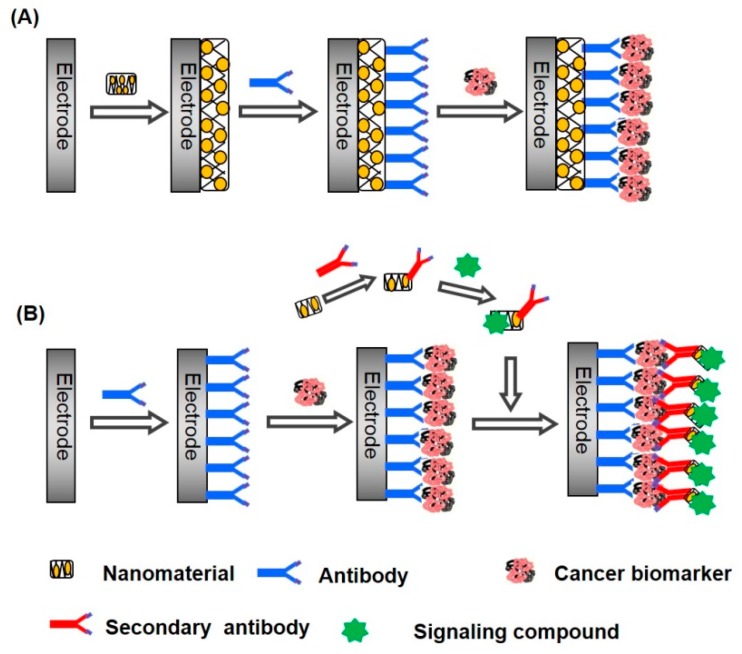
This article reviews recent progress in the development of nanomaterial-based electrochemical biosensors for cancer biomarkers. Because of their high electrical conductivity, high affinity to biomolecules, and high surface area-to-weight ratios, nanomaterials, including metal nanoparticles, carbon nanotubes, and graphene, have been used for fabricating electrochemical biosensors. Electrodes are often coated with nanomaterials to increase the effective surface area of the electrodes and immobilize a large number of biomolecules such as enzymes and antibodies. Alternatively, nanomaterials are used as signaling labels for increasing the output signals of cancer biomarker sensors, in which nanomaterials are conjugated with secondary antibodies and redox compounds. According to this strategy, a variety of biosensors have been developed for detecting cancer biomarkers. Recent studies show that using nanomaterials is highly advantageous in preparing high-performance biosensors for detecting lower levels of cancer biomarkers. This review focuses mainly on the protocols for using nanomaterials to construct cancer biomarker sensors and the performance characteristics of the sensors. Recent trends in the development of cancer biomarker sensors are discussed according to the nanomaterials used.
本文综述了基于纳米材料的癌症生物标志物电化学生物传感器的最新进展。由于金属纳米颗粒、碳纳米管和石墨烯等纳米材料具有高电导率、对生物分子的高亲和力以及高比表面积,它们已被用于制造电化学生物传感器。电极通常涂覆纳米材料以增加电极的有效表面积,并固定大量生物分子,如酶和抗体。或者,纳米材料用作信号标记以增加癌症生物标志物传感器的输出信号,其中纳米材料与二抗和氧化还原化合物缀合。根据这一策略,已开发出多种用于检测癌症生物标志物的生物传感器。最近的研究表明,使用纳米材料在制备用于检测较低水平癌症生物标志物的高性能生物传感器方面具有很大优势。本综述主要关注使用纳米材料构建癌症生物标志物传感器的方案以及传感器的性能特征。根据所使用的纳米材料讨论了癌症生物标志物传感器开发的最新趋势。