School of Psychology.
Psychol Bull. 2018 Nov;144(11):1200-1227. doi: 10.1037/bul0000164. Epub 2018 Sep 27.
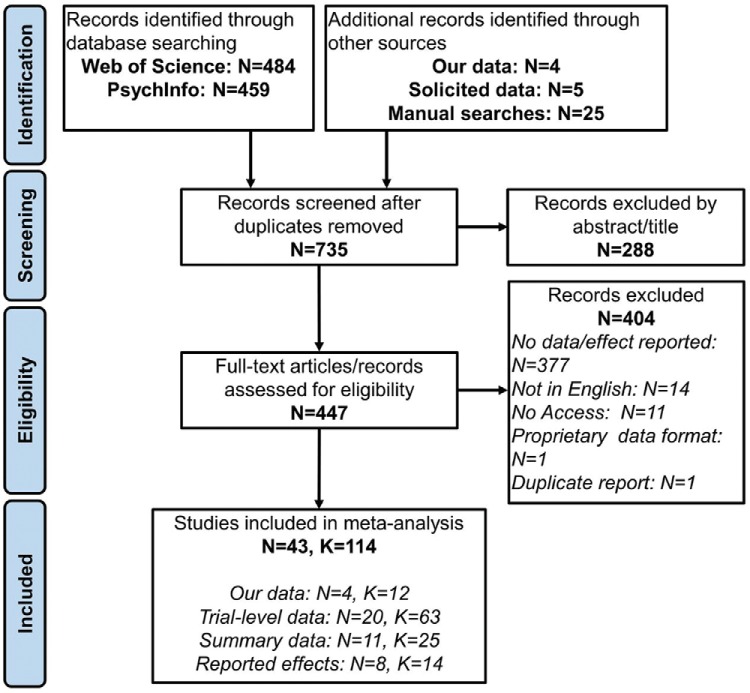
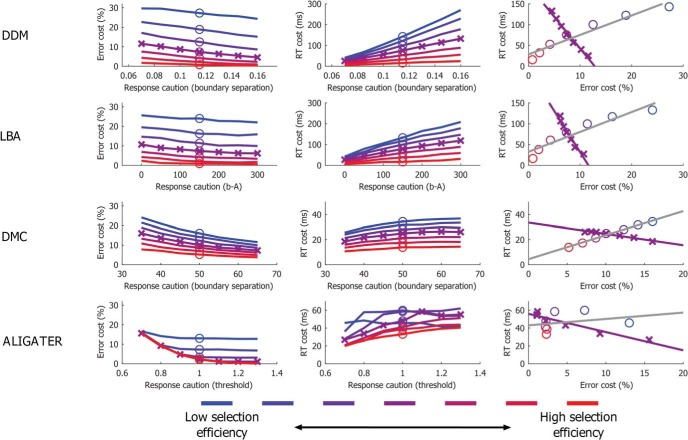
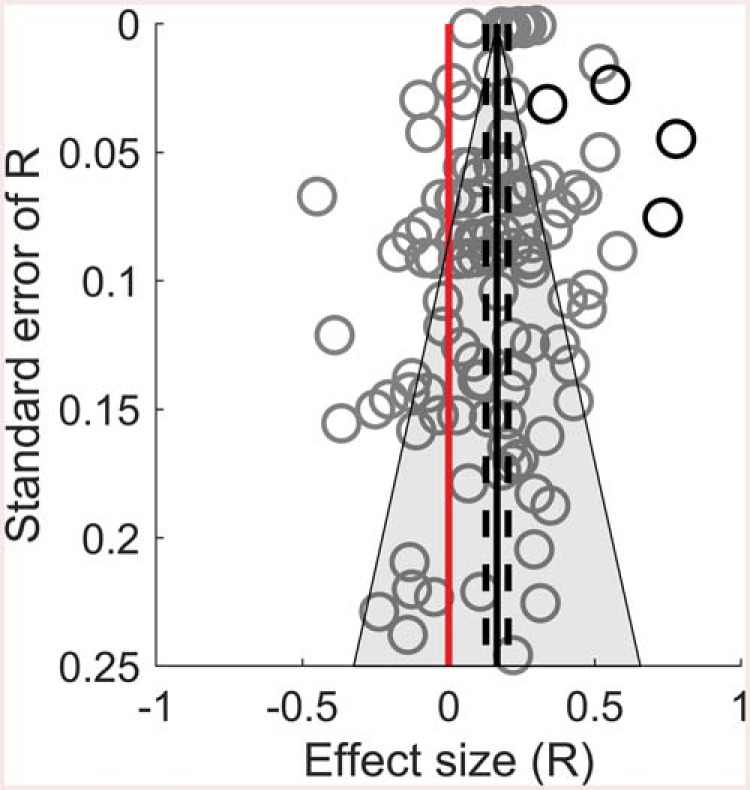
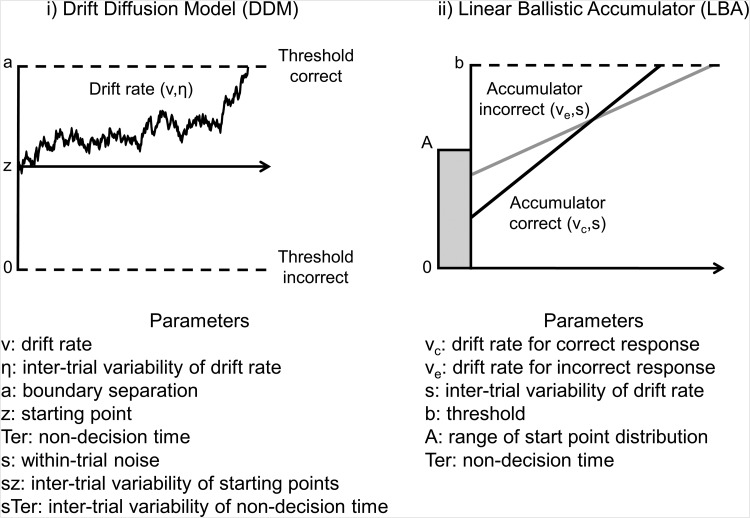
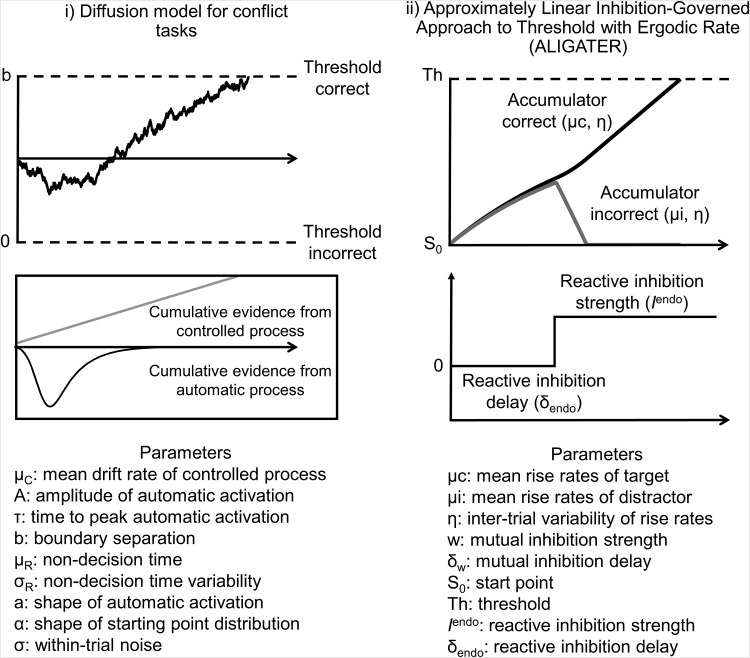
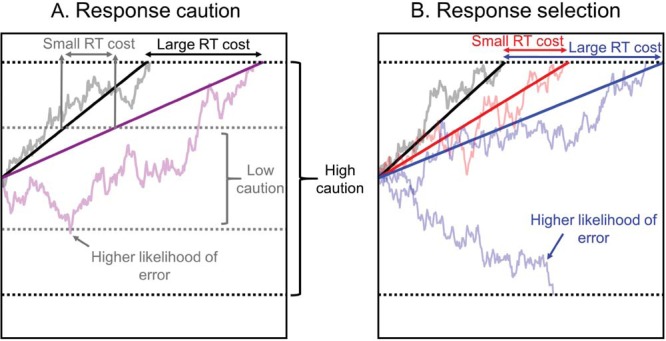
The underpinning assumption of much research on cognitive individual differences (or group differences) is that task performance indexes cognitive ability in that domain. In many tasks performance is measured by differences (costs) between conditions, which are widely assumed to index a psychological process of interest rather than extraneous factors such as speed-accuracy trade-offs (e.g., Stroop, implicit association task, lexical decision, antisaccade, Simon, Navon, flanker, and task switching). Relatedly, reaction time (RT) costs or error costs are interpreted similarly and used interchangeably in the literature. All of this assumes a strong correlation between RT-costs and error-costs from the same psychological effect. We conducted a meta-analysis to test this, with 114 effects across a range of well-known tasks. Counterintuitively, we found a general pattern of weak, and often no, association between RT and error costs (mean = .17, range -.45 to .78). This general problem is accounted for by the theoretical framework of evidence accumulation models, which capture individual differences in (at least) 2 distinct ways. Differences affecting accumulation rate produce positive correlation. But this is cancelled out if individuals also differ in response threshold, which produces negative correlations. In the models, subtractions between conditions do not isolate processing costs from caution. To demonstrate the explanatory power of synthesizing the traditional subtraction method within a broader decision model framework, we confirm 2 predictions with new data. Thus, using error costs or RT costs is more than a pragmatic choice; the decision carries theoretical consequence that can be understood through the accumulation model framework. (PsycINFO Database Record (c) 2018 APA, all rights reserved).
许多认知个体差异(或群体差异)研究的基本假设是,任务表现指标在该领域的认知能力。在许多任务中,表现是通过条件之间的差异(成本)来衡量的,这些差异被广泛认为是对感兴趣的心理过程的指标,而不是无关因素,例如速度准确性权衡(例如,Stroop、内隐联想任务、词汇判断、反扫视、Simon、Navon、侧翼和任务转换)。相关地,反应时间(RT)成本或错误成本在文献中以类似的方式解释并可互换使用。所有这些都假设 RT 成本和来自同一心理效应的错误成本之间存在很强的相关性。我们进行了一项荟萃分析来检验这一点,共有 114 个效应涉及一系列知名任务。反直觉的是,我们发现 RT 和错误成本之间普遍存在微弱的关联,而且通常没有关联(平均值=0.17,范围-0.45 到 0.78)。这个普遍问题可以用证据积累模型的理论框架来解释,该模型至少以两种不同的方式捕捉个体差异。影响积累率的差异会产生正相关。但是,如果个体在反应阈值上也存在差异,这会产生负相关,那么这种相关性就会被抵消。在模型中,条件之间的减法并不能将处理成本与谨慎分开。为了证明在更广泛的决策模型框架内综合传统减法方法的解释能力,我们用新数据证实了两个预测。因此,使用错误成本或 RT 成本不仅仅是一个实际的选择;这个决策带有理论后果,可以通过积累模型框架来理解。(PsycINFO 数据库记录(c)2018 APA,保留所有权利)。