Alshuail Nora, Alehaideb Zeyad, Alghamdi Sahar, Suliman Rasha, Al-Eidi Hamad, Ali Rizwan, Barhoumi Tlili, Almutairi Mansour, Alwhibi Mona, Alghanem Bandar, Alamro Abir, Alghamdi Amani, Matou-Nasri Sabine
Biochemistry Department, College of Science, King Saud University, Riyadh 11495, Saudi Arabia.
Medical Research Core Facility and Platforms, King Abdullah International Medical Research Center (KAIMRC), King Saud bin Abdulaziz University for Health Sciences (KSAU-HS), Ministry of National Guard-Health Affairs (MNGHA), Riyadh 11481, Saudi Arabia.
Pharmaceuticals (Basel). 2022 Aug 26;15(9):1060. doi: 10.3390/ph15091060.
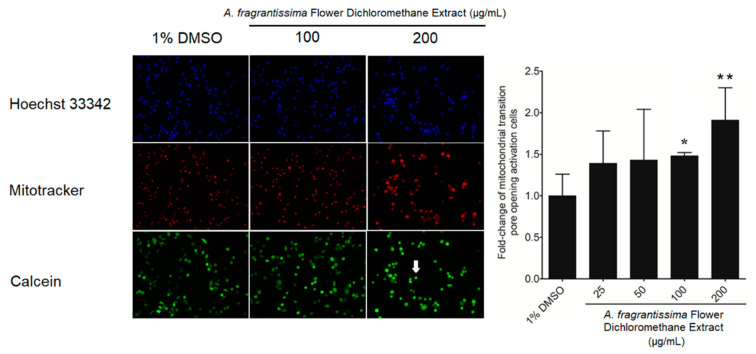
The aggressive triple-negative breast cancer (TNBC) is a challenging disease due to the absence of tailored therapy. The search for new therapies involves intensive research focusing on natural sources. () is a traditional medicine from the Middle East region. Various solvent extracts from different plant parts, including flowers, leaves, and roots, were tested on TNBC MDA-MB-231 cells. Using liquid chromatography, the fingerprinting revealed rich and diverse compositions for plant parts using polar to non-polar solvent extracts indicating possible differences in bioactivities. Using the CellTiter-Glo™ viability assay, the half-maximal inhibitory concentration (IC) values were determined for each extract and ranged from 32.4 to 161.7 µg/mL. The flower dichloromethane extract had the lowest mean IC value and was chosen for further investigation. Upon treatment with increasing flower dichloromethane extract concentrations, the MDA-MB-231 cells displayed, in a dose-dependent manner, enhanced morphological and biochemical hallmarks of apoptosis, including cell shrinkage, phosphatidylserine exposure, caspase activity, and mitochondrial outer membrane permeabilization, assessed using phase-contrast microscopy, fluorescence-activated single-cell sorting analysis, Image-iT™ live caspase, and mitochondrial transition pore opening activity, respectively. Anticancer target prediction and molecular docking studies revealed the inhibitory activity of a few flower dichloromethane extract-derived metabolites against carbonic anhydrase IX, an enzyme reported for its anti-apoptotic properties. In conclusion, these findings suggest promising therapeutic values of the flower dichloromethane extract against TNBC development.
侵袭性三阴性乳腺癌(TNBC)由于缺乏针对性治疗,是一种具有挑战性的疾病。寻找新疗法需要对天然来源进行深入研究。()是一种来自中东地区的传统药物。对TNBC MDA-MB-231细胞测试了从不同植物部位(包括花、叶和根)提取的各种溶剂提取物。使用液相色谱法,指纹图谱显示了使用极性到非极性溶剂提取物的植物部位具有丰富多样的成分,表明生物活性可能存在差异。使用CellTiter-Glo™ 活力测定法,测定了每种提取物的半数最大抑制浓度(IC)值,范围为32.4至161.7 µg/mL。花二氯甲烷提取物的平均IC值最低,因此被选作进一步研究。用递增浓度的花二氯甲烷提取物处理后,MDA-MB-231细胞以剂量依赖方式呈现出凋亡增强的形态学和生化特征,包括细胞皱缩、磷脂酰丝氨酸暴露、半胱天冬酶活性以及线粒体膜通透性改变,分别使用相差显微镜、荧光激活单细胞分选分析、Image-iT™ 活半胱天冬酶和线粒体过渡孔开放活性进行评估。抗癌靶点预测和分子对接研究揭示了花二氯甲烷提取物衍生的几种代谢物对碳酸酐酶IX的抑制活性,该酶具有抗凋亡特性。总之,这些发现表明花二氯甲烷提取物对TNBC的发展具有有前景的治疗价值。