Hashemi Hassan, Heidari Zahra, Mohammadpour Mehrdad, Momeni-Moghaddam Hamed, Khabazkhoob Mehdi
Noor Ophthalmology Research Center, Noor Eye Hospital, Tehran, Iran.
Department of Ophthalmology, Bu-Ali Sina Hospital, Mazandaran University of Medical Sciences, Sari, Iran.
J Curr Ophthalmol. 2022 Jul 26;34(2):216-222. doi: 10.4103/joco.joco_198_21. eCollection 2022 Apr-Jun.
To evaluate the total corneal thickness distribution pattern using a high-resolution spectral-domain optical coherence tomography (HR SD-OCT) for distinguishing normal eyes from keratoconus (KCN).
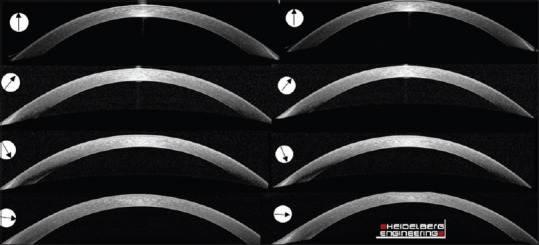
One hundred and forty-four patients were enrolled in three groups (55 normal, 45 mild KCN, and 44 moderate-to-severe KCN eyes) in this prospective diagnostic test study. Total corneal thickness was measured in 8 semi-meridians using HR SD-OCT (Heidelberg Engineering, Heidelberg, Germany) in 5 and 7 mm zones. The central corneal thickness (CCT), corneal focal thinning (minimum thickness [Min], min minus median and maximum [Min-Med, Min-Max]), and asymmetry indices (inferior minus superior [I-S] and supranasal minus infratemporal [SN-IT]) were calculated. One-way analysis of variance and the area under the receiver operating characteristic curve (AUC) were used for the analysis.
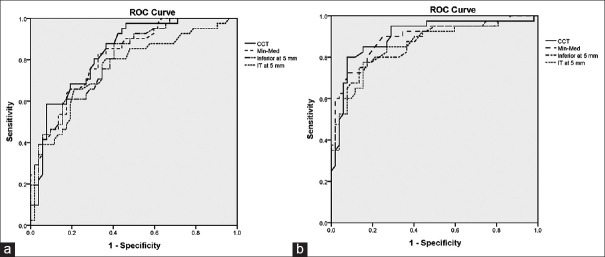
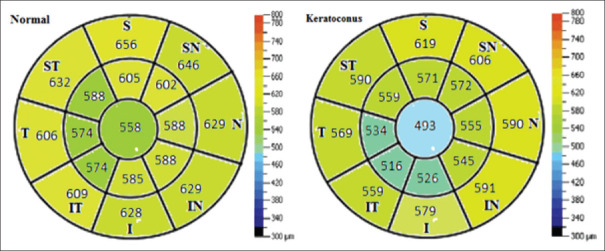
Thinner CCT, lower Min thickness, more negative Min-Max, Min-Med, and greater I-S and SN-IT were found in KCN eyes compared to the control group ( < 0.001). The inferior and IT semi-meridians were the thinnest locations in KCN cases in the 5 mm central zone ( < 0.001). CCT followed by Min-Med had the highest discriminative ability for differentiating mild KCN (AUC, sensitivity and specificity: 0.822, 87.0%, 60.37% and 0.805, 82.93%, 66.0%, respectively) and moderate-to-severe KCN (0.902, 87.82%, 73.08% and 0.892, 85.37%, and 78.85%, respectively) from normal corneas.
The inferior and IT sectors of the cornea with the largest thickness changes in the 5 mm zone are the most common thinning sites in keratoconic corneas, and CCT and Min-Med are the most sensitive indices for the diagnosis of KCN.
使用高分辨率光谱域光学相干断层扫描(HR SD-OCT)评估全角膜厚度分布模式,以区分正常眼与圆锥角膜(KCN)。
在这项前瞻性诊断试验研究中,144例患者被纳入三组(55只正常眼、45只轻度KCN眼和44只中重度KCN眼)。使用HR SD-OCT(德国海德堡海德堡工程公司)在5毫米和7毫米区域的8个半子午线上测量全角膜厚度。计算中央角膜厚度(CCT)、角膜局部变薄(最小厚度[Min]、最小厚度减去中位数和最大值[Min-Med,Min-Max])以及不对称指数(下方减去上方[I-S]和鼻上侧减去颞下侧[SN-IT])。采用单因素方差分析和受试者操作特征曲线下面积(AUC)进行分析。
与对照组相比,KCN眼中CCT更薄、Min厚度更低、Min-Max和Min-Med更负,且I-S和SN-IT更大(<0.001)。在5毫米中央区域,下方和颞下侧半子午线是KCN病例中最薄的部位(<0.001)。对于区分轻度KCN(AUC、敏感性和特异性分别为:0.822、87.0%、60.37%)和中重度KCN(0.902、87.82%、73.08%)与正常角膜,CCT其次是Min-Med具有最高的鉴别能力(分别为0.805、82.93%、66.0%和0.892、85.37%、78.85%)。
在5毫米区域厚度变化最大的角膜下方和颞下侧区域是圆锥角膜最常见的变薄部位,CCT和Min-Med是诊断KCN最敏感的指标。