Hu Ricky, Chen Ishita, Peoples Jacob, Salameh Jean-Paul, Gönen Mithat, Romesser Paul B, Simpson Amber L, Reyngold Marsha
School of Medicine, Queen's University, Kingston, ON, Canada.
Department of Radiation Oncology, Memorial Sloan Kettering Cancer Center, New York, NY, USA.
Phys Imaging Radiat Oncol. 2022 Sep 13;24:36-42. doi: 10.1016/j.phro.2022.09.004. eCollection 2022 Oct.
Prognostic assessment of local therapies for colorectal liver metastases (CLM) is essential for guiding management in radiation oncology. Computed tomography (CT) contains liver texture information which may be predictive of metastatic environments. To investigate the feasibility of analyzing CT texture, we sought to build an automated model to predict progression-free survival using CT radiomics and artificial intelligence (AI).
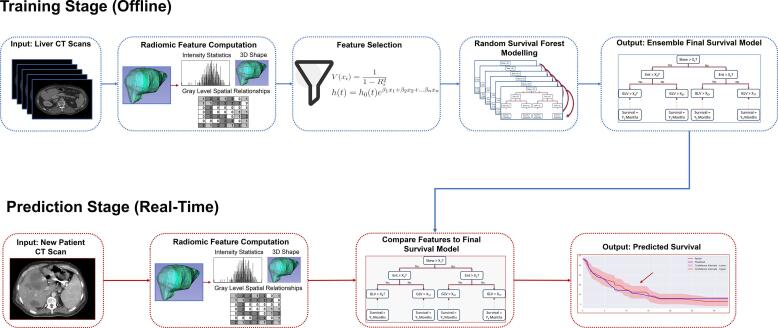
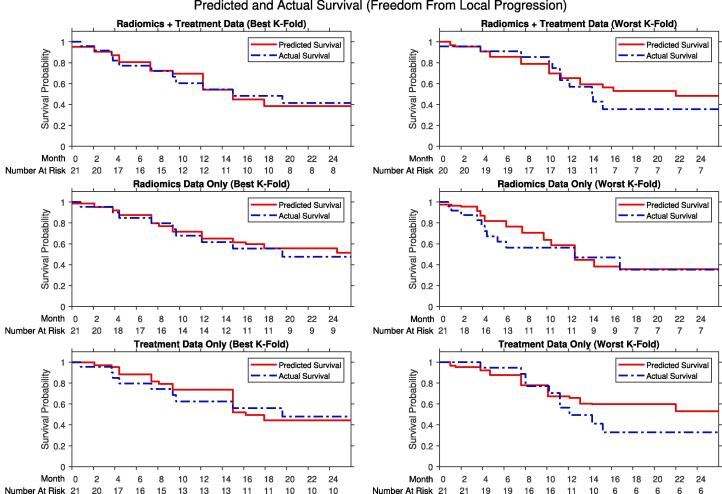
Liver CT scans and outcomes for N = 97 CLM patients treated with radiotherapy were retrospectively obtained. A survival model was built by extracting 108 radiomic features from liver and tumor CT volumes for a random survival forest (RSF) to predict local progression. Accuracies were measured by concordance indices (C-index) and integrated Brier scores (IBS) with 4-fold cross-validation. This was repeated with different liver segmentations and radiotherapy clinical variables as inputs to the RSF. Predictive features were identified by perturbation importances.
The AI radiomics model achieved a C-index of 0.68 (CI: 0.62-0.74) and IBS below 0.25 and the most predictive radiomic feature was gray tone difference matrix strength (importance: 1.90 CI: 0.93-2.86) and most predictive treatment feature was maximum dose (importance: 3.83, CI: 1.05-6.62). The clinical data only model achieved a similar C-index of 0.62 (CI: 0.56-0.69), suggesting that predictive signals exist in radiomics and clinical data.
The AI model achieved good prediction accuracy for progression-free survival of CLM, providing support that radiomics or clinical data combined with machine learning may aid prognostic assessment and management.
结直肠癌肝转移(CLM)局部治疗的预后评估对于指导放射肿瘤学的治疗管理至关重要。计算机断层扫描(CT)包含肝脏纹理信息,这可能对转移环境具有预测性。为了研究分析CT纹理的可行性,我们试图构建一个使用CT放射组学和人工智能(AI)预测无进展生存期的自动化模型。
回顾性获取了N = 97例接受放疗的CLM患者的肝脏CT扫描图像和治疗结果。通过从肝脏和肿瘤CT体积中提取108个放射组学特征,为随机生存森林(RSF)构建一个生存模型,以预测局部进展情况。通过一致性指数(C指数)和综合Brier评分(IBS)并采用4折交叉验证来测量准确性。以不同的肝脏分割和放疗临床变量作为RSF的输入重复此操作。通过扰动重要性识别预测特征。
AI放射组学模型的C指数为0.68(CI:0.62 - 0.74),IBS低于0.25,最具预测性的放射组学特征是灰度共生矩阵强度(重要性:1.90,CI:0.93 - 2.86),最具预测性的治疗特征是最大剂量(重要性:3.83,CI:1.05 - 6.62)。仅临床数据模型的C指数为0.62(CI:0.56 - 0.69),表明放射组学和临床数据中均存在预测信号。
AI模型对CLM的无进展生存期实现了良好的预测准确性,为放射组学或临床数据与机器学习相结合可能有助于预后评估和管理提供了支持。