Department of Animal Science, Robert H. Smith Faculty of Agriculture, Food, and Environment, The Hebrew University of Jerusalem, Rehovot 7610001, Israel.
Department of Animal Science, Robert H. Smith Faculty of Agriculture, Food, and Environment, The Hebrew University of Jerusalem, Rehovot 7610001, Israel.
Poult Sci. 2022 Nov;101(11):102136. doi: 10.1016/j.psj.2022.102136. Epub 2022 Aug 15.
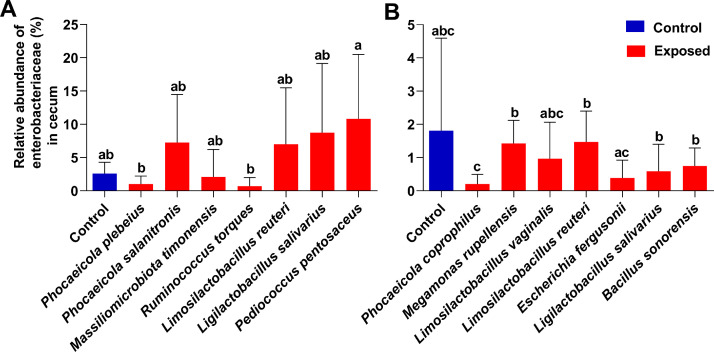
The development of probiotics for chickens is a rapidly expanding field. The main approach to probiotics is to administer the probiotic strain throughout the bird's life, usually through incorporation in the feed. However, probiotics which would utilize bacterial strains capable of permanently colonizing the gut after a single exposure are likely to have a greater impact on the developing gut community as well as on the host, would simplify probiotic use and also reduce costs in an industrial setting. Finally, very limited and conflicting information about the colonization ability of different bacterial strains has been reported. Here we report 2 colonization experiments using 14 different bacterial strains from diverse phylogenetic groups. In both experiments, groups of chicks were orally inoculated on the day of hatch with different bacterial strains that had been previously isolated from adult heavy breeders. In the first experiment, colonization of the bacterial strains in broiler chicks was determined 7 d after treatment. In the second experiment, colonization was followed in layer chicks until d 17. Ten of the bacterial strains, including Lactobacillales and Bacteroidales strains, were able to colonize chicks after a single exposure for the duration of the experiment. For a few of these strains, exposure had little effect compared to non-treated chicks due to natural background colonization. Only 4 strains failed to colonize the chicks. Moreover, it is shown that fecal samples are useful to identify and provide a dynamic view of colonization. We further analyzed the effects of artificial colonization on microbiota composition. Some of the strains used in this research were found to reduce Enterobacteriaceae family abundance, implying that they might be useful in reducing relevant pathogen levels. To conclude, our results show that the development of single exposure based probiotics is possible.
益生菌在鸡中的开发是一个快速发展的领域。益生菌的主要方法是在鸟类的一生中给予益生菌株,通常通过掺入饲料中。然而,利用能够在单次暴露后永久定植肠道的细菌菌株的益生菌,很可能对正在发育的肠道群落以及宿主产生更大的影响,将简化益生菌的使用并降低工业环境中的成本。最后,关于不同细菌菌株定植能力的信息非常有限且相互矛盾。在这里,我们报告了 2 项使用来自不同系统发育群的 14 种不同细菌菌株的定植实验。在这两个实验中,实验组雏鸡在孵化当天通过口服接种先前从成年重型饲养者中分离出的不同细菌菌株。在第一个实验中,在处理后 7 天确定肉鸡雏鸡中细菌菌株的定植情况。在第二个实验中,在层鸡中进行定植,直到第 17 天。包括乳杆菌科和拟杆菌科菌株在内的 10 种细菌菌株能够在单次暴露后定植雏鸡,持续整个实验期间。对于其中一些菌株,由于自然背景定植,暴露的效果与未处理的雏鸡相比几乎没有影响。只有 4 种菌株未能定植雏鸡。此外,研究表明粪便样本可用于识别和提供定植的动态视图。我们进一步分析了人工定植对微生物群落组成的影响。在这项研究中使用的一些菌株被发现减少肠杆菌科家族的丰度,这意味着它们可能有助于降低相关病原体的水平。总之,我们的结果表明,单次暴露的益生菌的开发是可行的。