Zheng Liyun, Yang Chun, Sheng Ruofan, Dai Yongming, Zeng Mengsu
Shanghai Institute of Medical Imaging, Shanghai, China.
Department of Radiology, Zhongshan Hospital, Fudan University, No. 180 Fenglin Road, Xuhui District, Shanghai, 20032, China.
Insights Imaging. 2022 Sep 24;13(1):155. doi: 10.1186/s13244-022-01290-9.
Recently, a whole-body 5 T MRI scanner was developed to open the door of abdominal imaging at high-field strength. This prospective study aimed to evaluate the feasibility of renal imaging at 5 T and compare the image quality, potential artifacts, and contrast ratios with 3 T.
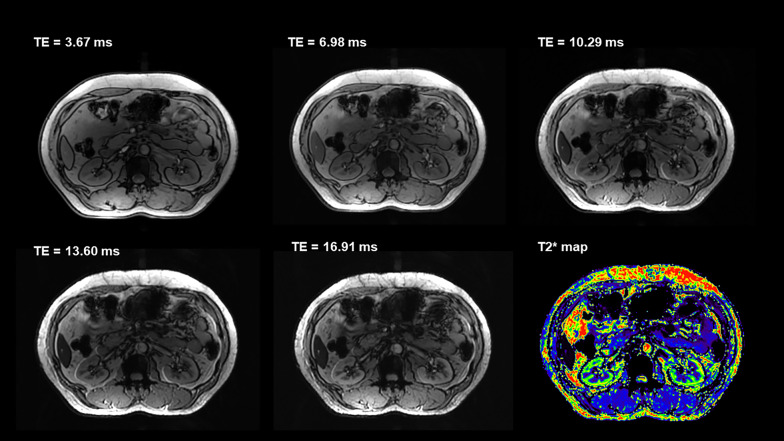
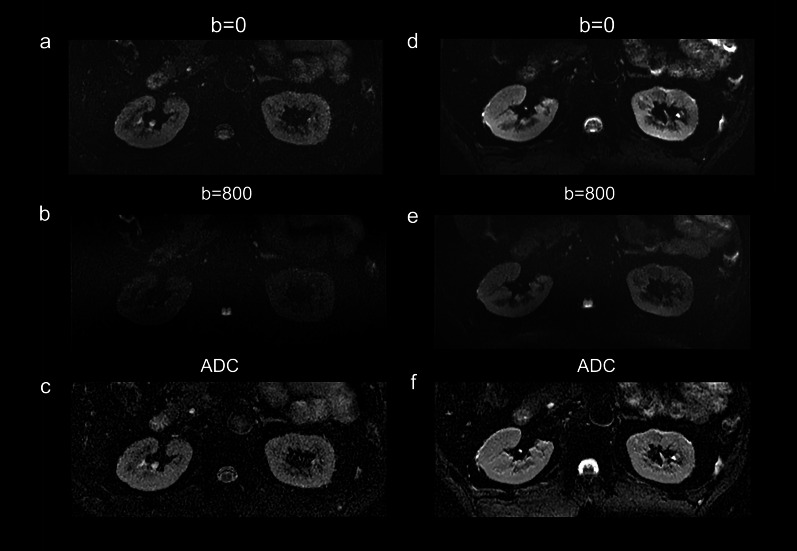
Forty healthy volunteers underwent MRI examination both at 3 T and 5 T. MRI sequences included T1-weighted gradient-echo (GRE), T2-weighted fast spin echo, diffusion-weighted imaging, and multi-echo GRE T2* mapping. Image quality and presence of artifacts were assessed for all sequences using four-point scales. For anatomical imaging, the signal-to-noise ratio (SNR) and contrast ratio (CR) of abdomen organ tissues were calculated. Besides, for functional imaging, the contrast-to-noise ratio of cortex/medulla was calculated. Wilcoxon signed rank-sum test was used to compare the visual evaluation scores and quantitative measurements between 3 and 5 T images.
Compared to 3 T examination, T1-weighted sequence at 5 T showed significantly better image quality with higher conspicuity of the renal veins and arteries, and comparable artifacts. Image quality was comparable between both field strengths on T2-weighted images, whereas a significantly higher level of artifacts was observed at 5 T. Besides, 5 T MRI contributed to higher SNR and CR for abdomen organ tissues. For functional imaging, 5 T MRI showed improved corticomedullar discrimination. There was no significant difference between apparent diffusion coefficient of renal at 3 T and 5 T, while 5 T MRI resulted in significantly shorter T2* values in both cortex and medulla.
5 T MRI provides anatomical and functional images of the kidney with sufficient image quality.
最近,一台全身5T磁共振成像(MRI)扫描仪被开发出来,开启了高场强腹部成像的大门。这项前瞻性研究旨在评估5T下肾脏成像的可行性,并将图像质量、潜在伪影以及对比率与3T进行比较。
40名健康志愿者分别接受了3T和5T的MRI检查。MRI序列包括T1加权梯度回波(GRE)、T2加权快速自旋回波、扩散加权成像以及多回波GRE T2*映射。使用四点量表对所有序列的图像质量和伪影情况进行评估。对于解剖成像,计算腹部器官组织的信噪比(SNR)和对比率(CR)。此外,对于功能成像,计算皮质/髓质的对比噪声比。采用Wilcoxon符号秩和检验来比较3T和5T图像之间的视觉评估分数和定量测量结果。
与3T检查相比,5T下的T1加权序列显示出明显更好的图像质量,肾动静脉显示更清晰,伪影情况相当。T2加权图像上两种场强的图像质量相当,但5T时观察到的伪影水平明显更高。此外,5T MRI使腹部器官组织的SNR和CR更高。对于功能成像,5T MRI显示皮质髓质分辨能力有所提高。3T和5T时肾脏的表观扩散系数之间无显著差异,但5T MRI使皮质和髓质的T2*值均显著缩短。
5T MRI能够提供具有足够图像质量的肾脏解剖和功能图像。