Yang Miaomiao, Zhong Wei, Zou Wenhui, Peng Jingzi, Tang Xiangqi
Department of Neurology, The Second Xiangya Hospital of Central South University, Changsha, China.
Department of Neurology, The First Affiliated Hospital of Shaoyang University, Shaoyang, China.
Front Neurol. 2022 Sep 8;13:913442. doi: 10.3389/fneur.2022.913442. eCollection 2022.
Hemorrhagic transformation (HT) is the most serious complication of ischemic stroke patients after intravenous thrombolysis and leads to a poor clinical prognosis. This study aimed to determine the independent predictors associated with HT in stroke patients with intravenous thrombolysis and to establish and validate a nomogram that combines with predictors to predict the probability of HT after intravenous thrombolysis in patients with ischemic stroke.
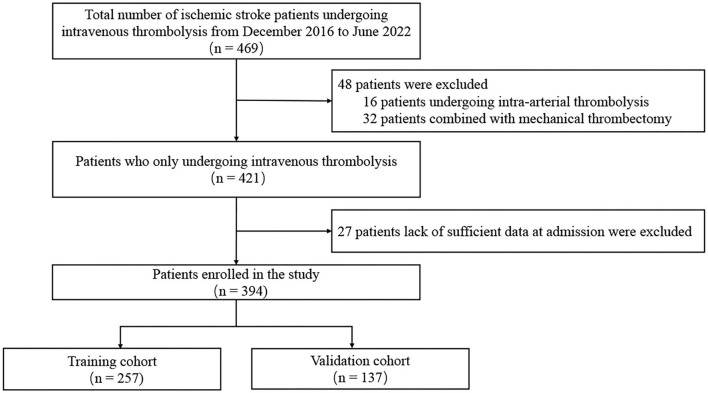
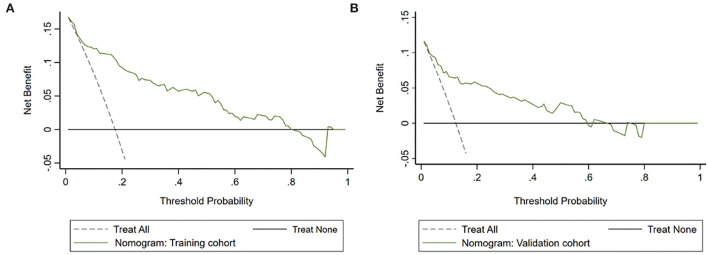
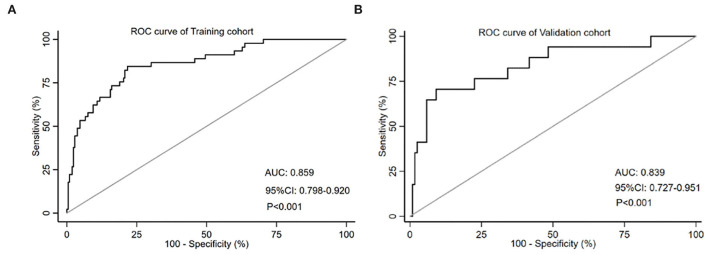
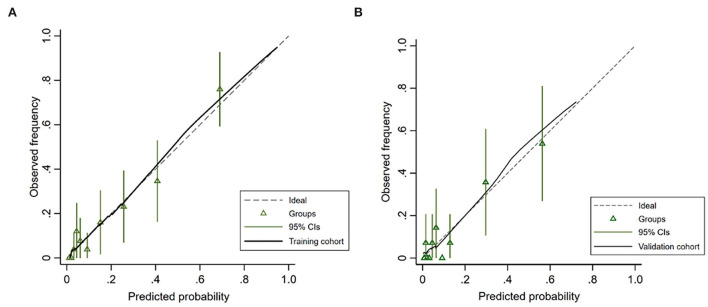
This study enrolled ischemic stroke patients with intravenous thrombolysis from December 2016 to June 2022. All the patients were divided into training and validation cohorts. The nomogram was composed of the significant predictors for HT in the training cohort as obtained by the multivariate logistic regression analysis. The area under the receiver operating characteristic curve was used to assess the discriminative performance of the nomogram. The calibration performance of the nomogram was assessed by the Hosmer-Lemeshow goodness-of-fit test and calibration plots. Decision curve analysis was used to test the clinical validity of the nomogram.
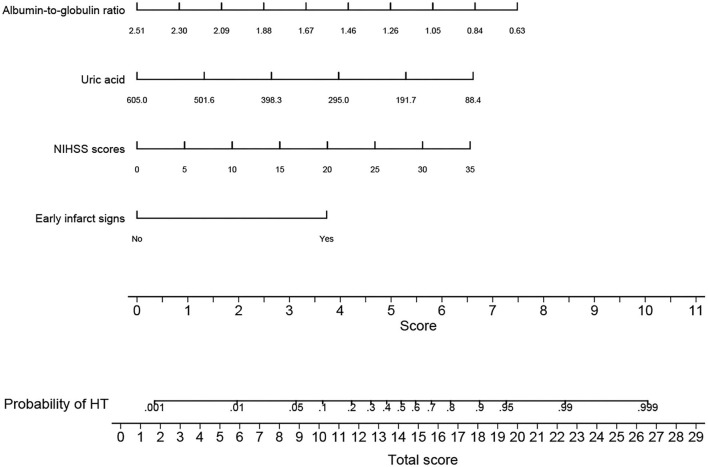
A total of 394 patients with intravenous thrombolysis were enrolled in the study. In the training cohort ( = 257), 45 patients had HT after intravenous thrombolysis. Multivariate logistic regression analysis demonstrated early infarct signs (OR, 7.954; 95% CI, 3.553-17.803; < 0.001), NIHSS scores (OR, 1.110; 95% CI, 1.054-1.168; < 0.001), uric acid (OR, 0.993; 95% CI, 0.989-0.997; = 0.001), and albumin-to-globulin ratio (OR, 0.109; 95% CI, 0.023-0.508; = 0.005) were independent predictors for HT and constructed the nomogram. In the training and validation cohorts, the AUC of the nomogram was 0.859 and 0.839, respectively. The Hosmer-Lemeshow goodness-of-fit test and calibration plot showed good concordance between predicted and observed probability in the training and validation cohorts. Decision curve analysis indicated that the nomogram was significantly useful for predicting HT in the training and further confirmed in the validation cohort.
This study proposes a novel and practical nomogram based on early infarct signs, NIHSS scores, uric acid, and albumin-to-globulin ratio that can well predict the probability of HT after intravenous thrombolysis in patients with ischemic stroke.
出血性转化(HT)是缺血性脑卒中患者静脉溶栓后最严重的并发症,会导致临床预后不良。本研究旨在确定静脉溶栓的脑卒中患者中与HT相关的独立预测因素,并建立和验证一个结合这些预测因素的列线图,以预测缺血性脑卒中患者静脉溶栓后发生HT的概率。
本研究纳入了2016年12月至2022年6月接受静脉溶栓的缺血性脑卒中患者。所有患者被分为训练队列和验证队列。列线图由多因素逻辑回归分析得出的训练队列中HT的显著预测因素组成。采用受试者工作特征曲线下面积评估列线图的辨别性能。通过Hosmer-Lemeshow拟合优度检验和校准图评估列线图的校准性能。采用决策曲线分析检验列线图的临床有效性。
本研究共纳入394例接受静脉溶栓的患者。在训练队列(n = 257)中,45例患者静脉溶栓后发生HT。多因素逻辑回归分析显示,早期梗死征象(OR,7.954;95%CI,3.553 - 17.803;P < 0.001)、美国国立卫生研究院卒中量表(NIHSS)评分(OR,1.110;95%CI,1.054 - 1.168;P < 0.001)、尿酸(OR,0.993;95%CI,0.989 - 0.997;P = 0.001)和白蛋白球蛋白比值(OR,0.109;95%CI,0.023 - 0.508;P = 0.005)是HT的独立预测因素,并据此构建了列线图。在训练队列和验证队列中,列线图的AUC分别为0.859和0.839。Hosmer-Lemeshow拟合优度检验和校准图显示训练队列和验证队列中预测概率与观察概率之间具有良好的一致性。决策曲线分析表明,列线图在训练队列中对预测HT具有显著作用,并在验证队列中得到进一步证实。
本研究提出了一种基于早期梗死征象、NIHSS评分、尿酸和白蛋白球蛋白比值的新颖实用的列线图,能够很好地预测缺血性脑卒中患者静脉溶栓后发生HT的概率。