Hou Tianfei, Chacon Aaron N, Su Wen, Katsumata Yuriko, Guo Zhenheng, Gong Ming C
Department of Physiology, College of Medicine, University of Kentucky, Lexington, KY, United States.
Department of Pharmacology and Nutritional Sciences, College of Medicine, University of Kentucky, Lexington, KY, United States.
Front Nutr. 2022 Sep 8;9:969345. doi: 10.3389/fnut.2022.969345. eCollection 2022.
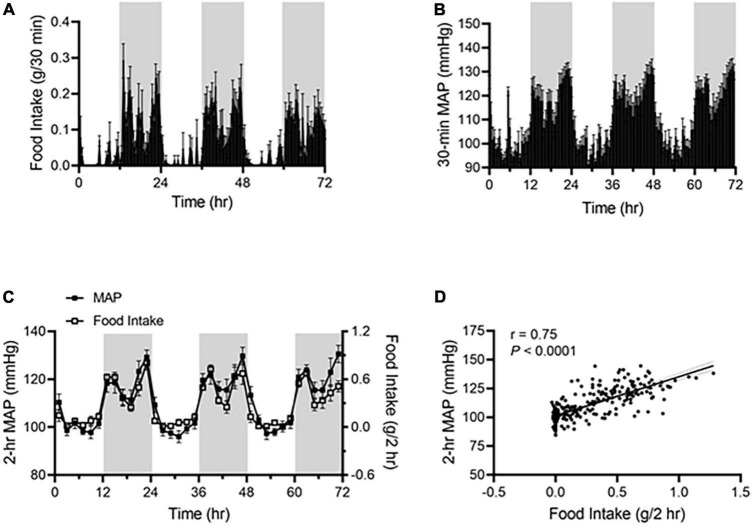
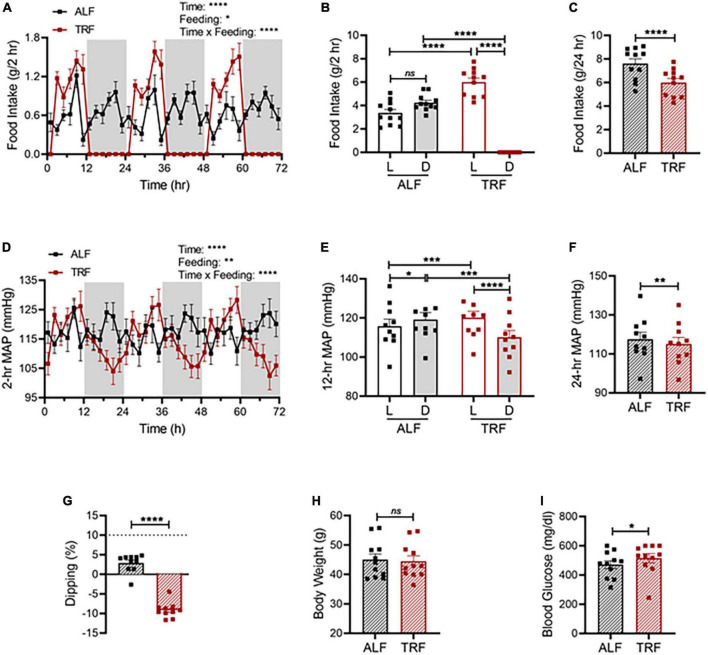
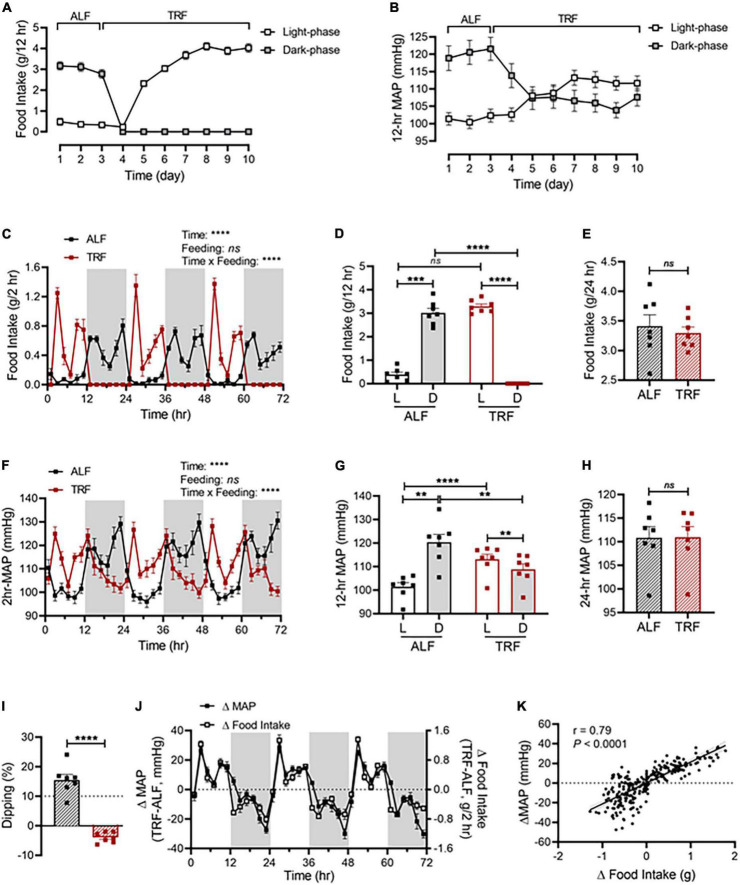
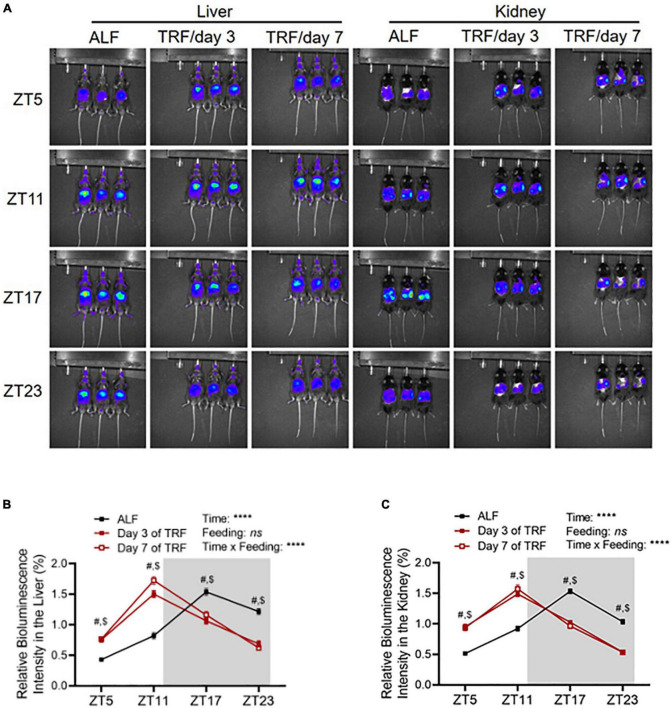
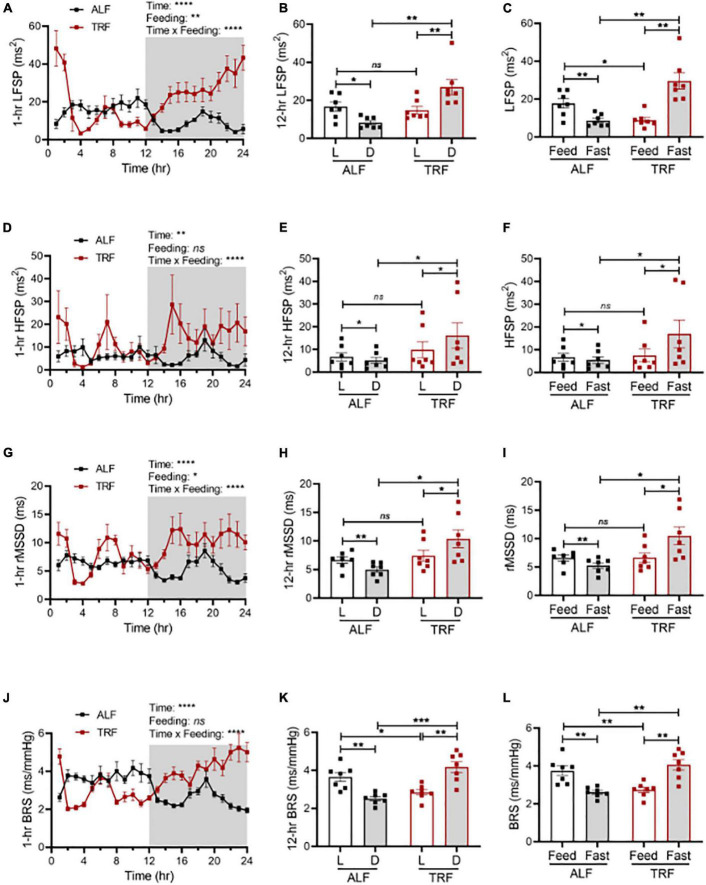
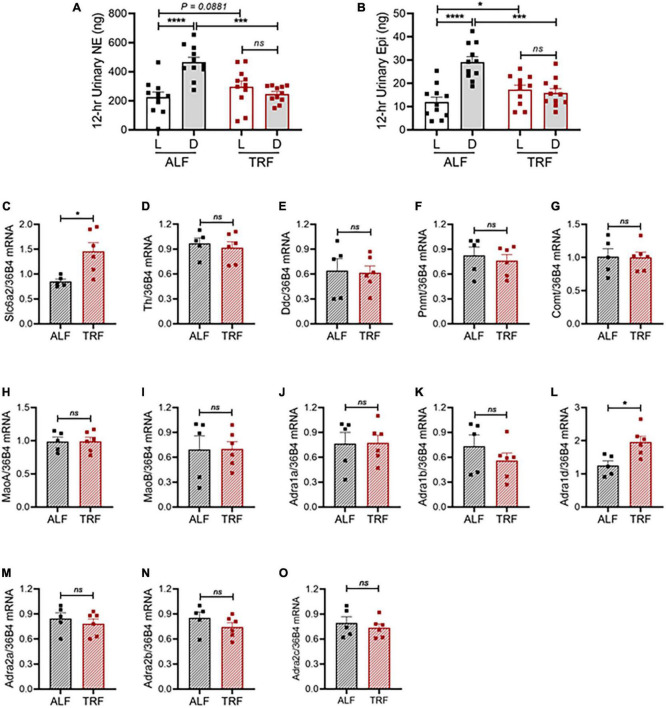
Disruption of blood pressure (BP) circadian rhythm, independent of hypertension, is emerging as an index for future target organ damage and is associated with a higher risk of cardiovascular events. Previous studies showed that changing food availability time alters BP rhythm in several mammalian species. However, the underlying mechanisms remain largely unknown. To address this, the current study specifically investigates (1) the relationship between rhythms of food intake and BP in wild-type mice; (2) effects of light-phase time-restricted feeding (TRF, food only available during light-phase) on BP circadian rhythm in wild-type and diabetic mice; (3) the roles of the autonomic system and clock gene in light-phase TRF induced changes in BP circadian rhythm. Food intake and BP of C57BL/6J and mice were simultaneously and continuously recorded using BioDAQ and telemetry systems under or light-phase TRF. Per2 protein daily oscillation was recorded by IVIS spectrum in mPer2 mice. Autonomic nerve activity was evaluated by heart rate variability, baroreflex, urinary norepinephrine (NE) and epinephrine (Epi) excretion, and mRNA expressions of catecholamines biosynthetic and catabolic enzymes, and alpha-adrenergic receptors in mesenteric resistance arteries. We found that in wild-type mice, the BP level was correlated with the food intake temporally across the 24 h. Reversing the feeding time by imposing light-phase TRF resulted in reverse or inverted BP dipping. Interestingly, the net changes in food intake were correlated with the net alteration in BP temporally under light-phase TRF. In mice, light-phase TRF worsened the existing non-dipping BP. The food intake and BP circadian rhythm changes were associated with alterations in Per2 protein daily oscillation and the time-of-day variations in heart rate variability, baroreflex, and urinary excretion of NE and Epi, and increased mRNA expression of (encoding NE transporter) and (encoding alpha-adrenergic receptor 1d) in the mesenteric resistance arteries, indicating the sympathetic nervous system (SNS) was modulated after light-phase TRF. Collectively, our results demonstrated that light-phase TRF results in reverse dipping of BP in wild-type and diabetic mice and revealed the potential role of the sympathetic pathway in light-phase TRF-induced BP circadian rhythm alteration.
血压(BP)昼夜节律的紊乱,独立于高血压之外,正逐渐成为未来靶器官损伤的一个指标,并与心血管事件的较高风险相关。先前的研究表明,改变食物供应时间会改变几种哺乳动物的血压节律。然而,其潜在机制在很大程度上仍然未知。为了解决这个问题,当前的研究专门调查了:(1)野生型小鼠食物摄入节律与血压之间的关系;(2)光期限时进食(TRF,仅在光期提供食物)对野生型和糖尿病小鼠血压昼夜节律的影响;(3)自主神经系统和时钟基因在光期TRF诱导的血压昼夜节律变化中的作用。在正常或光期TRF条件下,使用BioDAQ和遥测系统同时连续记录C57BL/6J小鼠的食物摄入量和血压。通过IVIS spectrum在mPer2小鼠中记录Per2蛋白的每日振荡。通过心率变异性、压力反射、尿去甲肾上腺素(NE)和肾上腺素(Epi)排泄以及肠系膜阻力动脉中儿茶酚胺生物合成和分解代谢酶以及α-肾上腺素能受体的mRNA表达来评估自主神经活动。我们发现,在野生型小鼠中,24小时内血压水平在时间上与食物摄入量相关。通过实施光期TRF来颠倒进食时间会导致血压下降的颠倒或反转。有趣的是,在光期TRF条件下,食物摄入量的净变化在时间上与血压的净变化相关。在糖尿病小鼠中,光期TRF使现有的血压非勺型情况恶化。食物摄入量和血压昼夜节律的变化与Per2蛋白每日振荡的改变以及心率变异性、压力反射以及NE和Epi尿排泄的昼夜变化相关,并且肠系膜阻力动脉中(编码NE转运体)和(编码α-肾上腺素能受体1d)的mRNA表达增加,表明光期TRF后交感神经系统(SNS)受到了调节。总体而言,我们的结果表明,光期TRF导致野生型和糖尿病小鼠出现血压下降的反转,并揭示了交感神经通路在光期TRF诱导的血压昼夜节律改变中的潜在作用。