Liu Lu-Yao, Xie Guo-Jun, Xing De-Feng, Liu Bing-Feng, Ding Jie, Ren Nan-Qi
State Key Laboratory of Urban Water Resource and Environment, School of Environment, Harbin Institute of Technology, Harbin, 150090, China.
Environ Sci Ecotechnol. 2020 Apr 24;2:100029. doi: 10.1016/j.ese.2020.100029. eCollection 2020 Apr.
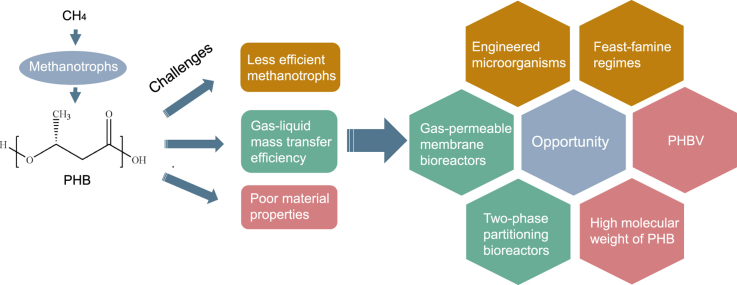
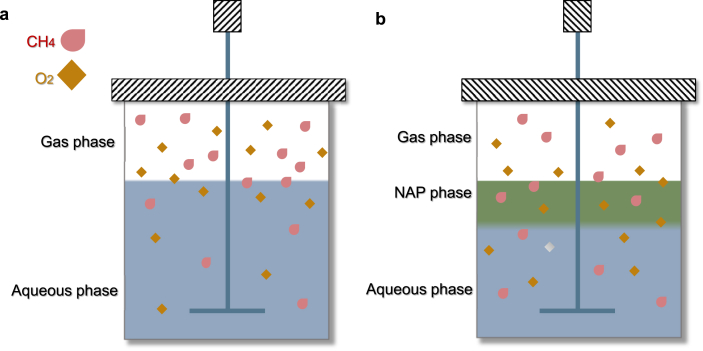
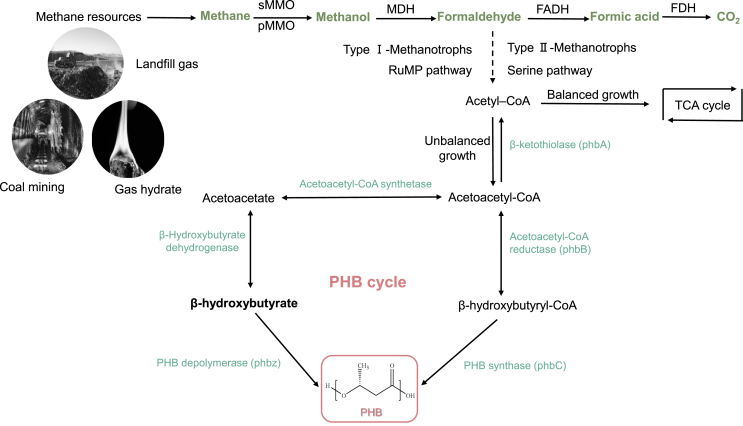
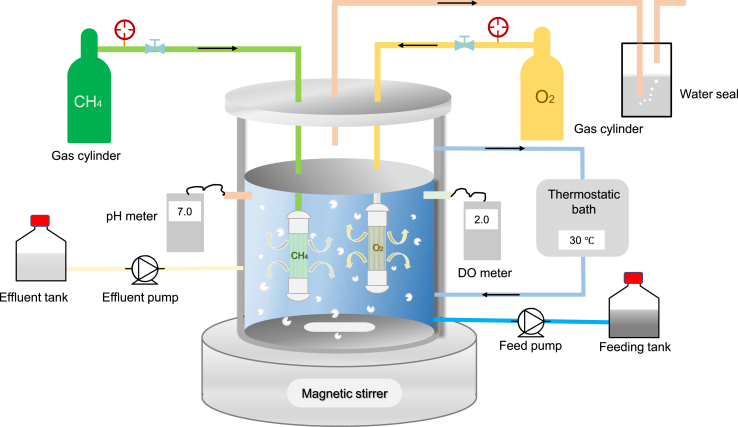
Methane emissions and plastic pollution are critical global challenges. The biological conversion of methane to poly-β-hydroxybutyrate (PHB) not only mitigates methane emissions but also provides biodegradable polymer substitutes for petroleum-based materials used in plastics production. This work provides an early overview of the methane-based PHB advances and discusses challenges and related strategies. Recent advances of PHB, including PHB biosynthetic pathways, methanotrophs, bioreactors, and the performances of PHB materials are introduced. Major challenges of methane-based PHB production are discussed in detail; these include low efficiency of methanotrophs, low gas-liquid mass transfer efficiency, and poor material properties. To overcome these limitations, various approaches are also explored, such as feast-famine regimes, engineered microorganisms, gas-permeable membrane bioreactors, two-phase partitioning bioreactors, poly-β-hydroxybutyrate--hydroxyvalerate synthesis, and molecular weight manipulation.
甲烷排放和塑料污染是全球面临的重大挑战。将甲烷生物转化为聚-β-羟基丁酸酯(PHB)不仅能减少甲烷排放,还能为塑料生产中使用的石油基材料提供可生物降解的聚合物替代品。本文对基于甲烷的PHB研究进展进行了初步概述,并讨论了面临的挑战及相关策略。介绍了PHB的最新进展,包括PHB生物合成途径、甲烷营养菌、生物反应器以及PHB材料的性能。详细讨论了基于甲烷的PHB生产面临的主要挑战,包括甲烷营养菌效率低、气液传质效率低以及材料性能差等问题。为克服这些限制,还探索了各种方法,如饥饱交替培养法、工程微生物、透气膜生物反应器、两相分配生物反应器、聚-β-羟基丁酸酯-羟基戊酸酯合成以及分子量调控等。