Merck Institute for Pharmacometrics, Lausanne, Switzerland, an affiliate of Merck KGaA, Darmstadt, Germany.
Certara, Broomfield, Colorado, USA.
Clin Transl Sci. 2022 Dec;15(12):2899-2908. doi: 10.1111/cts.13417. Epub 2022 Oct 17.
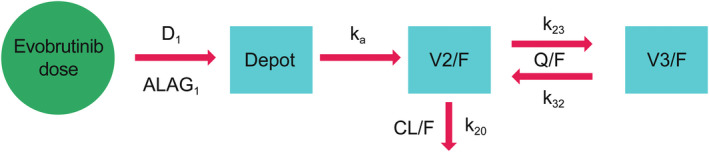
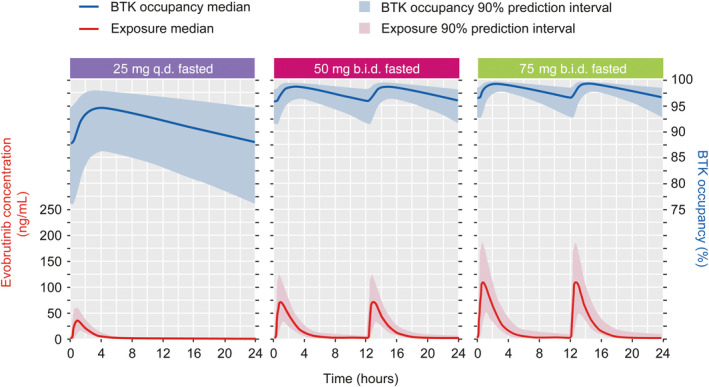
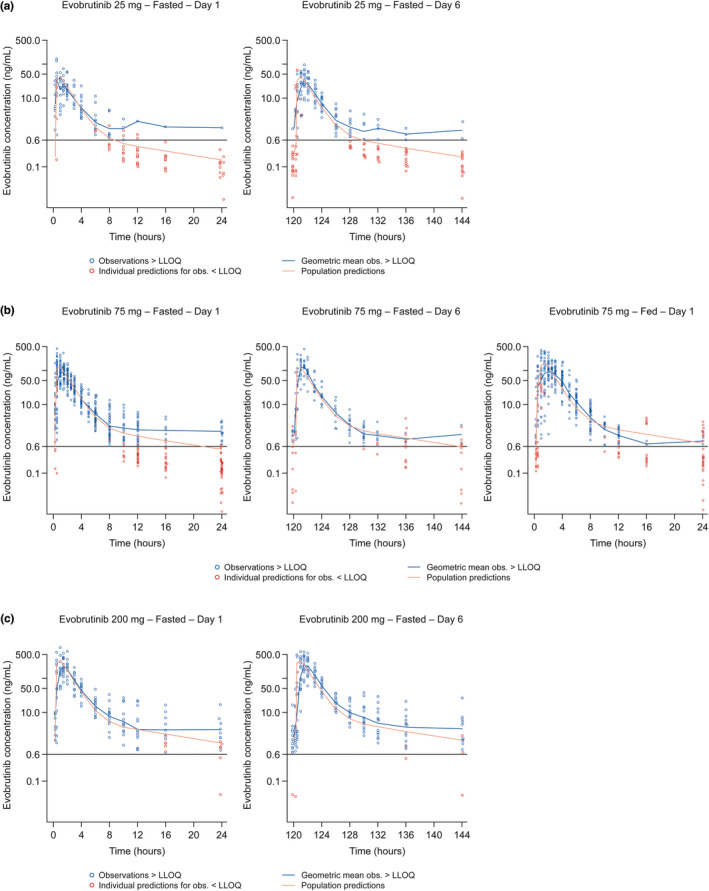
Evobrutinib, a Bruton's tyrosine kinase (BTK) inhibitor, has shown therapeutic potential in relapsing multiple sclerosis. This analysis aimed to develop pharmacokinetic (PK) and pharmacodynamic (PD; BTK occupancy [BTKO]) models of evobrutinib and simulate PK and BTKO profiles under alternative dosing regimens. Data were obtained from two phase I evobrutinib studies in healthy adult participants (Japanese and non-Japanese). Overall, 2326 observations were available from 76 participants; n = 42 from Study MS200527_0017 Part A received evobrutinib 25, 75, or 200 mg once-daily oral doses for 6 days while fasted; n = 18 from Study MS200527_0019 and n = 16 from Study MS200527_0017 Part B received single evobrutinib 75 mg oral doses with food (low-fat meal) and while fasted. Population PK/PD modeling for evobrutinib concentrations and BTKO (fraction unbound) were performed using nonlinear mixed-effects modeling. The effect of once-daily/twice-daily regimens and doses of 10-200 mg on BTKO were simulated. A two-compartment model with sequential zero-first order absorption and first-order elimination adequately described the data. Bioavailability increased by 49% with food compared with when fasted. There was no difference in PK parameters between Japanese and non-Japanese participants. The BTKO profile of evobrutinib was described by the irreversible binding population model. The simulated percentage of participants with minimum BTKO increased in a dose-dependent manner across the BTKO thresholds of interest (70%, 80%, 90%, and 95% occupancy). Evobrutinib doses of 25 mg once-daily, 50 mg twice-daily, or 75 mg twice-daily while fasted are possible choices for further development, assuming BTKO ≥70% at trough is needed to achieve efficacy.
依鲁替尼是一种布鲁顿酪氨酸激酶(BTK)抑制剂,在复发型多发性硬化症的治疗中具有潜力。本分析旨在建立依鲁替尼的药代动力学(PK)和药效动力学(PD;BTK 占有率[BTKO])模型,并模拟不同给药方案下的 PK 和 BTKO 特征。数据来自两项在健康成年参与者(日本和非日本)中进行的 I 期依鲁替尼研究。共有 76 名参与者的 2326 个观察值可用;来自研究 MS200527_0017 部分 A 的 42 名参与者每天一次口服依鲁替尼 25、75 或 200mg,连续 6 天禁食;来自研究 MS200527_0019 的 18 名参与者和研究 MS200527_0017 部分 B 的 16 名参与者每天一次口服依鲁替尼 75mg,进食(低脂餐)和禁食时。使用非线性混合效应模型对依鲁替尼浓度和 BTKO(未结合分数)进行群体 PK/PD 建模。模拟了每天一次/每天两次方案和 10-200mg 剂量对 BTKO 的影响。一个两室模型,具有顺序零一阶吸收和一阶消除,充分描述了数据。与禁食相比,进食时生物利用度增加了 49%。日本和非日本参与者的 PK 参数无差异。依鲁替尼的 BTKO 特征由不可逆结合群体模型描述。模拟的最小 BTKO 参与者百分比在与感兴趣的 BTKO 阈值(70%、80%、90%和 95%占有率)相关的剂量依赖性方式增加。假设达到疗效需要在谷值时 BTKO≥70%,那么每天一次口服 25mg、每天两次口服 50mg 或每天两次口服 75mg 依鲁替尼可能是进一步开发的选择。