Lukas Linda, Buhl Christina, Schulte-Körne Gerd, Sfärlea Anca
Department of Child and Adolescent Psychiatry, Psychosomatics and Psychotherapy, University Hospital, LMU Munich, Nussbaumstr. 5, 80336, Munich, Germany.
J Eat Disord. 2022 Sep 29;10(1):143. doi: 10.1186/s40337-022-00661-3.
Anorexia nervosa (AN) is associated with impairments in socio-emotional functioning, including difficulties in interpersonal relationships as well as alexithymia (difficulties identifying and describing one's emotions). Although the onset of the disorder is mostly in adolescence, a developmental period in which interpersonal relationships to parents as well as peers undergo major changes, only few studies have investigated the quality of interpersonal relationships in adolescent AN patients. Furthermore, the mechanisms linking poor relationship quality to eating disorder psychopathology are not yet clarified, albeit some research suggests that alexithymia might play a pivotal role. The aims of the present study were investigating the quality of interpersonal relationships to parents and peers in adolescents with AN compared to healthy adolescents as well as exploring the mediating role of alexithymia in the association between relationship quality and eating disorder symptoms.
Self-report questionnaires were used to assess relationship quality (Inventory of Parent and Peer Attachment) and alexithymia (Toronto Alexithymia Scale) in 12-18 year old female adolescents with AN (n = 35) in comparison to healthy adolescents (n = 40).
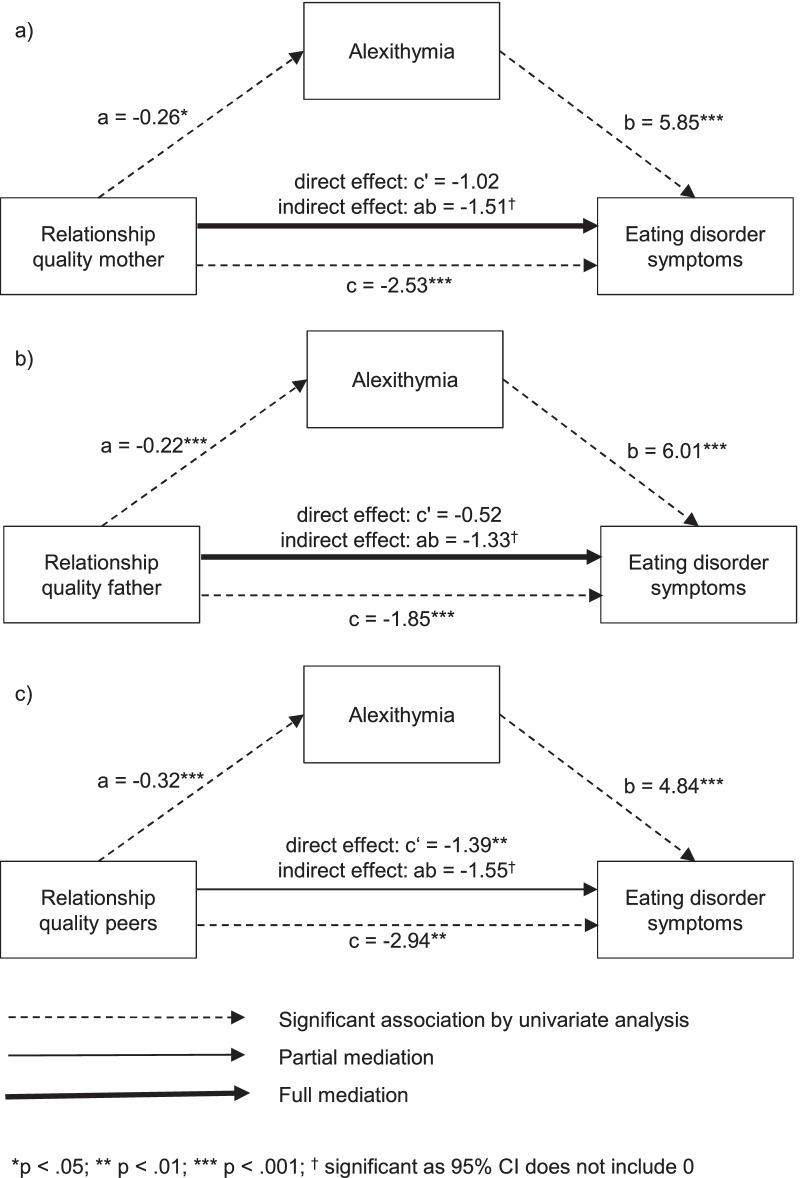
Adolescents with AN reported lower relationship quality to both of their parents and to peers compared to healthy controls. Relationship quality scores were negatively correlated to alexithymia as well as eating disorder symptoms. Alexithymia fully meditated the association between eating disorder symptoms and relationship quality to parents and partially mediated the association between eating disorder symptoms and relationship quality to peers.
The results indicate difficulties in interpersonal relationships among adolescents with AN and emphasize the role of peer relationships for adolescents' eating disorder psychopathology. Alexithymia seems to play an important role in explaining the link between quality of relationships and eating disorder psychopathology. Results suggest that treatment should not only focus on family relationships but also address relationships to peers as well as adolescents' competence in identifying and dealing with their emotions.
神经性厌食症(AN)与社会情感功能障碍有关,包括人际关系困难以及述情障碍(难以识别和描述自己的情绪)。尽管该疾病大多在青春期发病,而这一发育阶段与父母及同伴的人际关系会发生重大变化,但仅有少数研究调查了青少年神经性厌食症患者的人际关系质量。此外,尽管一些研究表明述情障碍可能起关键作用,但人际关系质量差与饮食失调心理病理学之间的关联机制尚未阐明。本研究的目的是调查与健康青少年相比,青少年神经性厌食症患者与父母及同伴的人际关系质量,以及探讨述情障碍在人际关系质量与饮食失调症状之间的关联中所起的中介作用。
使用自我报告问卷评估12至18岁患有神经性厌食症的女性青少年(n = 35)与健康青少年(n = 40)的人际关系质量(父母与同伴依恋量表)和述情障碍(多伦多述情障碍量表)。
与健康对照组相比,患有神经性厌食症的青少年报告其与父母及同伴的关系质量较低。人际关系质量得分与述情障碍以及饮食失调症状呈负相关。述情障碍完全中介了饮食失调症状与与父母的关系质量之间的关联,部分中介了饮食失调症状与与同伴的关系质量之间的关联。
结果表明青少年神经性厌食症患者存在人际关系困难,并强调同伴关系在青少年饮食失调心理病理学中的作用。述情障碍似乎在解释人际关系质量与饮食失调心理病理学之间的联系方面起着重要作用。结果表明,治疗不仅应关注家庭关系,还应处理与同伴的关系以及青少年识别和处理自己情绪的能力。