Qu Xiujuan, Li Lexuan, Zhou Xiaohan, Dong Qi, Liu Hanli, Liu Hesheng, Yang Qin, Han Ying, Niu Haijing
Beijing Normal University, IDG/McGovern Institute for Brain Research, State Key Laboratory of Cognitive Neuroscience and Learning, Beijing, China.
University of Texas at Arlington, Department of Bioengineering, Arlington, Texas, United States.
Neurophotonics. 2022 Jul;9(3):035005. doi: 10.1117/1.NPh.9.3.035005. Epub 2022 Sep 27.
Decline in cognitive ability is a significant issue associated with healthy aging. Transcranial photobiomodulation (tPBM) is an emerging non-invasive neuromodulation technique and has shown promise to overcome this challenge.
This study aimed to investigate the effects of seven-day repeated tPBM, compared to those of single tPBM and baseline, on improving -back working memory in healthy older adults and to evaluate the persistent efficacy of repeated tPBM.
In a sham-controlled and within-subject design, 61 healthy older adults were recruited to participate in a longitudinal study involving an experimental baseline, seven days of tPBM treatment (12 min daily, 1064-nm laser, ) in the left dorsolateral prefrontal cortex and three weeks of follow-ups. Behavioral performance in the -back ( ) was recorded poststimulation during the baseline, the first and seventh days of the tPBM session, and the three weekly follow-ups. A control group with 25 participants was included in this study to rule out the practice and placebo effects. The accuracy rate and response time were used in the statistical analysis.
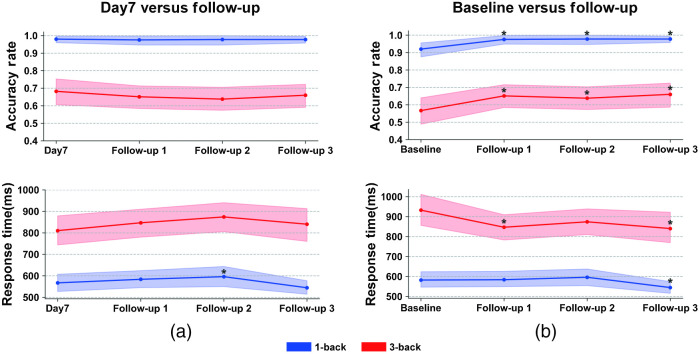
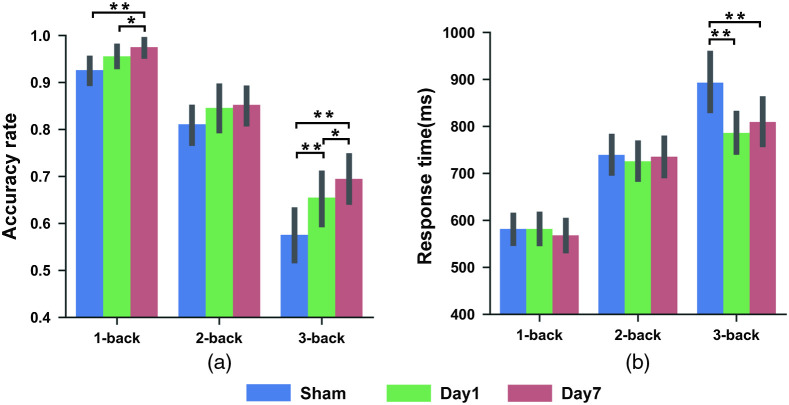
Repeated and single tPBM significantly improved accuracy rate in 1- and 3-back tasks and decreased response time in 3-back compared to the baseline. Moreover, the repeated tPBM resulted in a significantly higher improvement in accuracy rate than the single tPBM. These improvements in accuracy rate and response time lasted at least three weeks following repeated tPBM. In contrast, the control group showed no significant improvement in behavioral performance.
This study demonstrated that seven-day repeated tPBM improved the working memory of healthy older adults more efficiently, with the beneficial effect lasting at least three weeks. These findings provide fundamental evidence that repeated tPBM may be a potential intervention for older individuals with memory decline.
认知能力下降是与健康衰老相关的一个重要问题。经颅光生物调节(tPBM)是一种新兴的非侵入性神经调节技术,已显示出克服这一挑战的潜力。
本研究旨在调查与单次tPBM和基线相比,为期七天的重复tPBM对改善健康老年人回溯工作记忆的影响,并评估重复tPBM的持续疗效。
在一项假对照的受试者内设计中,招募了61名健康老年人参与一项纵向研究,该研究包括实验基线、在左侧背外侧前额叶皮层进行七天的tPBM治疗(每天12分钟,1064纳米激光)以及三周的随访。在基线、tPBM治疗的第一天和第七天以及每周的三次随访期间,在刺激后记录回溯任务中的行为表现。本研究纳入了一个由25名参与者组成的对照组,以排除练习和安慰剂效应。统计分析中使用了准确率和反应时间。
与基线相比,重复和单次tPBM均显著提高了1-back和3-back任务的准确率,并缩短了3-back任务的反应时间。此外,重复tPBM在准确率上的提高显著高于单次tPBM。重复tPBM后,这些准确率和反应时间的改善至少持续了三周。相比之下,对照组的行为表现没有显著改善。
本研究表明,为期七天的重复tPBM能更有效地改善健康老年人的工作记忆,且有益效果至少持续三周。这些发现提供了基本证据,表明重复tPBM可能是对记忆衰退老年人的一种潜在干预措施。