Chaudhari Akhil, Wang Xinlong, Wu Anqi, Liu Hanli
Department of Bioengineering, University of Texas at Arlington, 500 UTA Blvd, Arlington, TX 76019, USA.
Bioengineering (Basel). 2023 Sep 5;10(9):1043. doi: 10.3390/bioengineering10091043.
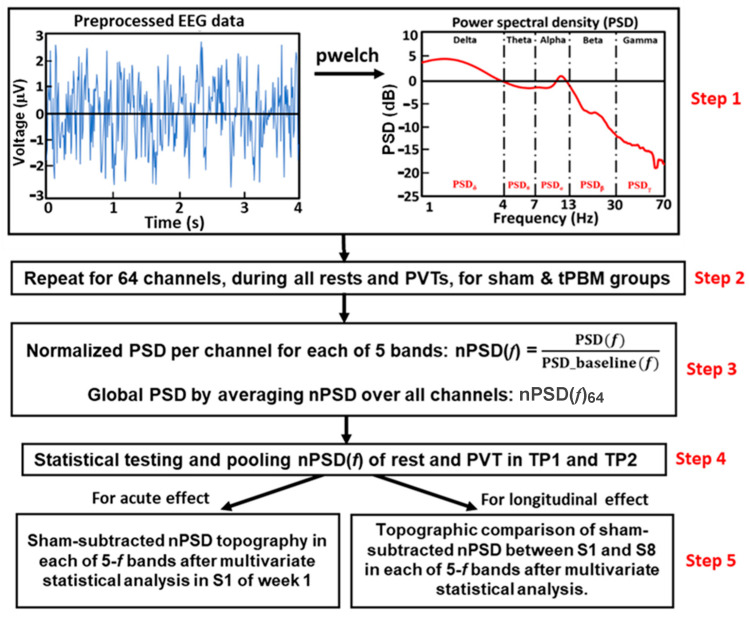
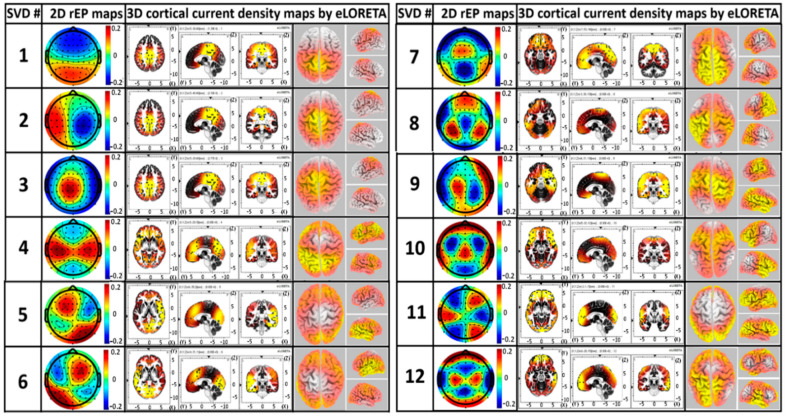
Transcranial photobiomodulation (tPBM) has been suggested as a non-invasive neuromodulation tool. The repetitive administration of light-emitting diode (LED)-based tPBM for several weeks significantly improves human cognition. To understand the electrophysiological effects of LED-tPBM on the human brain, we investigated alterations by repeated tPBM in vigilance performance and brain networks using electroencephalography (EEG) in healthy participants. Active and sham LED-based tPBM were administered to the right forehead of young participants twice a week for four weeks. The participants performed a psychomotor vigilance task (PVT) during each tPBM/sham experiment. A 64-electrode EEG system recorded electrophysiological signals from each participant during the first and last visits in a 4-week study. Topographical maps of the EEG power enhanced by tPBM were statistically compared for the repeated tPBM effect. A new data processing framework combining the group's singular value decomposition (gSVD) with eLORETA was implemented to identify EEG brain networks. The reaction time of the PVT in the tPBM-treated group was significantly improved over four weeks compared to that in the sham group. We observed acute increases in EEG delta and alpha powers during a 10 min LED-tPBM while the participants performed the PVT task. We also found that the theta, beta, and gamma EEG powers significantly increased overall after four weeks of LED-tPBM. Combining gSVD with eLORETA enabled us to identify EEG brain networks and the corresponding network power changes by repeated 4-week tPBM. This study clearly demonstrated that a 4-week prefrontal LED-tPBM can neuromodulate several key EEG networks, implying a possible causal effect between modulated brain networks and improved psychomotor vigilance outcomes.
经颅光生物调节(tPBM)已被提议作为一种非侵入性神经调节工具。基于发光二极管(LED)的tPBM连续数周重复给药可显著改善人类认知。为了解LED-tPBM对人脑的电生理影响,我们使用脑电图(EEG)研究了健康参与者重复进行tPBM后警觉性能和脑网络的变化。对年轻参与者的右前额每周进行两次主动和假的基于LED的tPBM,持续四周。在每次tPBM/假实验期间,参与者执行一项心理运动警觉任务(PVT)。在一项为期4周的研究中,一个64电极EEG系统在首次和最后一次访视期间记录了每个参与者的电生理信号。对tPBM增强的EEG功率地形图进行统计学比较,以分析重复tPBM的效果。实施了一种将组奇异值分解(gSVD)与eLORETA相结合的新数据处理框架,以识别EEG脑网络。与假手术组相比,tPBM治疗组的PVT反应时间在四周内显著改善。我们观察到,在参与者执行PVT任务时,10分钟的LED-tPBM期间EEG的δ波和α波功率急剧增加。我们还发现,LED-tPBM四周后,θ波、β波和γ波的EEG功率总体上显著增加。将gSVD与eLORETA相结合,使我们能够通过重复4周的tPBM识别EEG脑网络以及相应的网络功率变化。这项研究清楚地表明,为期4周的前额叶LED-tPBM可以对几个关键的EEG网络进行神经调节,这意味着调节后的脑网络与改善的心理运动警觉结果之间可能存在因果关系。