School of Biological Sciences, University of Auckland, Private Bag 92019, Auckland, 1142, New Zealand.
Yale University, Department of Molecular, Cellular and Developmental Biology, Faculty of Arts and Sciences, 260 Whitney Avenue, New Haven, CT, 06511, USA.
Plant J. 2022 Nov;112(4):1029-1050. doi: 10.1111/tpj.15994. Epub 2022 Oct 17.
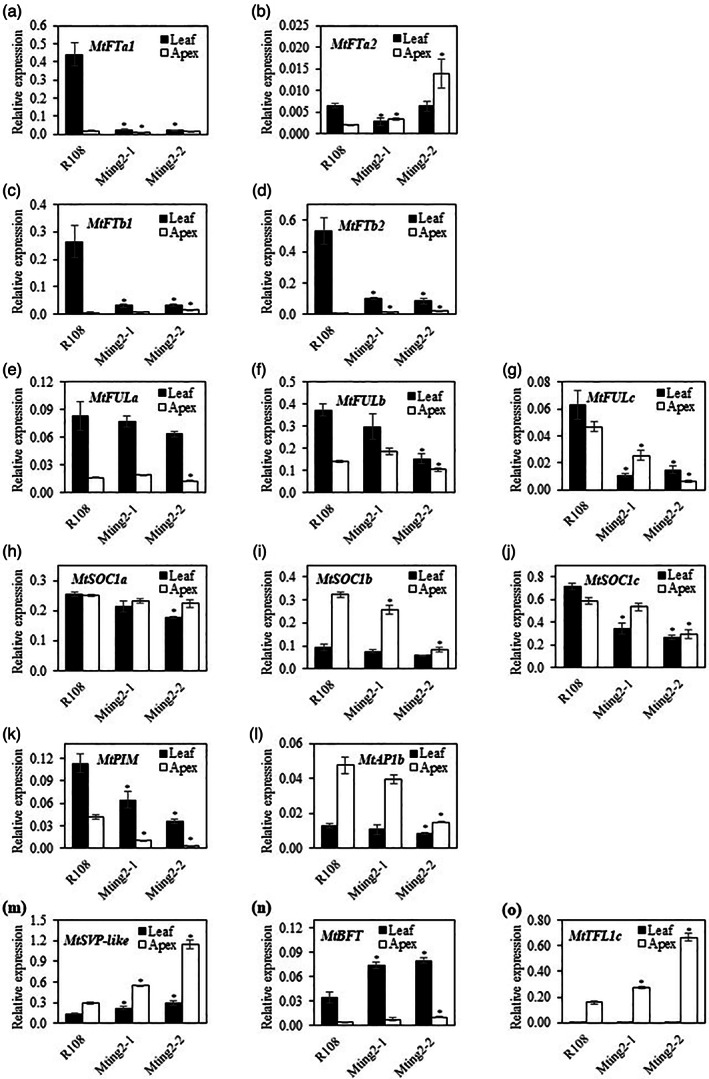
Flowering of the reference legume Medicago truncatula is promoted by winter cold (vernalization) followed by long-day photoperiods (VLD) similar to winter annual Arabidopsis. However, Medicago lacks FLC and CO, key regulators of Arabidopsis VLD flowering. Most plants have two INHIBITOR OF GROWTH (ING) genes (ING1 and ING2), encoding proteins with an ING domain with two anti-parallel alpha-helices and a plant homeodomain (PHD) finger, but their genetic role has not been previously described. In Medicago, Mting1 gene-edited mutants developed and flowered normally, but an Mting2-1 Tnt1 insertion mutant and gene-edited Mting2 mutants had developmental abnormalities including delayed flowering particularly in VLD, compact architecture, abnormal leaves with extra leaflets but no trichomes, and smaller seeds and barrels. Mting2 mutants had reduced expression of activators of flowering, including the FT-like gene MtFTa1, and increased expression of the candidate repressor MtTFL1c, consistent with the delayed flowering of the mutant. MtING2 overexpression complemented Mting2-1, but did not accelerate flowering in wild type. The MtING2 PHD finger bound H3K4me2/3 peptides weakly in vitro, but analysis of gene-edited mutants indicated that it was dispensable to MtING2 function in wild-type plants. RNA sequencing experiments indicated that >7000 genes are mis-expressed in the Mting2-1 mutant, consistent with its strong mutant phenotypes. Interestingly, ChIP-seq analysis identified >5000 novel H3K4me3 locations in the genome of Mting2-1 mutants compared to wild type R108. Overall, our mutant study has uncovered an important physiological role of a plant ING2 gene in development, flowering, and gene expression, which likely involves an epigenetic mechanism.
模式豆科植物蒺藜苜蓿的开花受到冬季寒冷(春化)的促进,随后是长日照光周期(VLD),类似于冬季一年生拟南芥。然而,蒺藜苜蓿缺乏 FLC 和 CO,这是拟南芥 VLD 开花的关键调节因子。大多数植物有两个 INHIBITOR OF GROWTH (ING) 基因(ING1 和 ING2),它们编码具有 ING 结构域的蛋白质,该结构域具有两个反平行的α-螺旋和一个植物同源结构域(PHD)指,但其遗传作用尚未得到描述。在蒺藜苜蓿中,Mting1 基因编辑突变体发育并正常开花,但 Mting2-1 Tnt1 插入突变体和基因编辑 Mting2 突变体发育异常,包括开花延迟,特别是在 VLD 中,紧凑的结构,异常的叶子有额外的小叶但没有毛状体,以及更小的种子和桶。Mting2 突变体中包括 FT 样基因 MtFTa1 在内的开花激活因子的表达减少,候选抑制剂 MtTFL1c 的表达增加,与突变体的开花延迟一致。MtING2 过表达互补了 Mting2-1,但在野生型中并没有加速开花。MtING2 PHD 指在体外弱结合 H3K4me2/3 肽,但对基因编辑突变体的分析表明,它在野生型植物中对 MtING2 功能是可有可无的。RNA 测序实验表明,Mting2-1 突变体中有超过 7000 个基因表达错误,与强烈的突变表型一致。有趣的是,与野生型 R108 相比,ChIP-seq 分析在 Mting2-1 突变体的基因组中鉴定出超过 5000 个新的 H3K4me3 位置。总的来说,我们的突变体研究揭示了植物 ING2 基因在发育、开花和基因表达方面的重要生理作用,这可能涉及到一个表观遗传机制。