Department of Biology, University of York, Heslington, York, UK.
York Biomedical Research Institute, University of York, Heslington, York, UK.
J Physiol. 2023 May;601(9):1543-1553. doi: 10.1113/JP282306. Epub 2022 Oct 21.
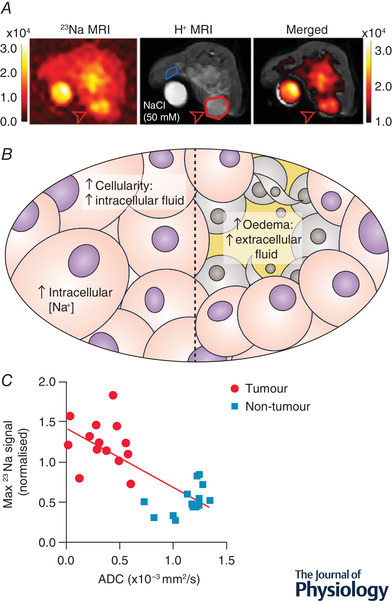
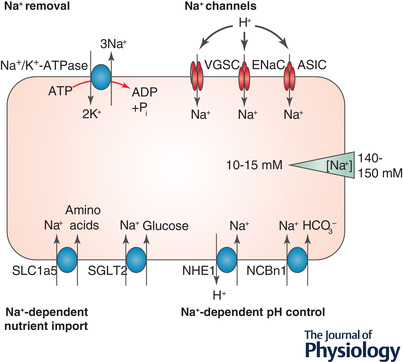
Cancers of epithelial origin such as breast, prostate, cervical, gastric, colon and lung cancer account for a large proportion of deaths worldwide. Better treatment of metastasis, the main cause of cancer deaths, is therefore urgently required. Several of these tumours have been shown to have an abnormally high concentration of Na ([Na ]) and emerging evidence points to this accumulation being due to elevated intracellular [Na ]. This poses intriguing questions about the cellular mechanisms underlying Na dysregulation in cancer, and its pathophysiological significance. Elevated intracellular [Na ] may be due to alterations in activity of the Na /K -ATPase, and/or increased influx via Na channels and Na -linked transporters. Maintenance of the electrochemical Na gradient across the plasma membrane is vital to power many cellular processes that are highly active in cancer cells, including glucose and glutamine import. Na channels are also upregulated in cancer cells, which in turn promotes tumour growth and metastasis. For example, ENaC and ASICs are overexpressed in cancers, increasing invasion and proliferation. In addition, voltage-gated Na channels are also upregulated in a range of tumour types, where they promote metastatic cell behaviours via various mechanisms, including membrane potential depolarisation and altered pH regulation. Together, recent findings relating to elevated Na in the tumour microenvironment and how this may be regulated by several classes of Na channels provide a link between altered Na handling and poor clinical outcome. There are new opportunities to leverage this altered Na microenvironment for therapeutic benefit, as exemplified by several ongoing clinical trials.
上皮来源的癌症,如乳腺癌、前列腺癌、宫颈癌、胃癌、结肠癌和肺癌,在全球死亡病例中占很大比例。因此,迫切需要更好地治疗转移,这是癌症死亡的主要原因。有证据表明,其中一些肿瘤的 Na([Na+])浓度异常升高,这表明这种积累是由于细胞内[Na+]升高所致。这引发了关于癌症中 Na 失调的细胞机制及其病理生理意义的有趣问题。细胞内[Na+]的升高可能是由于 Na+/K+-ATP 酶活性的改变,以及/或通过 Na 通道和 Na 依赖性转运体的增加内流所致。维持质膜两侧电化学 Na 梯度对许多在癌细胞中高度活跃的细胞过程至关重要,包括葡萄糖和谷氨酰胺的摄取。Na 通道在癌细胞中也上调,这反过来又促进了肿瘤的生长和转移。例如,ENaC 和 ASICs 在癌症中过度表达,增加了侵袭和增殖。此外,电压门控 Na 通道在多种肿瘤类型中也上调,通过各种机制促进转移性细胞行为,包括膜电位去极化和 pH 调节改变。总之,最近发现肿瘤微环境中 Na 升高,以及几种 Na 通道可能调节这种升高,为改变的 Na 处理与不良临床结局之间的联系提供了证据。利用这种改变的 Na 微环境来获得治疗益处的新机会正在出现,一些正在进行的临床试验就是例证。