Caumo Sofia, Lázaro Wilkinson L, Sobreira Oliveira Ernandes, Beringui Karmel, Gioda Adriana, Massone Carlos German, Carreira Renato, de Freitas Djair Sergio, Ignacio Aurea R A, Hacon Sandra
National School of Public Health, Oswaldo Cruz Foundation, Rio de Janeiro, RJ Brazil.
Brazilian Research Network on Global Climate Change - Rede Clima, Rio de Janeiro, Brazil.
Air Qual Atmos Health. 2022;15(12):2239-2254. doi: 10.1007/s11869-022-01248-2. Epub 2022 Sep 28.
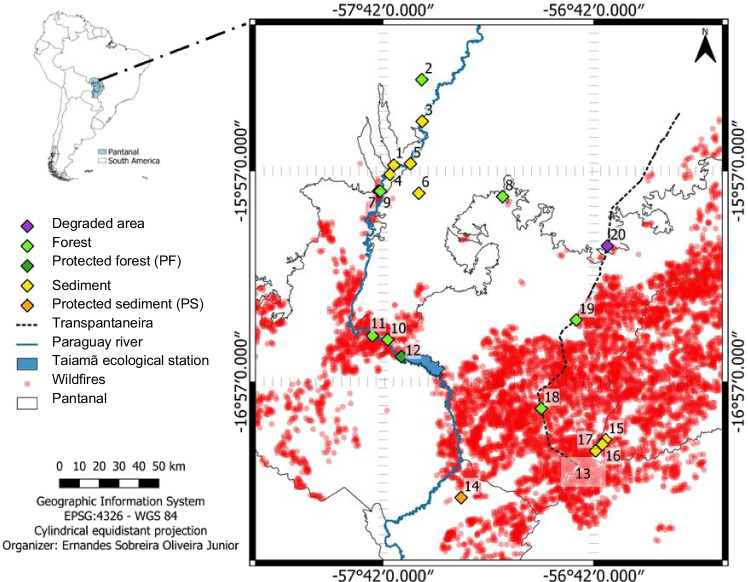
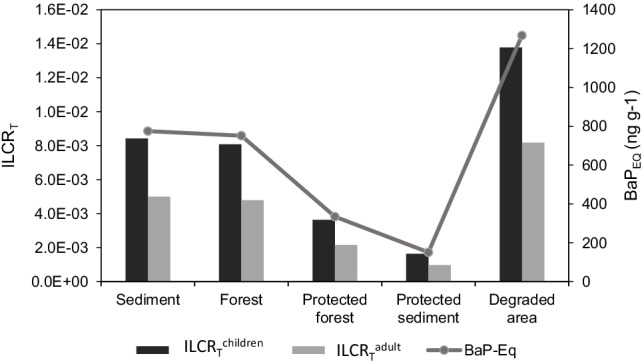
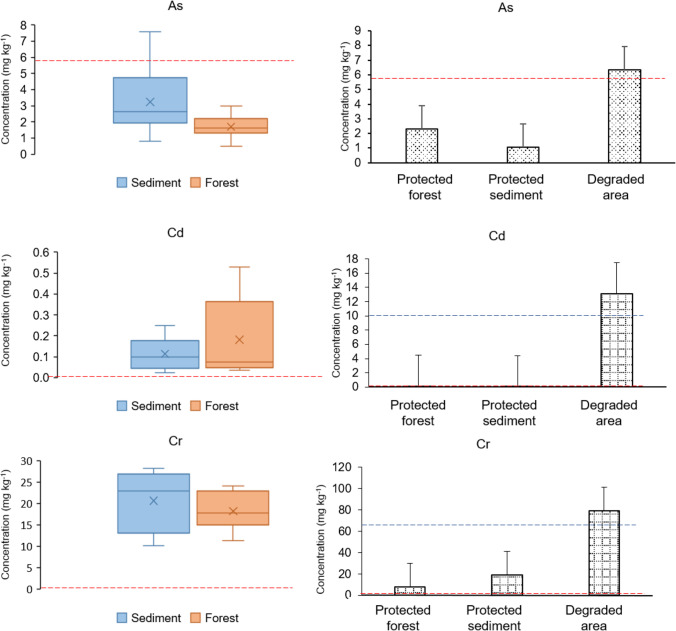
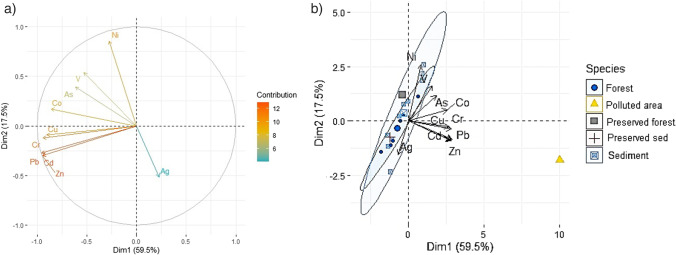
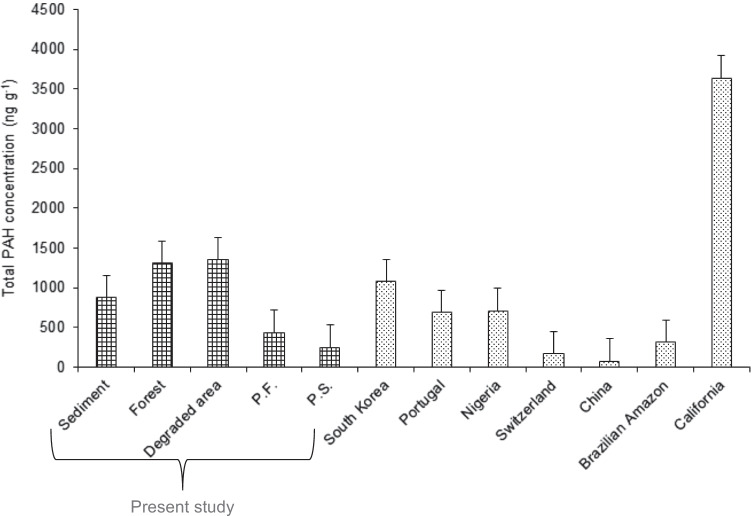
Wildfires have increased in the last years and, when caused by intentional illegal burnings, are frequently run out of control. Wildfire has been pointed out as an important source of polycyclic aromatic hydrocarbons (PAHs) and trace elements (TEs) - such as, As, Ni, and Pb - to environmental compartments, and thus may pose a risk to human health and to the ecosystem. In 2020, the Brazilian biome, Pantanal, faced the largest losses by wildfires in the last 22 years. Ashes from the topsoil layer in Pantanal were collected after these wildfires at 20 sites divided into the sediment, forest, PF, PS, and degraded sites. Toxicity and associated risks for human health were also evaluated. The areas highly impacted by wildfires and by artisanal gold mining activities showed higher concentrations for TEs and PAHs than the protected areas. Pb varied from 8 ± 4 to 224 ± 81 mg kg, and total PAH concentration ranged between 880 ± 314 and 1350 ± 70 ng g, at sites impacted by anthropogenic activities. Moreover, health risk assessments for TE and PAH indicated a potentially great risk for children and adults, via ingestion, inhalation, and dermal pathway. The carcinogenic risks exceeded reference values, for both TE and PAH, suggesting harmful conditions, especially for vulnerable groups, such as children and the elderly.
The online version contains supplementary material available at 10.1007/s11869-022-01248-2.
近年来野火有所增加,当由故意非法焚烧引起时,往往会失控。野火已被指出是多环芳烃(PAHs)和微量元素(TEs)——如砷、镍和铅——进入环境介质的重要来源,因此可能对人类健康和生态系统构成风险。2020年,巴西的潘塔纳尔生物群落遭受了过去22年来最严重的野火损失。在这些野火之后,在潘塔纳尔的20个地点采集了表层土壤层的灰烬,这些地点分为沉积物、森林、PF、PS和退化地点。还评估了对人类健康的毒性和相关风险。受野火和手工采金活动影响严重的地区,其TEs和PAHs的浓度高于保护区。在受人为活动影响的地点,铅含量在8±4至224±81毫克/千克之间,总PAH浓度在880±314至1350±70纳克/克之间。此外,对TE和PAH的健康风险评估表明,通过摄入、吸入和皮肤接触途径,儿童和成人面临潜在的巨大风险。TE和PAH的致癌风险均超过参考值,表明存在有害状况,尤其是对儿童和老年人等弱势群体。
在线版本包含可在10.1007/s11869-022-01248-2获取的补充材料。