Wang Jiatian, Fan Peiyang, Wei Yong, Wang Jiaqi, Zou Weihao, Zhou Guofa, Zhong Daibin, Zheng Xueli
Department of Pathogen Biology, School of Public Health, Southern Medical University, Guangzhou, China.
Program in Public Health, College of Health Sciences, University of California, Irvine, Irvine, CA, United States.
Front Microbiol. 2022 Sep 14;13:990978. doi: 10.3389/fmicb.2022.990978. eCollection 2022.
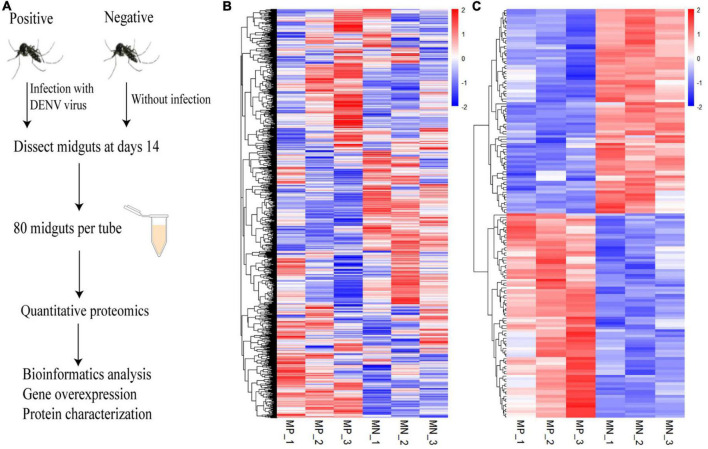
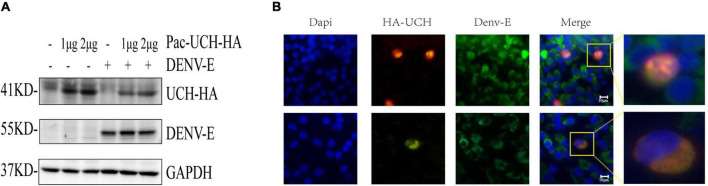
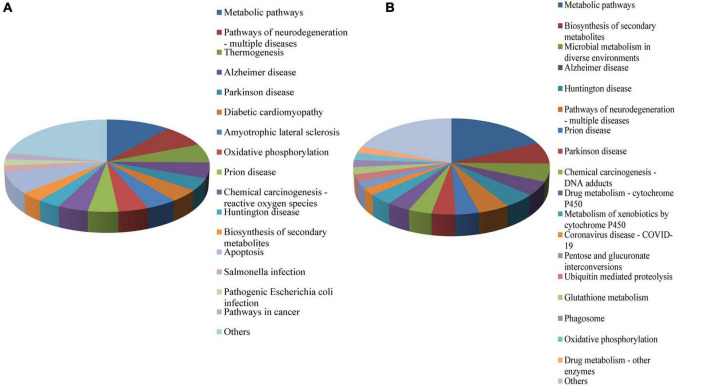
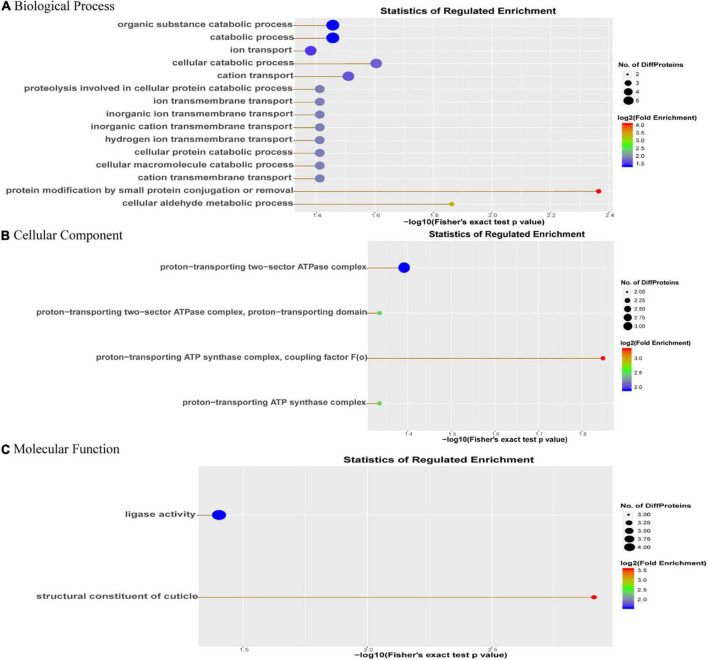
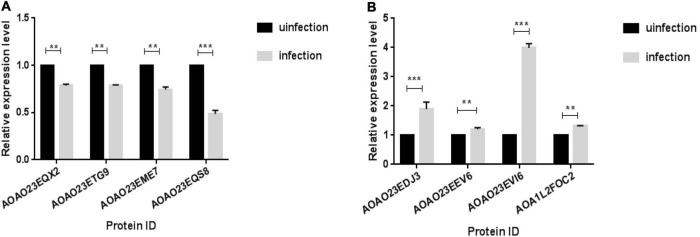
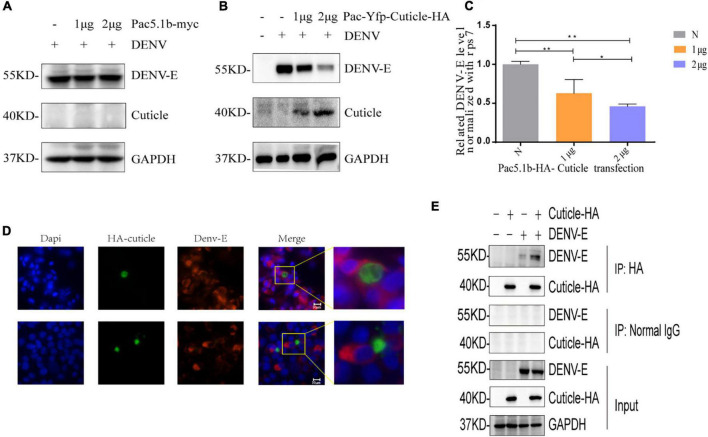
Aedes albopictus (Ae. albopictus), an important vector of dengue virus (DENV), is distributed worldwide. Identifying host proteins involved in flavivirus replication in and determining their natural antiviral mechanisms are critical to control virus transmission. Revealing the key proteins related to virus replication and exploring the host-pathogen interaction are of great significance in finding new pathways of the natural immune response in . Isobaric tags for relative and absolute quantification (iTRAQ) was used to perform a comparative proteomic analysis between the midgut of infected with DENV and the control. 3,419 proteins were detected, of which 162 were ≥ 1.2-fold differentially upregulated or ≤ 0.8-fold differentially downregulated ( < 0.05) during DENV infections. Differentially expressed proteins (DEPs) were mainly enriched in ubiquitin ligase complex, structural constituent of cuticle, carbohydrate metabolism, and lipid metabolism pathways. We found that one of the DEPs, a putative pupal cuticle (PC) protein could inhibit the replication of DENV and interact with the DENV-E protein. In addition, the result of immunofluorescence (IF) test showed that there was co-localization between ubiquitin carboxyl-terminal hydrolase (UCH) protein and the DENV-E protein, and virus infection reduced the level of this protein. iTRAQ-based proteomic analysis of the midgut identified dengue infection-induced upregulated and downregulated proteins. The interaction between the PC and UCH proteins in the midgut of might exert a natural antiviral mechanism in mosquito.
白纹伊蚊是登革病毒的重要传播媒介,分布于全球。识别参与黄病毒在其中复制的宿主蛋白并确定其天然抗病毒机制对于控制病毒传播至关重要。揭示与病毒复制相关的关键蛋白并探索宿主-病原体相互作用对于发现伊蚊天然免疫反应的新途径具有重要意义。采用相对和绝对定量等压标签(iTRAQ)技术对感染登革病毒的伊蚊中肠与对照进行比较蛋白质组学分析。共检测到3419种蛋白质,其中162种在登革病毒感染期间差异上调≥1.2倍或差异下调≤0.8倍(P<0.05)。差异表达蛋白(DEPs)主要富集于泛素连接酶复合体、表皮结构成分、碳水化合物代谢和脂质代谢途径。我们发现其中一种DEPs,一种假定的蛹表皮(PC)蛋白可以抑制登革病毒的复制并与登革病毒E蛋白相互作用。此外,免疫荧光(IF)试验结果表明泛素羧基末端水解酶(UCH)蛋白与登革病毒E蛋白存在共定位,且病毒感染降低了该蛋白的水平。基于iTRAQ的伊蚊中肠蛋白质组学分析确定了登革病毒感染诱导的上调和下调蛋白。伊蚊中肠中PC蛋白和UCH蛋白之间的相互作用可能在蚊子中发挥天然抗病毒机制。