Department of Health Policy and Management, University of North Carolina at Chapel Hill, Gillings School of Global Public Health, Chapel Hill, NC, USA.
Lineberger Comprehensive Cancer Center, University of North Carolina at Chapel Hill, Chapel Hill, NC, USA.
Trials. 2022 Oct 3;23(1):839. doi: 10.1186/s13063-022-06745-4.
Almost half of the patients with cancer report cancer-related financial hardship, termed "financial toxicity" (FT), which affects health-related quality of life, care retention, and, in extreme cases, mortality. This increasingly prevalent hardship warrants urgent intervention. Financial navigation (FN) targets FT by systematically identifying patients at high risk, assessing eligibility for existing resources, clarifying treatment cost expectations, and working with patients and caregivers to develop a plan to cope with cancer costs. This trial seeks to (1) identify FN implementation determinants and implementation outcomes, and (2) evaluate the effectiveness of FN in improving patient outcomes.
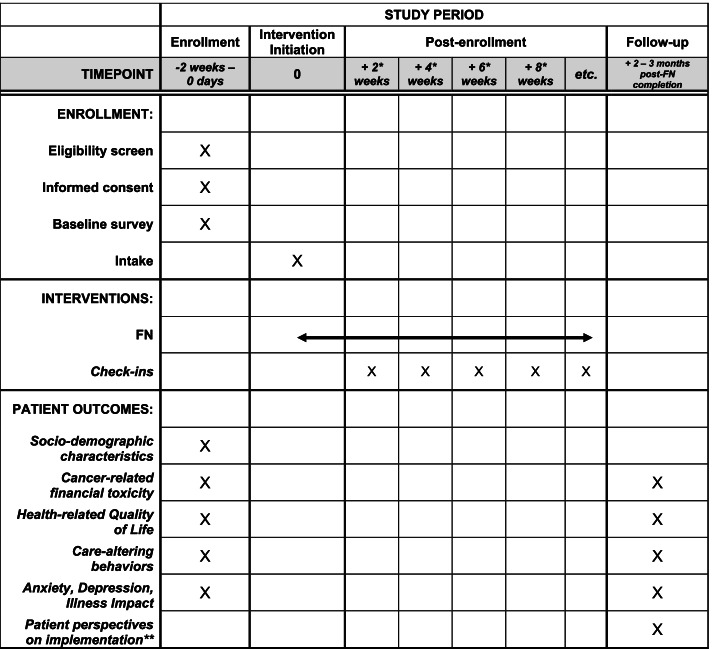
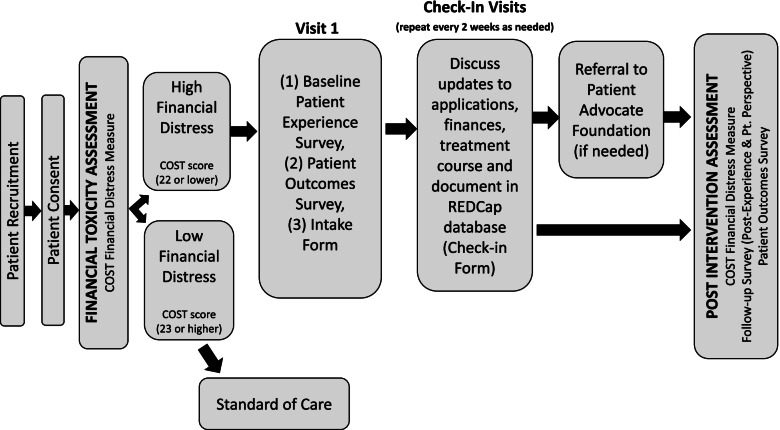
The Lessening the Impact of Financial Toxicity (LIFT) study is a multi-site Phase 2 clinical trial. We use a pre-/post- single-arm intervention to examine the effect of FN on FT in adults with cancer. The LIFT trial is being conducted at nine oncology care settings across North Carolina in the United States. Sites vary in geography (five rural, four non-rural), size (21-974 inpatient beds), and ownership structure (governmental, non-profit). The study will enroll 780 patients total over approximately 2 years. Eligible patients must be 18 years or older, have a confirmed cancer diagnosis (any type) within the past 5 years or be living with advanced disease, and screen positive for cancer-related financial distress. LIFT will be delivered by full- or part-time financial navigators and consists of 3 components: (1) systematic FT screening identification and comprehensive intake assessment; (2) connecting patients experiencing FT to financial support resources via trained oncology financial navigators; and (3) ongoing check-ins and electronic tracking of patients' progress and outcomes by financial navigators. We will measure intervention effectiveness by evaluating change in FT (via the validated Comprehensive Score of Financial Toxicity, or COST instrument) (primary outcome), as well as health-related quality of life (PROMIS Global Health Questionnaire), and patient-reported delayed or forgone care due to cost. We also assess patient- and stakeholder-reported implementation and service outcomes post-intervention, including uptake, fidelity, acceptability, cost, patient-centeredness, and timeliness.
This study adds to the growing evidence on FN by evaluating its implementation and effectiveness across diverse oncology care settings.
ClinicalTrials.gov NCT04931251. Registered on June 18, 2021.
近一半的癌症患者报告称存在与癌症相关的经济困难,这被称为“财务毒性”(FT),它会影响与健康相关的生活质量、治疗保留率,在极端情况下,还会影响死亡率。这种日益普遍的困难需要紧急干预。财务导航(FN)通过系统地识别高风险患者,评估现有资源的资格,澄清治疗费用预期,并与患者和护理人员合作制定应对癌症费用的计划,从而解决财务毒性问题。这项试验旨在:(1)确定 FN 的实施决定因素和实施结果,以及(2)评估 FN 在改善患者结果方面的有效性。
减少财务毒性影响(LIFT)研究是一项多地点的 2 期临床试验。我们使用前后单臂干预措施来研究 FN 对癌症患者财务毒性的影响。LIFT 试验正在美国北卡罗来纳州的 9 个肿瘤护理机构进行。这些机构在地理位置(5 个农村,4 个非农村)、规模(21-974 张住院病床)和所有权结构(政府、非营利)方面存在差异。该研究将在大约 2 年内共招募 780 名患者。合格患者必须年满 18 岁,在过去 5 年内确诊患有癌症(任何类型),或患有晚期疾病,并经癌症相关财务困境筛查呈阳性。LIFT 将由全职或兼职财务导航员提供,由 3 个部分组成:(1)系统地进行财务毒性筛查,以确定和进行综合摄入评估;(2)通过经过培训的肿瘤学财务导航员将经历财务毒性的患者与财务支持资源联系起来;(3)财务导航员持续检查并通过电子方式跟踪患者的进展和结果。我们将通过评估财务毒性的变化(通过经过验证的综合财务毒性评分,或 COST 工具)(主要结果),以及健康相关生活质量(PROMIS 全球健康问卷),以及因费用而延迟或放弃的护理,来衡量干预措施的有效性。我们还评估了干预后的患者和利益相关者报告的实施和服务结果,包括参与度、保真度、可接受性、成本、以患者为中心和及时性。
本研究通过评估 FN 在不同肿瘤护理环境中的实施情况和有效性,为 FN 的不断发展提供了更多证据。
ClinicalTrials.gov NCT04931251。于 2021 年 6 月 18 日注册。