Hidangmayum A, Debnath A, Guru A, Singh B N, Upadhyay S K, Dwivedi P
Department of Plant Physiology, Institute of Agricultural Sciences, Banaras Hindu University, Varanasi, India.
Department of Civil Engineering, Indian Institute of Technology (BHU), Varanasi, India.
Int J Environ Sci Technol (Tehran). 2022 Sep 29:1-26. doi: 10.1007/s13762-022-04560-7.
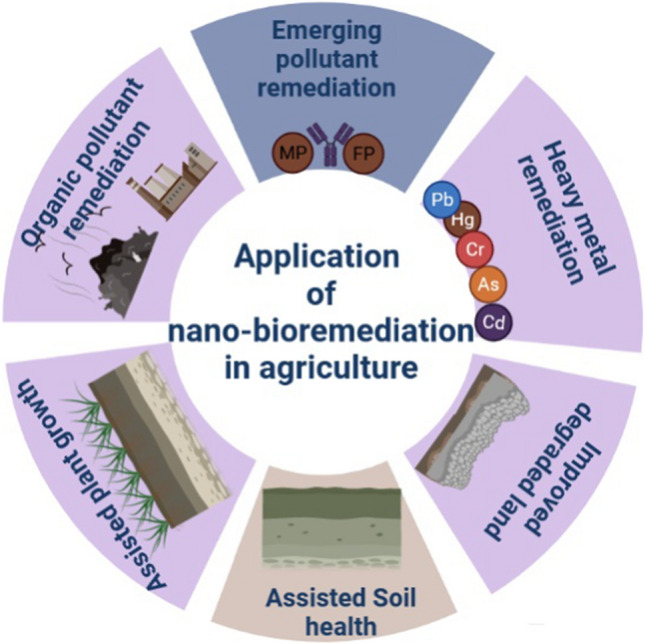
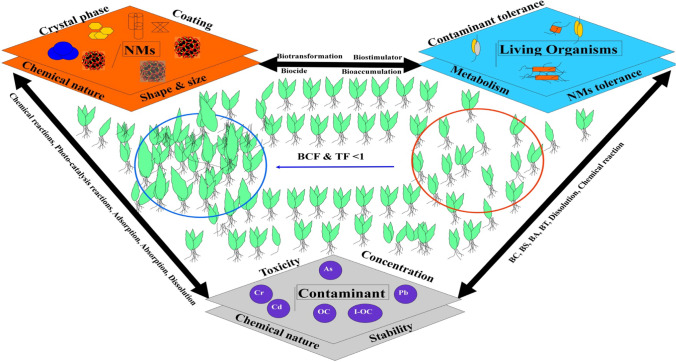
The rise in environmental pollutant levels in recent years is mostly attributable to anthropogenic activities such as industrial, agricultural and other activities. Additionally, these activities may produce excessive levels of dangerous toxicants such as heavy metals, organic pollutants including pesticide and herbicide chemicals, and sewage discharges from residential and commercial sources. With a focus on environmentally friendly, sustainable technology, new technologies such as combined process of nanotechnology and bioremediation are urgently needed to accelerate the cost-effective remediation process to alleviate toxic contaminants than the conventional remediation methods. Numerous studies have shown that nanoparticles possess special qualities including improved catalysis and adsorption as well as increased reactivity. Currently, microorganisms and their extracts are being used as promising, environmentally friendly catalysts for engineered nanomaterial. In the long term, this combination of both technologies called nano-bioremediation may significantly alter the field of environmental remediation since it is more intelligent, safe, environmentally friendly, economical and green. This review provides an overview of soil and water remediation techniques as well as the use of nano-bioremediation, which is made from various living organisms. Additionally, current developments related to the mechanism, model and kinetic studies for remediation of agricultural contaminants have been discussed.
近年来,环境污染物水平的上升主要归因于工业、农业等人为活动。此外,这些活动可能会产生过量的危险毒物,如重金属、包括农药和除草剂化学品在内的有机污染物,以及来自住宅和商业来源的污水排放。为了聚焦环境友好型、可持续技术,迫切需要纳米技术与生物修复相结合等新技术,以加速具有成本效益的修复过程,比传统修复方法更有效地减轻有毒污染物。大量研究表明,纳米颗粒具有特殊性质,包括催化和吸附性能的改善以及反应活性的提高。目前,微生物及其提取物正被用作工程纳米材料的有前景的、环境友好型催化剂。从长远来看,这种被称为纳米生物修复的两种技术的结合可能会显著改变环境修复领域,因为它更智能、安全、环保、经济且绿色。本综述概述了土壤和水的修复技术以及纳米生物修复的应用,纳米生物修复由各种生物体构成。此外,还讨论了与农业污染物修复的机制、模型和动力学研究相关的当前进展。