Estrada-Gómez Sebastián, Vargas-Muñoz Leidy Johana, Higuita-Gutiérrez Luis Felipe
Grupo de Toxinologia y Alternativas Terapeuticas Alimentarias, Universidad de Antioquia UdeA, Medellin, Antioquia, Colombia.
Tech Life Saving (TLS), Medellin, Antioquia, Colombia.
Drug Healthc Patient Saf. 2022 Sep 29;14:171-184. doi: 10.2147/DHPS.S367757. eCollection 2022.
Snakebite envenomation is a public health event of mandatory reporting in Colombia. It is considered a medical emergency in which the government must guarantee antivenom availability. We describe snakebite epidemiological figures in Colombia between 2008 and 2020 and correlate them with antivenom manufacturing figures to determine rate coverage and the need for antivenom.
We performed an ecological study based on secondary official figures from the National Health Institute, the National Institute for Surveillance of Medicines and Foods, the National Administrative Department of Statistics and the Ministry of Health and Social Protection. Absolute and relative frequencies were calculated with 95% confidence intervals, position measurements, dispersion and central tendency.
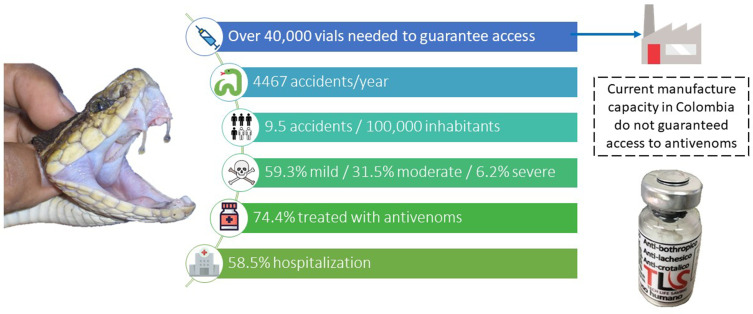
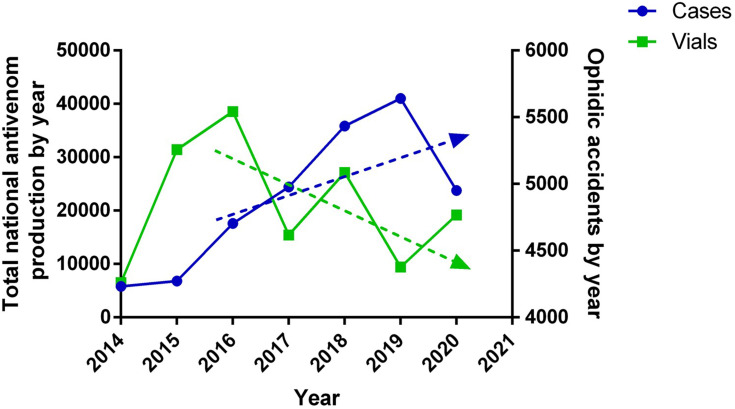
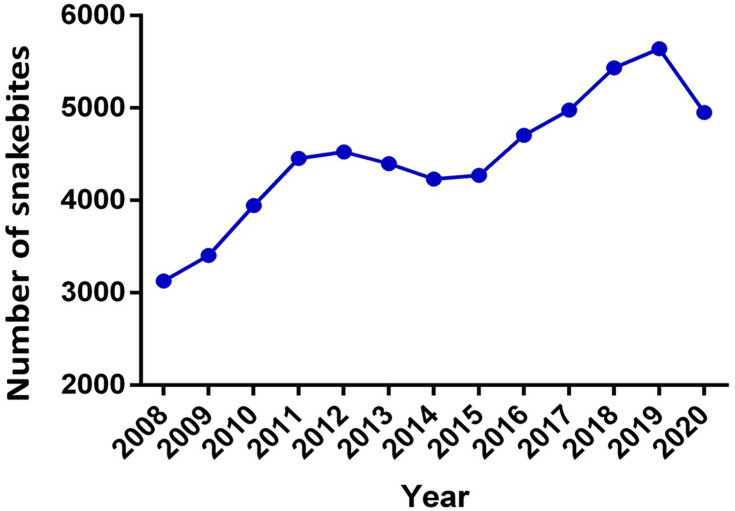
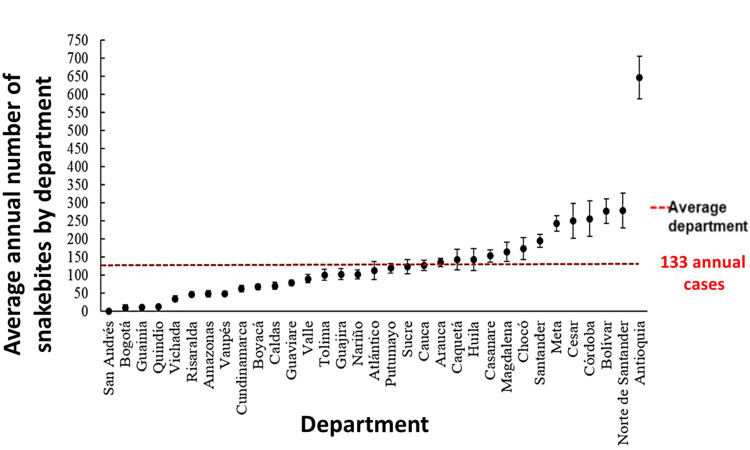
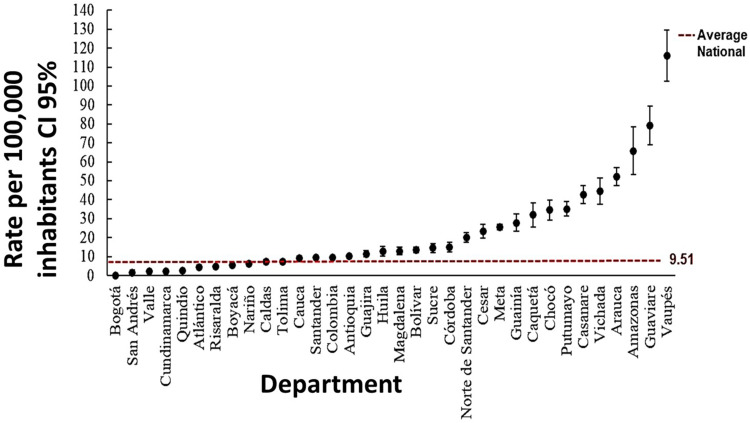
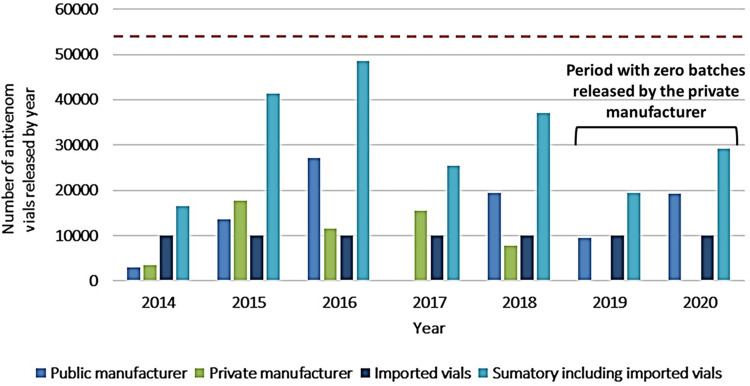
Through our research, we revealed that in the last 13 years (2008-2020), there were an average of 4467 annual snakebite envenomation cases affecting all the departments in Colombia. Antioquia reported the highest number of snakebites with 647 (95% CI 588-706) cases per year. The population incidence per 100,000 inhabitants was 9.5; the highest rates were found in Vaupés at 116.1 and Guaviare at 79.24. During the last seven years (2014-2020) Colombia produced an average of 21,104 antivenom vials per year, while the annual demand for antivenom is estimated at 54,440 units needed to guarantee access.
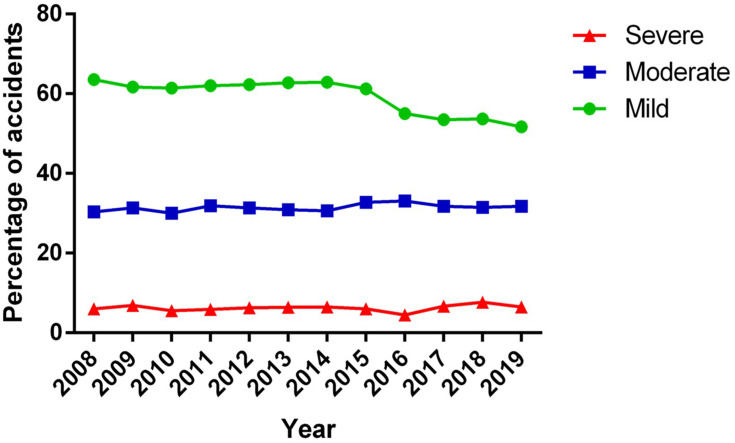
Colombia does not produce sufficient vials to cover their needs, and this is why only 74.4% of accidents (out of the 92% not classified as dry bites) were treated, and even 9.7% of the severe accidents did not receive the specific treatment (8% of the victims were classified as dry bites). Figures support the regular antivenom shortages declared by the Ministry of Health and Social Protection in the last 13 years (11 health emergency declarations). New efforts are needed to: 1) boost the production of GMP-based high-quality antivenom, that covers the national needs and is made availability, 2) a better estimation method to calculate the need for antivenom in Colombia, and 3) implementation of production-distribution chains guaranteeing access in remote communities.
在哥伦比亚,蛇咬伤中毒是一项强制报告的公共卫生事件。它被视为一种医疗紧急情况,政府必须确保抗蛇毒血清的供应。我们描述了2008年至2020年期间哥伦比亚蛇咬伤的流行病学数据,并将其与抗蛇毒血清的生产数据相关联,以确定覆盖率和对抗蛇毒血清的需求。
我们基于国家卫生研究所、国家药品和食品监督研究所、国家统计局以及卫生和社会保障部的二级官方数据进行了一项生态研究。计算了绝对频率和相对频率,并给出95%置信区间、位置测量值、离散度和集中趋势。
通过我们的研究发现,在过去13年(2008 - 2020年)中,哥伦比亚各部门每年平均有4467例蛇咬伤中毒病例。安蒂奥基亚报告的蛇咬伤病例数最多,每年有647例(95%置信区间为588 - 706例)。每10万居民中的人口发病率为9.5;在沃佩斯发病率最高,为116.1,瓜维亚雷为79.24。在过去七年(2014 - 2020年)中,哥伦比亚每年平均生产21,104瓶抗蛇毒血清,而抗蛇毒血清的年需求量估计为54,440单位才能确保供应。
哥伦比亚生产的抗蛇毒血清瓶数不足以满足需求,这就是为什么只有74.4%的事故(在92%未归类为干性咬伤的事故中)得到了治疗,甚至9.7%的严重事故没有得到特异性治疗(8%的受害者被归类为干性咬伤)。这些数据支持了卫生和社会保障部在过去13年中宣布的常规抗蛇毒血清短缺情况(11次卫生紧急声明)。需要做出新的努力:1)提高基于良好生产规范的高质量抗蛇毒血清的产量,以满足国家需求并确保供应;2)采用更好的估计方法来计算哥伦比亚对抗蛇毒血清的需求;3)实施生产 - 配送链,确保偏远社区能够获得抗蛇毒血清。