Hossain Mohammad Sorowar, Siam Md Hasanul Banna, Hasan Mohammad Nayeem, Jahan Rifat, Siddiqee Mahbubul H
Department of Emerging and Neglected Diseases, Biomedical Research Foundation, Dhaka, Bangladesh.
Department of Digital Health and Informatics, Biomedical Research Foundation, Dhaka, Bangladesh.
Heliyon. 2022 Sep 29;8(10):e10792. doi: 10.1016/j.heliyon.2022.e10792. eCollection 2022 Oct.
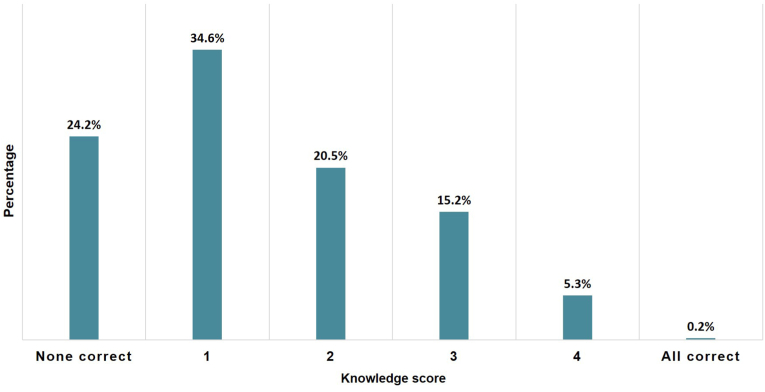
The availability of voluntary nonremunerated blood donors is a major concern in low- and middle-income countries because there is a substantial scarcity of safe blood supply against the expected demand. This study explores the status of knowledge, attitude, and practice regarding blood donation among students and teachers of residential religious academic institutions in Jamalpur district in Bangladesh. Religious institutions were selected through simple random sampling, and the cross-sectional survey included 512 participants. Descriptive and inferential statistics were performed with statistical significance defined as p < 0.05. Over 90% of the participants were students, non-smokers, and aged 18-30 years. The majority (92%) did not ever donate blood to anyone, yet over 42% wanted to be regular donors. More than 80% considered blood donation a moral responsibility and an Islamic act. The common reasons for not donating blood were lack of knowledge (40%), lack of opportunity (20%), thinking it was harmful to health (21%), fearing needles (16%), and no financial benefit (6%). Interestingly, more than 67% did not know their blood group, and about 61% of the respondents said they did not hear of or could not remember any blood donation program. The participants had poor knowledge of general eligibility criteria but an overall positive attitude towards blood donation. There was a weak positive correlation between knowledge, attitude, and practice scores. Participants willing to donate blood to strangers were four times more likely to do so regularly. Those who considered blood donation a religious act and a moral responsibility were twice as likely to become regular blood donors. This study reveals that many potential donors are being neglected, although they may be a valuable resource in addressing the ongoing blood donation issue.
在低收入和中等收入国家,自愿无偿献血者的数量是一个主要问题,因为安全血液供应相对于预期需求严重短缺。本研究探讨了孟加拉国贾马尔布尔区寄宿宗教院校的学生和教师在献血方面的知识、态度和行为状况。通过简单随机抽样选择宗教机构,横断面调查包括512名参与者。进行描述性和推断性统计,统计学显著性定义为p < 0.05。超过90%的参与者是学生、不吸烟者,年龄在18至30岁之间。大多数人(92%)从未向任何人献血,但超过42%的人希望成为定期献血者。超过80%的人认为献血是一种道德责任和伊斯兰教行为。不献血的常见原因是缺乏知识(40%)、缺乏机会(20%)、认为献血有害健康(21%)、害怕针头(16%)和没有经济利益(6%)。有趣的是,超过67%的人不知道自己的血型,约61%的受访者表示他们没有听说过或记不起任何献血项目。参与者对一般资格标准的了解较差,但对献血总体态度积极。知识、态度和行为得分之间存在微弱的正相关。愿意向陌生人献血的参与者定期献血的可能性是其他人的四倍。那些认为献血是宗教行为和道德责任的人成为定期献血者的可能性是其他人的两倍。这项研究表明,许多潜在的献血者被忽视了,尽管他们可能是解决当前献血问题的宝贵资源。