Hawassa University, College of Medicine and Health Sciences, School of Nursing, Hawassa, Ethiopia.
Australian Centre for Public and Population Health Research, School of Public Health, Faculty of Health, University of Technology Sydney, Ultimo, New South Wales, Australia.
Psychooncology. 2022 Nov;31(11):1809-1820. doi: 10.1002/pon.6045. Epub 2022 Oct 17.
It is imperative to provide care for patients with terminal illnesses such as cancer, though it demands time, financial resources and other unmet needs. Subsequently, caregivers might be exposed to psychological stress and other mental health problems. Previous meta-analysis finding shows caregivers of cancer patient suffer from depression. During the past 4 years, there has been a considerable increase in the number of newly studies, and we therefore intended to update this finding and provide current global prevalence of depression among caregivers of Cancer patients.
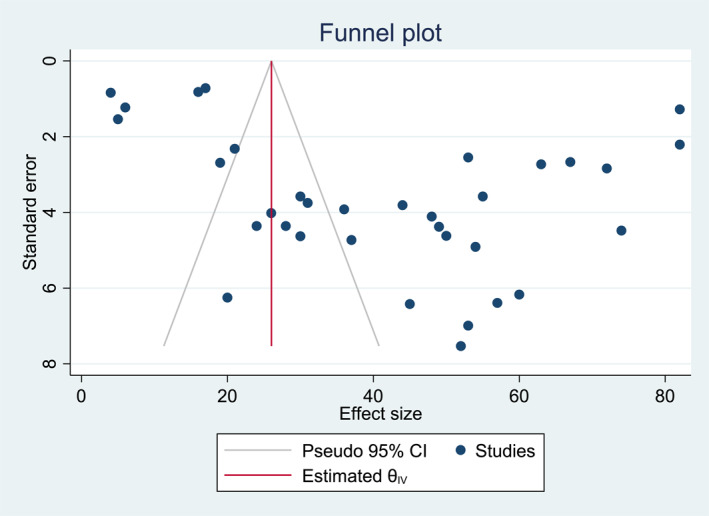
We searched PubMed, SCOPUS, CINAHIL, Embase, and PsychINFO to identify peer-reviewed studies which reported the prevalence of depression among caregivers of cancer patients using pre-defined eligibility criteria. Studies were pooled to estimate the global prevalence of depression using a random-effect meta-analysis model. Heterogeneity was assessed using Cochran's Q and I statistics. Funnel plot asymmetry and Egger's regression tests were used to check for publication bias.
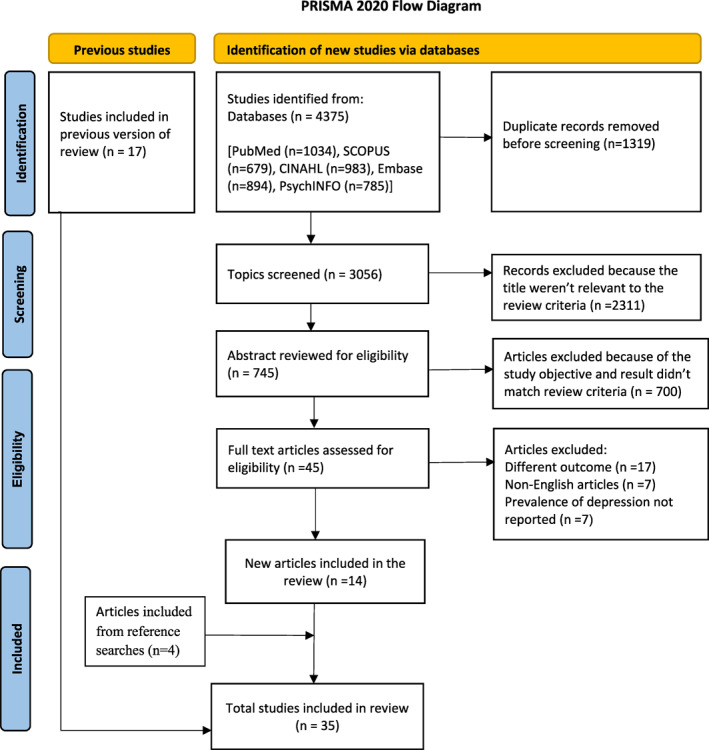
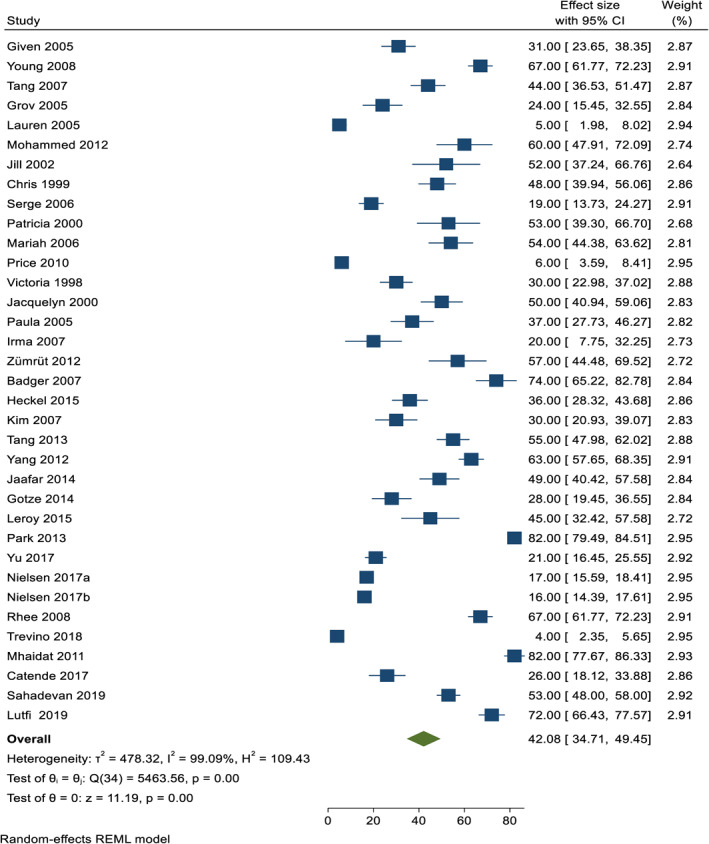
Our search identified 4375 studies, of which 35 studies with 11,396 participants were included in the meta-analysis. In the current review, the pooled prevalence of depression among caregivers of Cancer patients was 42.08% (95% CI: 34.71-49.45). The pooled prevalence of depression was higher in the studies that used cross-sectional data (42%, 95% CI: 31-52) than longitudinal data (34%, 95% CI: 18-50). We also observed a higher rate of depression among female caregivers when compared to their male counterparts (57.6%) (95% CI: 29.5-81.5).
Globally, around two in five cancer patient caregivers screened positive for depression, which needs due attention. Routine screening of depressive symptoms and providing psychosocial support for caregivers is crucial.
为癌症等绝症患者提供关怀是当务之急,这需要时间、财力资源和其他未满足的需求。因此,照顾者可能会面临心理压力和其他心理健康问题。先前的荟萃分析结果表明,癌症患者的照顾者患有抑郁症。在过去的 4 年中,新研究的数量相当增加,因此,我们旨在更新这一发现,并提供当前全球癌症患者照顾者抑郁的患病率。
我们搜索了 PubMed、SCOPUS、CINAHIL、Embase 和 PsychINFO,以确定使用预定义纳入标准报告癌症患者照顾者抑郁患病率的同行评议研究。使用随机效应荟萃分析模型对研究进行汇总,以估计全球癌症患者照顾者抑郁的患病率。使用 Cochran's Q 和 I 统计量评估异质性。使用漏斗图不对称和 Egger 的回归检验检查发表偏倚。
我们的搜索确定了 4375 项研究,其中 35 项研究共纳入了 11396 名参与者。在本次综述中,癌症患者照顾者中抑郁的总体患病率为 42.08%(95%CI:34.71-49.45)。使用横断面数据(42%,95%CI:31-52)的研究中抑郁的总体患病率高于纵向数据(34%,95%CI:18-50)。我们还观察到女性照顾者的抑郁率高于男性(57.6%)(95%CI:29.5-81.5)。
全球约有五分之二的癌症患者照顾者筛查出患有抑郁症,这需要引起关注。对抑郁症状进行常规筛查并为照顾者提供心理社会支持至关重要。