Division of Biological Science, Graduate School of Science and Technology, Nara Institute of Science and Technology, Ikoma, Japan.
Institute for Life and Medical Sciences, Kyoto University, Kyoto, Japan.
J Biol Chem. 2022 Nov;298(11):102572. doi: 10.1016/j.jbc.2022.102572. Epub 2022 Oct 7.
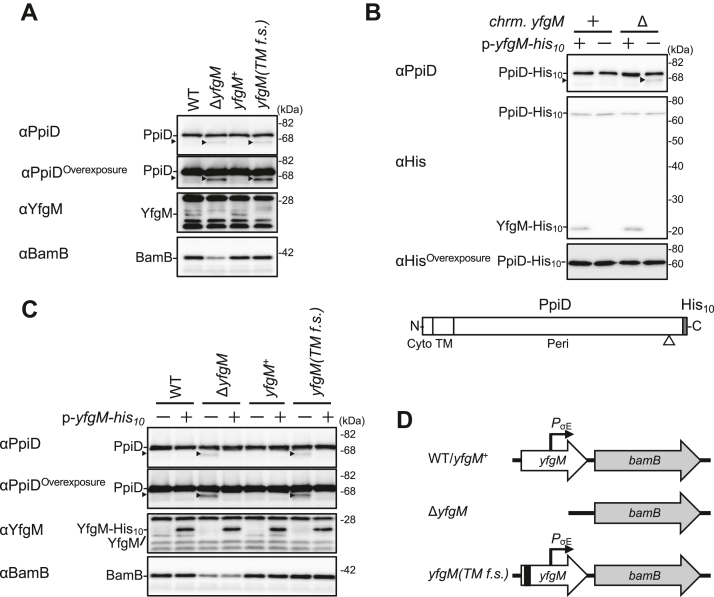
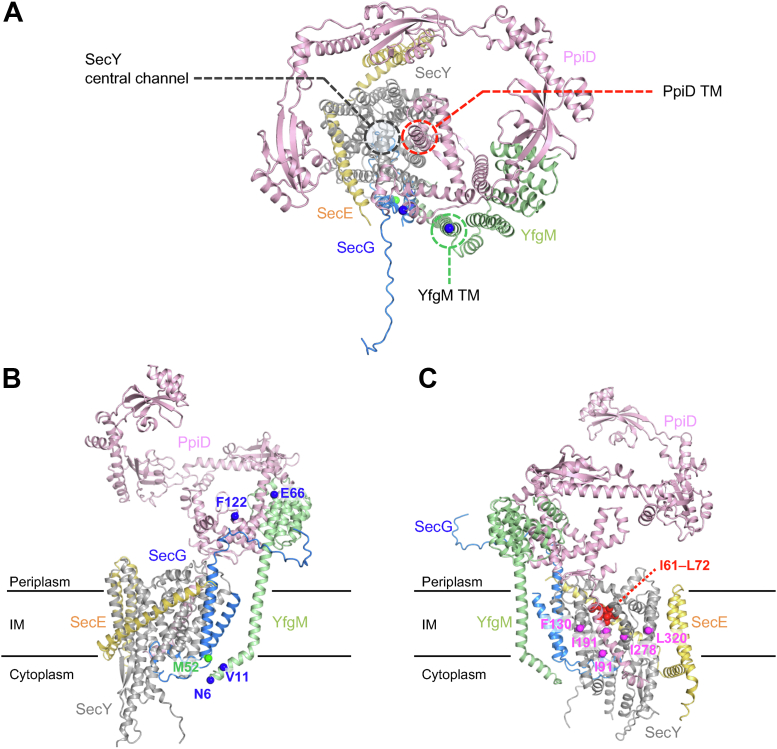
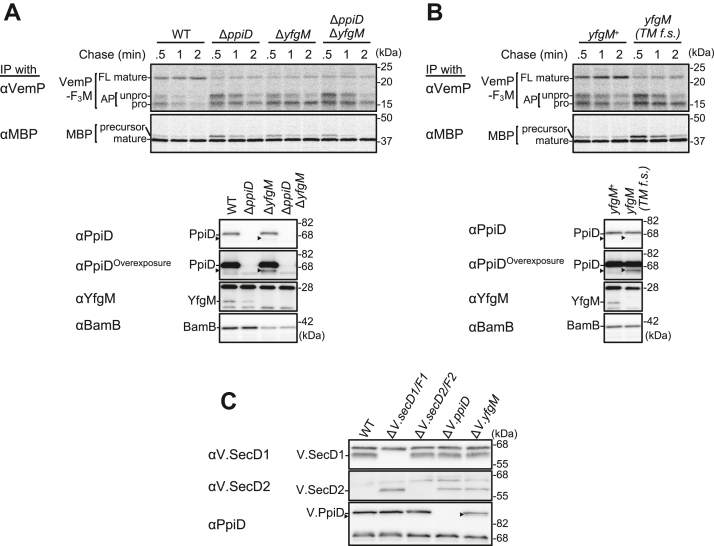
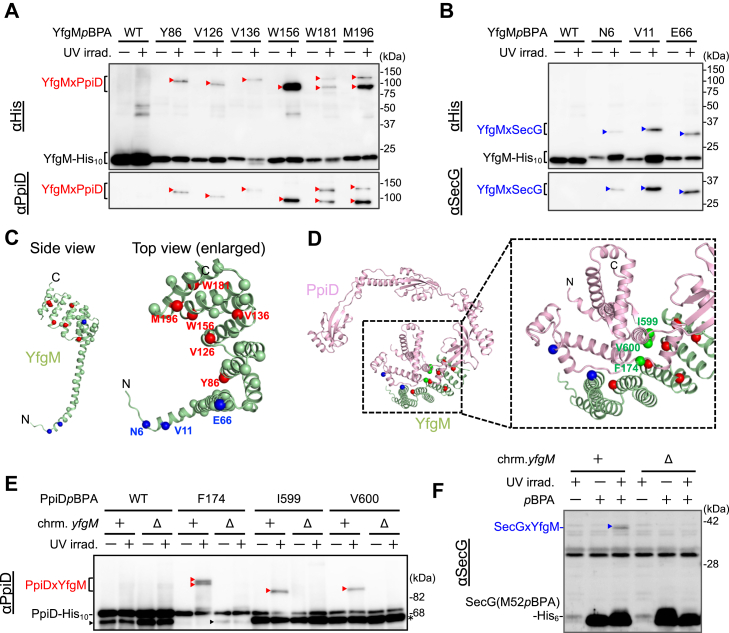
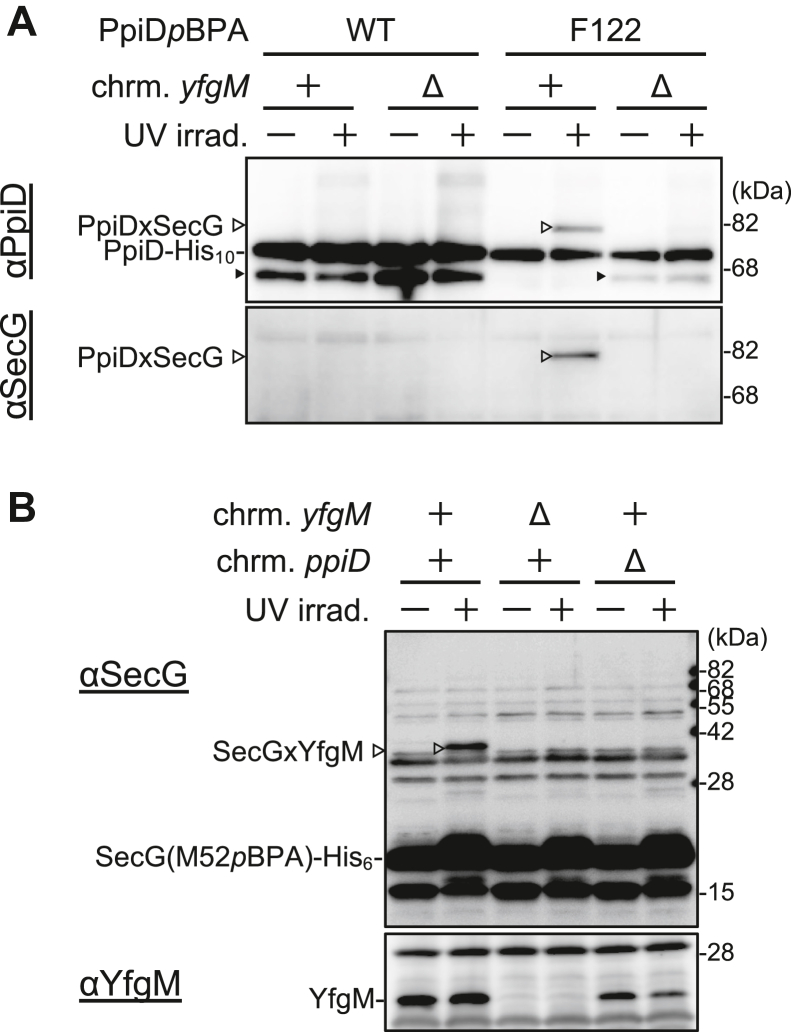
PpiD and YfgM are inner membrane proteins that are both composed of an N-terminal transmembrane segment and a C-terminal periplasmic domain. Escherichia coli YfgM and PpiD form a stable complex that interacts with the SecY/E/G (Sec) translocon, a channel that allows protein translocation across the cytoplasmic membrane. Although PpiD is known to function in protein translocation, the functional significance of PpiD-YfgM complex formation as well as the molecular mechanisms of PpiD-YfgM and PpiD/YfgM-Sec translocon interactions remain unclear. Here, we conducted genetic and biochemical studies using yfgM and ppiD mutants and demonstrated that a lack of YfgM caused partial PpiD degradation at its C-terminal region and hindered the membrane translocation of Vibrio protein export monitoring polypeptide (VemP), a Vibrio secretory protein, in both E. coli and Vibrio alginolyticus. While ppiD disruption also impaired VemP translocation, we found that the yfgM and ppiD double deletion exhibited no additive or synergistic effects. Together, these results strongly suggest that both PpiD and YfgM are required for efficient VemP translocation. Furthermore, our site-directed in vivo photocrosslinking analysis revealed that the tetratricopeptide repeat domain of YfgM and a conserved structural domain (NC domain) in PpiD interact with each other and that YfgM, like PpiD, directly interacts with the SecG translocon subunit. Crosslinking analysis also suggested that PpiD-YfgM complex formation is required for these proteins to interact with SecG. In summary, we propose that PpiD and YfgM form a functional unit that stimulates protein translocation by facilitating their proper interactions with the Sec translocon.
PpiD 和 YfgM 是内膜蛋白,均由 N 端跨膜结构域和 C 端周质域组成。大肠杆菌 YfgM 和 PpiD 形成稳定的复合物,与 SecY/E/G(Sec)易位子相互作用,该易位子是一种允许蛋白质穿过细胞质膜转移的通道。虽然已知 PpiD 参与蛋白质易位,但 PpiD-YfgM 复合物形成的功能意义以及 PpiD-YfgM 和 PpiD/YfgM-Sec 易位子相互作用的分子机制仍不清楚。在这里,我们使用 yfgM 和 ppiD 突变体进行了遗传和生化研究,证明了缺乏 YfgM 会导致 PpiD 在其 C 端区域部分降解,并阻碍 Vibrio 蛋白输出监测多肽(VemP),一种 Vibrio 分泌蛋白,在大肠杆菌和 Alg 弧菌中的膜易位。虽然 ppiD 缺失也会损害 VemP 易位,但我们发现 yfgM 和 ppiD 双缺失没有表现出附加或协同作用。总之,这些结果强烈表明 PpiD 和 YfgM 均是有效 VemP 易位所必需的。此外,我们的定点体内光交联分析表明,YfgM 的四肽重复结构域和 PpiD 中的保守结构域(NC 结构域)相互作用,并且 YfgM 像 PpiD 一样直接与 SecG 易位子亚基相互作用。交联分析还表明,PpiD-YfgM 复合物的形成是这些蛋白质与 SecG 相互作用所必需的。总之,我们提出 PpiD 和 YfgM 形成一个功能单元,通过促进它们与 Sec 易位子的适当相互作用来刺激蛋白质易位。