Department of Applied Physics, University of Zaragoza, Zaragoza, Spain.
Department of Applied Physics, University of Zaragoza, Zaragoza, Spain.
J Optom. 2022;15 Suppl 1(Suppl 1):S12-S21. doi: 10.1016/j.optom.2022.09.002. Epub 2022 Oct 7.
To discriminate suspect glaucomatous from control eyes using corneal densitometry based on the statistical modeling of the pixel intensity distribution of Scheimpflug images.
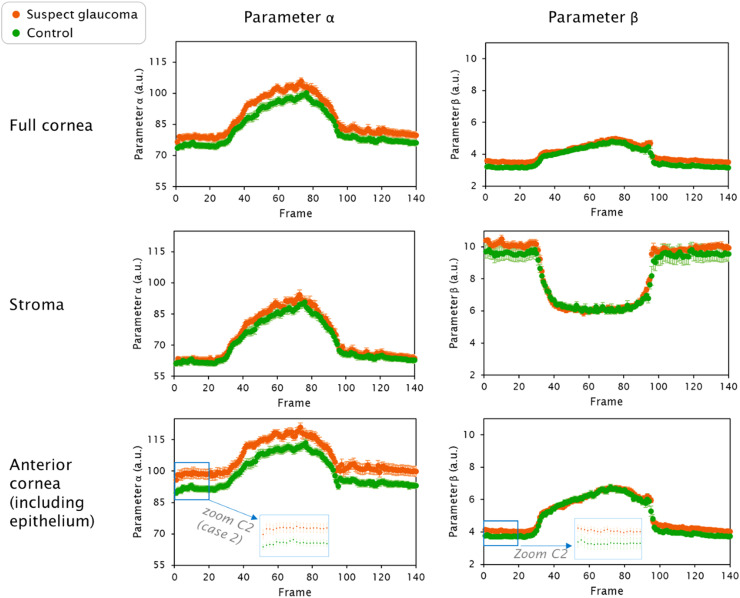
Twenty-four participants (10 suspect glaucomatous and 14 control eyes) were included in this retrospective study. Corneal biomechanics was assessed with the commercial Scheimpflug camera Corvis ST (Oculus). Sets of 140 images acquired per measurement were exported for further analysis. After corneal segmentation, pixel intensities corresponding to different corneal depths were statistically modeled for each image, from which corneal densitometry in the form of parameters α (brightness) and β (homogeneity) was derived. After data pre-processing, parameters α and β were input to six supervised machine learning algorithms that were trained, tested, and compared.
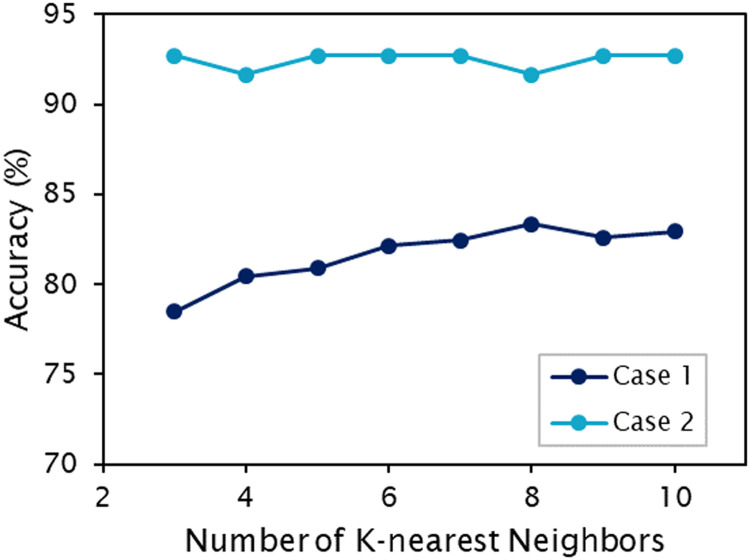
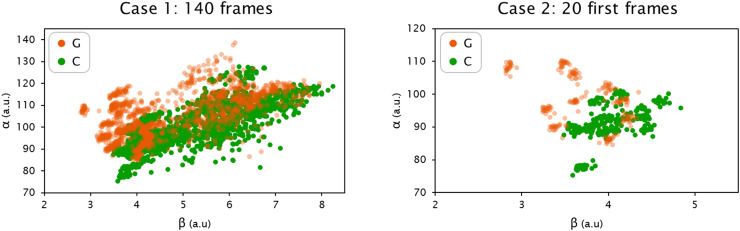
There exists a statistically significant difference in α and β parameters between suspect glaucomatous and control eyes (both, P < 0.05/N, Bonferroni). From the implemented supervised machine learning algorithms, the K-nearest neighbors (K-NN) algorithm reached 83.93% accuracy to discriminate between groups only using corneal densitometry parameters (α and β).
Densitometry of the anterior cornea including epithelium on its own has the potential to serve as a clinical tool for early glaucoma risk assessment.
利用基于 Scheimpflug 图像像素强度分布的统计建模,对疑似青光眼和对照眼进行角膜密度测定,以鉴别疑似青光眼和对照眼。
本回顾性研究纳入 24 名参与者(10 只疑似青光眼眼和 14 只对照眼)。采用商用 Scheimpflug 相机 Corvis ST(Oculus)评估角膜生物力学。每次测量采集 140 组图像,并对其进行进一步分析。在角膜分割后,对每张图像中不同角膜深度的像素强度进行统计建模,由此得出角膜密度参数α(亮度)和β(均匀性)。在数据预处理后,将参数α和β输入到经过训练、测试和比较的六种监督机器学习算法中。
疑似青光眼眼和对照眼的α和β参数存在统计学显著差异(均 P < 0.05/N,Bonferroni)。在所实施的监督机器学习算法中,仅使用角膜密度参数(α和β),K-最近邻(K-NN)算法的分组准确率达到 83.93%。
包括上皮在内的前角膜密度测定有可能成为早期青光眼风险评估的临床工具。