Yin Li, Gregg Alexander Christopher, Riccio Alessandra Marie, Hoyt Nicholas, Islam Zain Hussain, Ahn Jungeun, Le Quang, Patel Paranjay, Zhang Mengxue, He Xinran, McKinney Matthew, Kent Eric, Wang Bowen
Department of Surgery, School of Medicine, University of Virginia, Charlottesville, VA, United States.
School of Medicine and Health Sciences, George Washington University, Washington, DC, United States.
Front Cardiovasc Med. 2022 Sep 21;9:949262. doi: 10.3389/fcvm.2022.949262. eCollection 2022.
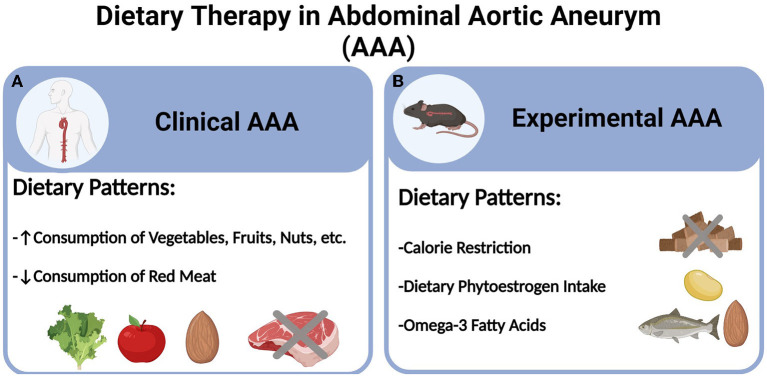
Abdominal aortic aneurysm (AAA) is a prevalent vascular disease with high mortality rates upon rupture. Despite its prevalence in elderly populations, there remain limited treatment options; invasive surgical repair, while risky, is the only therapeutic intervention with proven clinical benefits. Dietary factors have long been suggested to be closely associated with AAA risks, and dietary therapies recently emerged as promising avenues to achieve non-invasive management of a wide spectrum of diseases. However, the role of dietary therapies in AAA remains elusive. In this article, we will summarize the recent clinical and pre-clinical efforts in understanding the therapeutic and mechanistic implications of various dietary patterns and therapeutic approaches in AAA.
腹主动脉瘤(AAA)是一种常见的血管疾病,破裂时死亡率很高。尽管在老年人群中普遍存在,但治疗选择仍然有限;侵入性手术修复虽然有风险,但却是唯一经证实具有临床益处的治疗干预措施。长期以来,饮食因素一直被认为与腹主动脉瘤风险密切相关,饮食疗法最近成为实现多种疾病非侵入性管理的有前景的途径。然而,饮食疗法在腹主动脉瘤中的作用仍然难以捉摸。在本文中,我们将总结最近在理解各种饮食模式和治疗方法对腹主动脉瘤的治疗和机制影响方面的临床和临床前研究成果。