Zhang Haidong, Dong Hui, Pan Zheng, Du Xuanlong, Liu Shiwei, Xu Wenjing, Zhang Yewei
School of Medicine, Southeast University, Nanjing, China.
Hepatopancreatobiliary Center, Zhongda Hospital, Southeast University, Nanjing, China.
Front Oncol. 2022 Sep 23;12:998445. doi: 10.3389/fonc.2022.998445. eCollection 2022.
The liver is the most common organ for distant metastasis of pancreatic cancer, and patients with pancreatic cancer liver metastases (PCLM) often die in a short period of time. As such, the establishment of an effective nomogram to predict the probability of early death (survival time ≤3 months) in PCLM patients is of considerable significance.
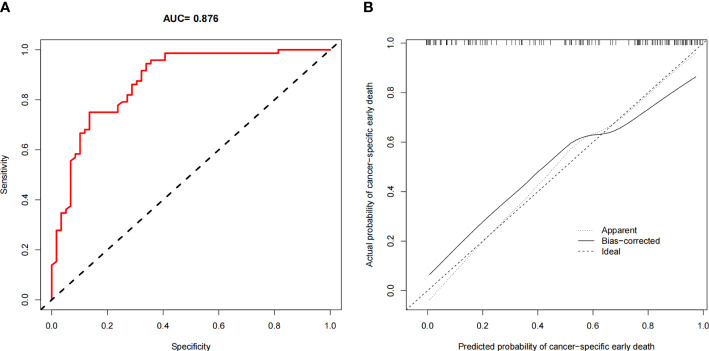
Patients diagnosed with PCLM in the Surveillance, Epidemiology, and End Result (SEER) database between 2010 and 2015 were included for model construction and internal validation. A data set was obtained from the Chinese population for external validation. Risk factors that contributed to all-cause and cancer-specific early death were determined by means of univariable and multivariable logistic regression. The accuracy of the nomogram was verified by means of receiver operating characteristic (ROC) curves, and the true consistency of the model was assessed by calibration curves. The clinical applicability of the model was evaluated by means of decision curve analysis (DCA).
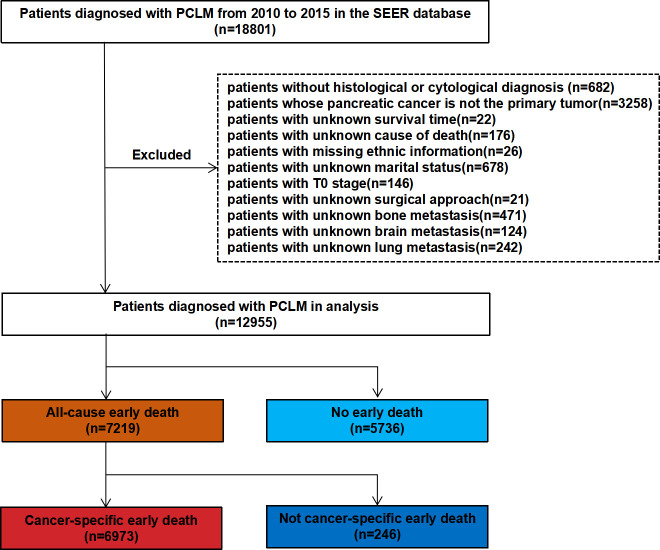
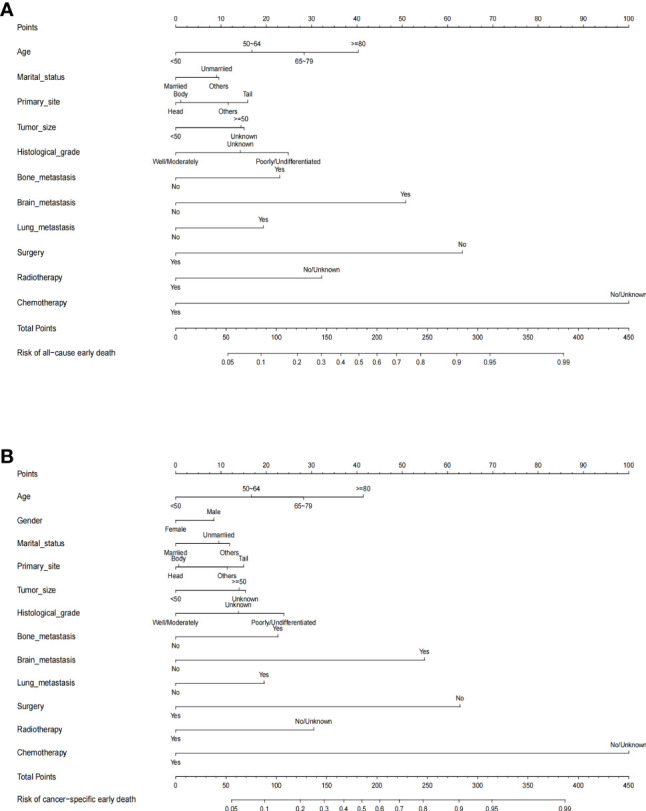
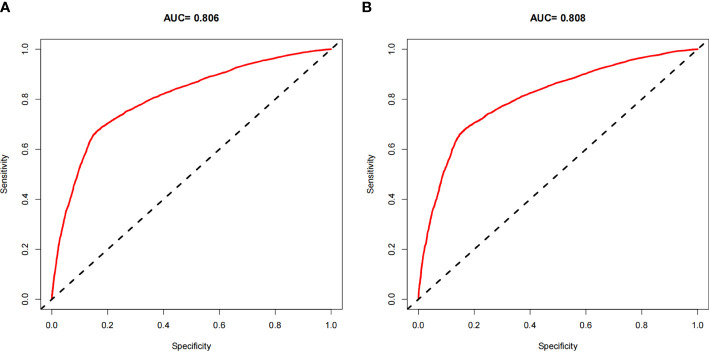
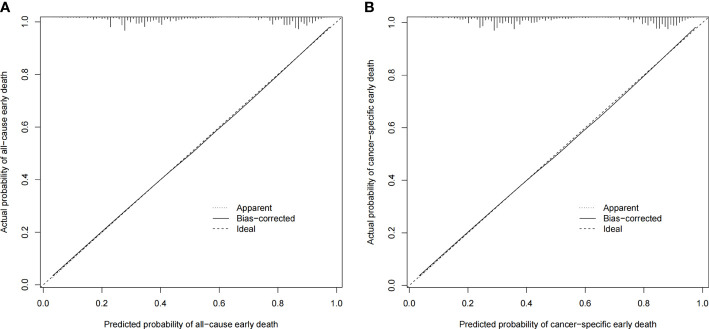
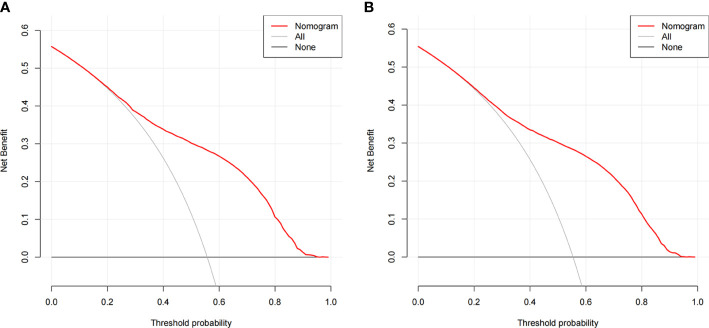
A total of 12,955 patients were included in the present study, of whom 7,219 (55.7%) experienced early death and 6,973 (53.8%) patients died of PCLM. Through multivariable logistic regression analysis, 11 risk factors associated with all-cause early death and 12 risk factors associated with cancer-specific early death were identified. The area under the curves (AUCs) for all-cause and cancer-specific early death were 0.806 (95% CI: 0.785- 0.827) and 0.808 (95% CI: 0.787- 0.829), respectively. Internal validation showed that the C-indexes of all-cause and cancer-specific early death after bootstrapping (5,000 re-samplings) were 0.805 (95% CI: 0.784-0.826) and 0.807 (95% CI: 0.786-0.828), respectively. As revealed by the calibration curves, the constructed nomograms exhibited good consistency. The decision curve analysis (DCA) indicated the nomograms had significant clinical applicability.
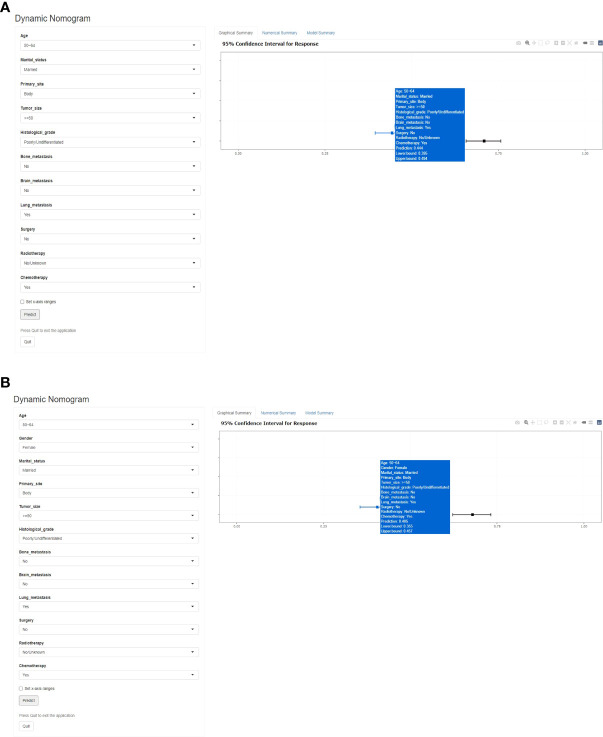
In the present study, reliable nomograms were developed for predicting the early death probability in patients with PCLM. Such tools can help clinicians identify high-risk patients and develop individualized treatment plans as early as possible.
肝脏是胰腺癌远处转移最常见的器官,胰腺癌肝转移(PCLM)患者通常在短时间内死亡。因此,建立有效的列线图来预测PCLM患者早期死亡(生存时间≤3个月)的概率具有重要意义。
纳入2010年至2015年监测、流行病学和最终结果(SEER)数据库中诊断为PCLM的患者进行模型构建和内部验证。从中国人群中获取数据集进行外部验证。通过单变量和多变量逻辑回归确定导致全因和癌症特异性早期死亡的危险因素。通过受试者操作特征(ROC)曲线验证列线图的准确性,并通过校准曲线评估模型的真实一致性。通过决策曲线分析(DCA)评估模型的临床适用性。
本研究共纳入12955例患者,其中7219例(55.7%)经历早期死亡,6973例(53.8%)患者死于PCLM。通过多变量逻辑回归分析,确定了11个与全因早期死亡相关的危险因素和12个与癌症特异性早期死亡相关的危险因素。全因和癌症特异性早期死亡的曲线下面积(AUC)分别为0.806(95%CI:0.785-0.827)和0.808(95%CI:0.787-0.829)。内部验证显示,自展法(5000次重新抽样)后全因和癌症特异性早期死亡的C指数分别为0.805(95%CI:0.784-0.826)和0.807(95%CI:0.786-0.828)。校准曲线显示,构建的列线图具有良好的一致性。决策曲线分析(DCA)表明列线图具有显著的临床适用性。
在本研究中,开发了可靠的列线图来预测PCLM患者的早期死亡概率。此类工具可帮助临床医生识别高危患者,并尽早制定个体化治疗方案。