Huang Kun, Chen Zhu, Yuan Xin-Zhu, He Yun-Shen, Lan Xiang, Du Chen-You
Department of General Surgery, Mianyang Hospital of Traditional Chinese Medicine, Mianyang 621000, Sichuan Province, China.
Department of Hepatobiliary Surgery, The First Affiliated Hospital of Chongqing Medical University, Chongqing 400000, China.
World J Gastrointest Oncol. 2025 May 15;17(5):102459. doi: 10.4251/wjgo.v17.i5.102459.
Stage IV pancreatic cancer (PC) has a poor prognosis and lacks individualized prognostic tools. Current survival prediction models are limited, and there is a need for more accurate, personalized methods. The Surveillance, Epidemiology, and End Results (SEER) database offers a valuable resource for studying large patient cohorts, yet machine learning-based nomograms for stage IV PC prognosis remain underexplored. This study hypothesizes that a machine learning-based nomogram can predict cancer-specific survival (CSS) and overall survival (OS) with high accuracy in stage IV PC patients.
To construct and validate a machine learning-based nomogram for predicting survival in stage IV PC patients using real-world data.
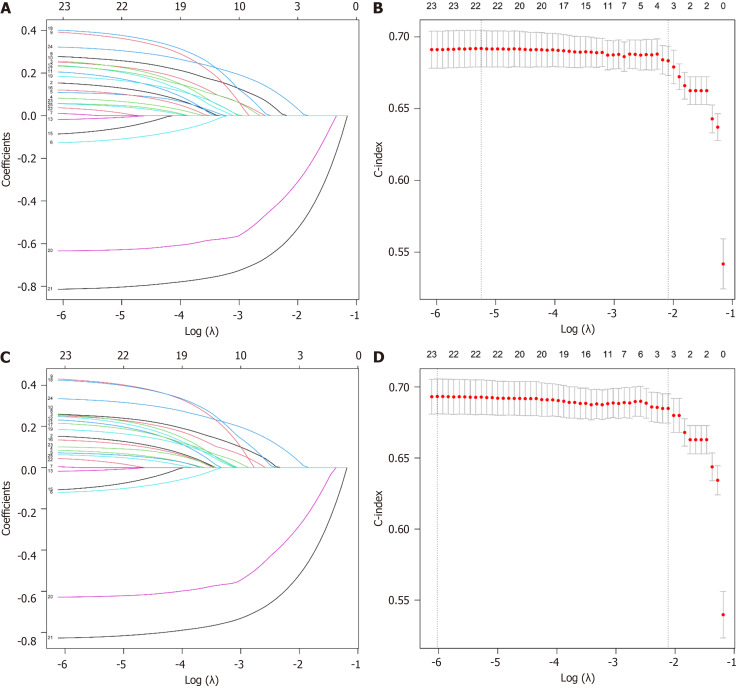
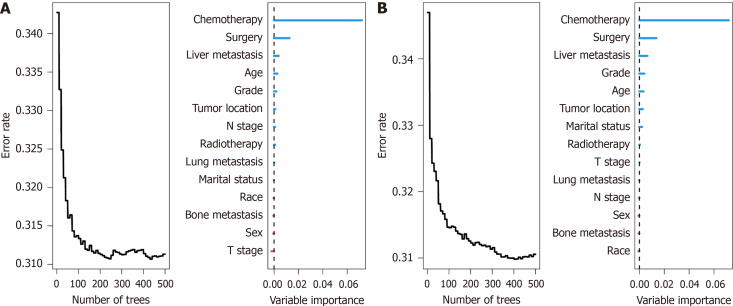
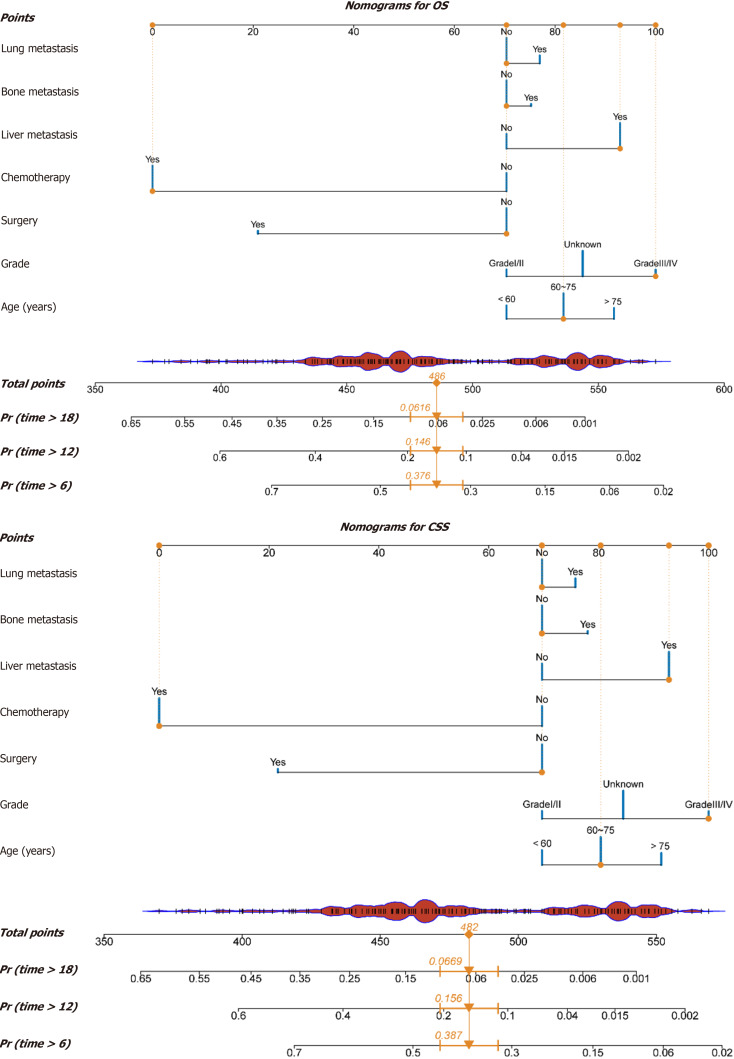
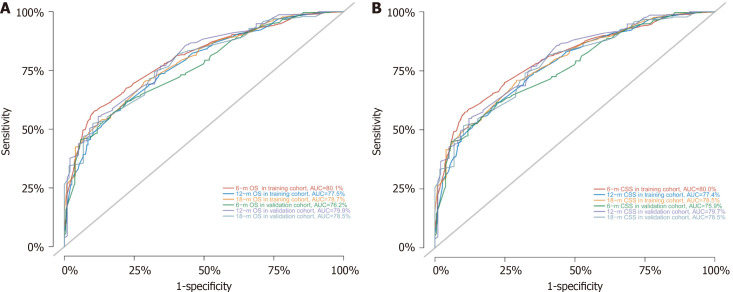
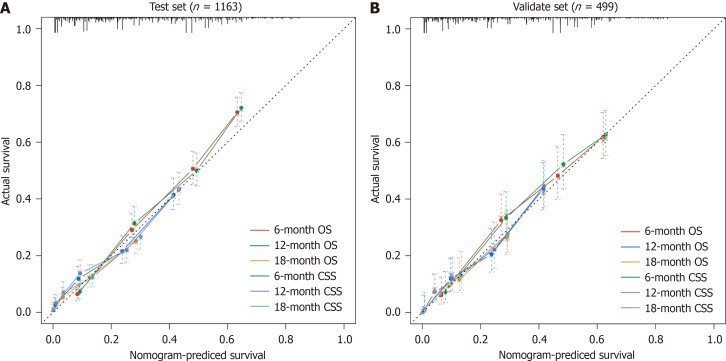
Clinical data from stage IV PC patients diagnosed pathology from 2000 to 2019 were extracted from the SEER database. Patients were randomly divided into a training set and a validation set in a 7:3 ratio. Multivariate Cox proportional hazards, Least Absolute Shrinkage and Selection Operator regression, and Random Survival Forest models were used to identify prognostic variables. A nomogram was constructed to predict CSS and OS at 6, 12, and 18 months. The C-index, receiver operating characteristic curves, and calibration curves were used to evaluate the model's predictive performance.
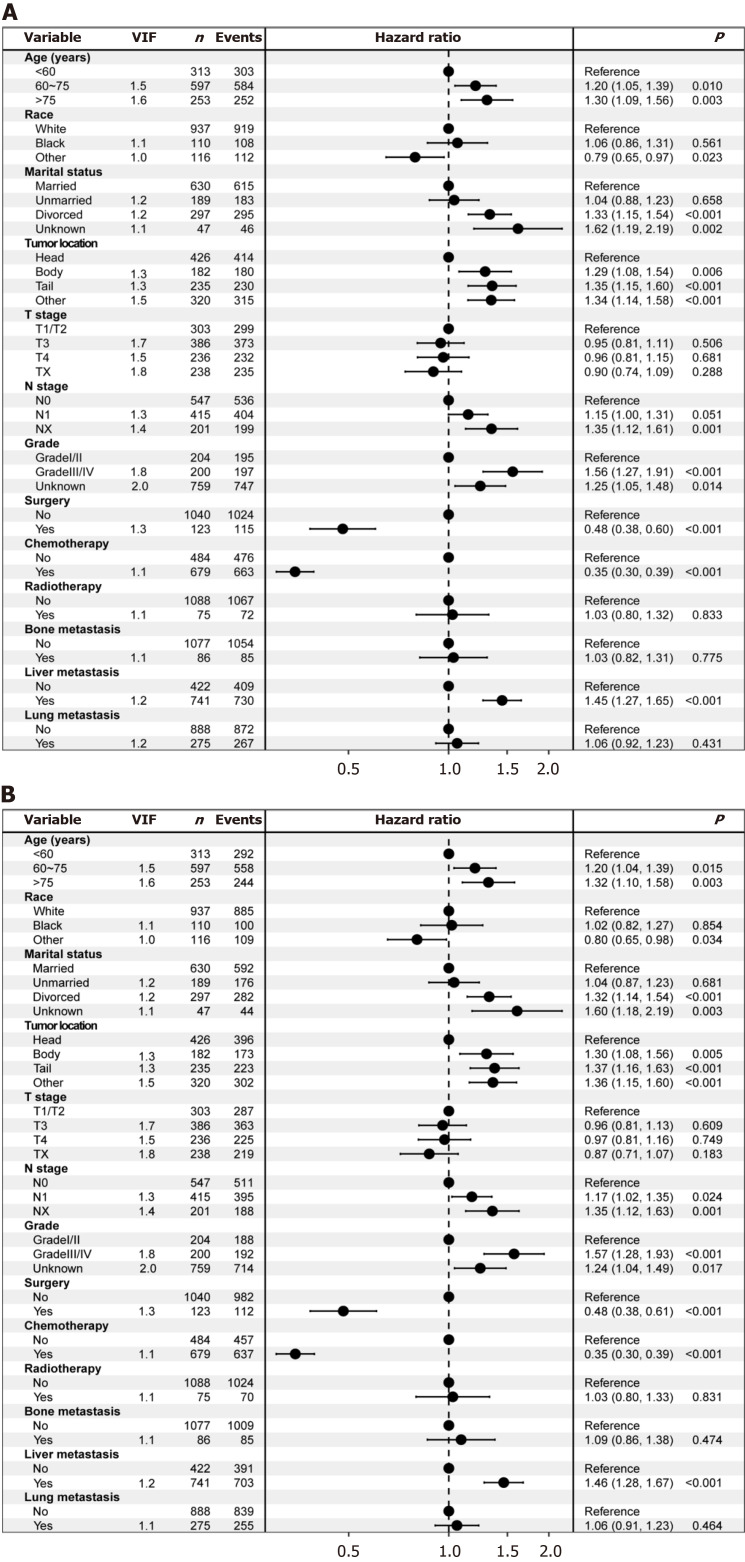
A total of 1662 patients were included (1163 in the training set, 499 in the validation set). The median follow-up times were 4 months [interquartile range (IQR): 1-10 months] for the training set and 4 months (IQR: 1-11 months) for the validation set. Key independent prognostic factors identified included age, race, marital status, tumor location, N stage, grade, surgery, chemotherapy, and liver metastasis. The nomogram accurately predicted OS and CSS at 6, 12, and 18 months, with a C-index of 0.727 (OS) and 0.727 (CSS) in the training set, and 0.719 (OS) and 0.716 (CSS) in the validation set. Calibration curves demonstrated excellent model accuracy.
The nomogram developed using age, grade, chemotherapy, surgery, and liver metastasis as predictors can reliably estimate survival outcomes for stage IV PC patients and offers a potential tool for individualized clinical decision-making.
IV期胰腺癌(PC)预后较差,且缺乏个体化的预后评估工具。目前的生存预测模型存在局限性,需要更准确、个性化的方法。监测、流行病学和最终结果(SEER)数据库为研究大型患者队列提供了宝贵资源,但基于机器学习的IV期PC预后列线图仍未得到充分探索。本研究假设基于机器学习的列线图能够高精度预测IV期PC患者的癌症特异性生存(CSS)和总生存(OS)。
利用真实世界数据构建并验证基于机器学习的列线图,以预测IV期PC患者的生存情况。
从SEER数据库中提取2000年至2019年诊断为IV期PC患者的临床数据及病理信息。患者按7:3的比例随机分为训练集和验证集。采用多变量Cox比例风险模型、最小绝对收缩和选择算子回归以及随机生存森林模型来识别预后变量。构建列线图以预测6个月、12个月和18个月时的CSS和OS。使用C指数、受试者工作特征曲线和校准曲线来评估模型的预测性能。
共纳入1662例患者(训练集1163例,验证集499例)。训练集的中位随访时间为4个月[四分位间距(IQR):1 - 10个月],验证集为4个月(IQR:1 - 11个月)。确定的关键独立预后因素包括年龄、种族、婚姻状况、肿瘤位置、N分期、分级、手术、化疗和肝转移。列线图准确预测了6个月、12个月和18个月时的OS和CSS,训练集的C指数为OS 0.727、CSS 0.727,验证集为OS 0.719、CSS 0.716。校准曲线显示模型准确性良好。
以年龄、分级、化疗、手术和肝转移作为预测指标构建的列线图能够可靠地估计IV期PC患者的生存结局,为个体化临床决策提供了潜在工具。