
农田中可食用蘑菇生产相关的土壤微生物多样性和功能能力。
Soil microbial diversity and functional capacity associated with the production of edible mushroom in croplands.
机构信息
Hunan Institute of Microbiology, Changsha, china.
College of Forestry, Central South University of Forestry & Technology, Changsha, China.
出版信息
PeerJ. 2022 Oct 3;10:e14130. doi: 10.7717/peerj.14130. eCollection 2022.
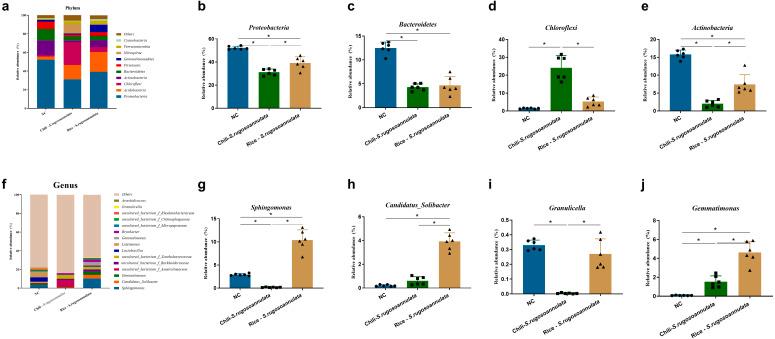
In recent years, a rare edible mushroom has become popular. has the characteristics of easy cultivation, low cost, high output value, and low labor requirement, making its economic benefits significantly superior to those of other planting industries. Accumulating research demonstrates that cultivating edible fungus is advantageous for farming soil. The present experiment used idle croplands in winter for cultivation. We explored the effects of cultivation on soil properties and soil microbial community structure in paddy and dry fields, respectively. We cultivated in the fields after planting chili and rice, respectively. The results showed that Chili- and Rice- planting patterns increased the yield, quality and amino acid content of . By analyzing the soil properties, we found that the Chili- and Rice- cropping patterns increased the total nitrogen, available phosphorus, soil organic carbon, and available potassium content of the soil. We used 16s amplicons for bacteria and internal transcribed spacer (ITS) region for fungi to analyze the microbial communities in rhizosphere soils. Notably, cultivation significantly increased the abundance of beneficial microorganisms such as , and and reduce the abundance of and . We consider cultivation in cropland can improve soil properties, regulate the community structure of soil microorganisms, increase the expression abundance of beneficial organisms and ultimately improve the yield and lay a good foundation for a new round of crops after this edible mushroom cultivation.
近年来,一种珍稀食用蘑菇 变得很受欢迎。 具有易栽培、成本低、产值高、劳动需求低的特点,经济效益明显优于其他种植业。越来越多的研究表明,栽培食用菌有利于改良土壤。本实验利用冬季闲置农田进行 栽培。我们分别探讨了 栽培对水田和旱地土壤性质和土壤微生物群落结构的影响。我们分别在种植辣椒和水稻后在田间进行 栽培。结果表明,辣椒-和水稻-种植模式提高了 的产量、品质和氨基酸含量。通过分析土壤性质,我们发现辣椒-和水稻-轮作模式增加了土壤中全氮、有效磷、土壤有机碳和有效钾的含量。我们使用 16s 扩增子分析细菌和内部转录间隔区(ITS)区域分析根际土壤中的微生物群落。值得注意的是, 栽培显著增加了有益微生物如 、 、 等的丰度,降低了 、 等的丰度。我们认为在农田中栽培 可以改善土壤性质,调节土壤微生物群落结构,增加有益生物的表达丰度,最终提高 的产量,并为这种食用菌栽培后的新一轮作物种植奠定良好基础。




 Zotero 插件