He HongZhen, Xu Mei, Fei ZhangYing, Xie Yuou, Gu XinYi, Zhu HongLiang, Wang JunJie
Department of Clinical Psychology, The First Affiliated Hospital of Fujian Medical University, Fuzhou, China.
Institute of Mental Health, Suzhou Guangji Hospital, The Affiliated Guangji Hospital of Soochow University, Suzhou, China.
Front Psychiatry. 2022 Sep 23;13:1006740. doi: 10.3389/fpsyt.2022.1006740. eCollection 2022.
Sex differences in the frequency and severity of personality disorders (PDs) have been widely reported in Western countries. However, limited literature suggests a similar sex distribution in the Chinese clinical population. This study investigated sex differences in self-reported and interviewed patients with PDs in a clinical population in China.
The participants were 1,389 consecutive outpatients with a mean age of 30.5 years, including 634 (45.6%) males and 755 (54.4%) females. Self-reported PD traits were assessed using the Personality Diagnostic Questionnaire Fourth Edition Plus (PDQ-4+). PDs were diagnosed according to the Structured Clinical Interview for Diagnostic and Statistical Manual of Mental Disorders, Fourth Edition (DSM-IV) Axis II (SCID-II).
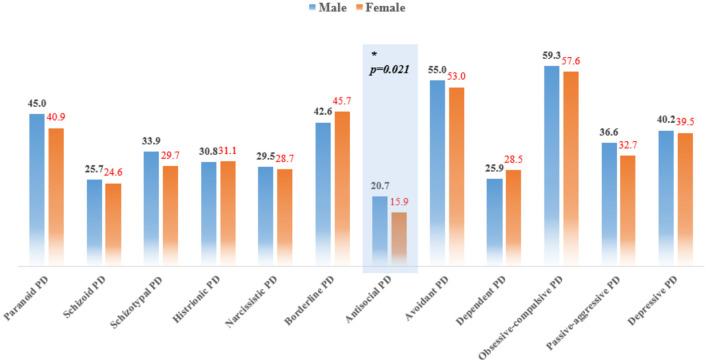
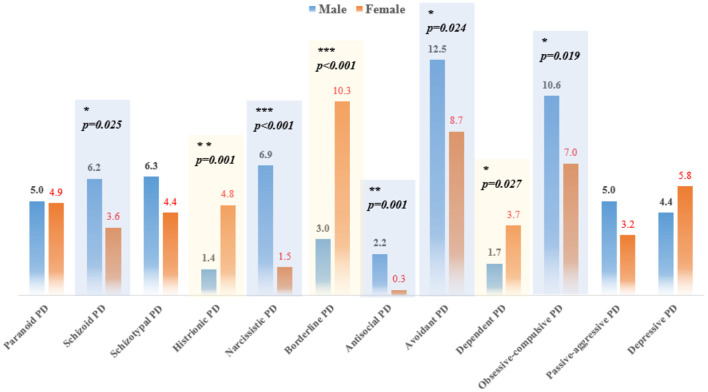
Male outpatients reported more paranoid, schizotypal, antisocial, and passive-aggressive PD traits, whereas females reported more borderline PD traits on the PDQ-4+. Self-reported PD traits in male outpatients were more likely to reach the positive threshold of antisocial PD than in females (χ = 5.293, = 0.021). Males were more likely to meet the criteria for schizoid (χ = 5.050, = 0.025), narcissistic (χ = 27.244, < 0.001), antisocial (χ = 11.430, = 0.001), avoidant (χ = 5.098, = 0.024), and obsessive-compulsive PD (χ = 5.496, = 0.019) diagnoses in the SCID-II. In contrast, females were more likely to meet the criteria of histrionic (χ = 12.327, = 0.001), borderline (χ = 28.538, < 0.001), and dependent (χ = 4.919, = 0.027) diagnoses.
These findings indicate gender differences in the traits, frequency, and pattern of PDs when assessed in a Chinese clinical population.
西方国家广泛报道了人格障碍(PDs)在发病率和严重程度上的性别差异。然而,仅有有限的文献表明中国临床人群中存在类似的性别分布情况。本研究调查了中国临床人群中自我报告及接受访谈的PDs患者的性别差异。
研究对象为1389名连续就诊的门诊患者,平均年龄30.5岁,其中男性634名(45.6%),女性755名(54.4%)。使用《人格诊断问卷第四版升级版》(PDQ - 4+)评估自我报告的PD特征。根据《精神障碍诊断与统计手册第四版》(DSM - IV)轴II的结构化临床访谈(SCID - II)诊断PDs。
男性门诊患者报告有更多的偏执型、分裂型、反社会型和被动攻击型PD特征,而女性在PDQ - 4+上报告有更多的边缘型PD特征。男性门诊患者自我报告的PD特征比女性更有可能达到反社会型PD的阳性阈值(χ = 5.293,P = 0.021)。在SCID - II中,男性更有可能符合分裂样人格障碍(χ = 5.050,P = 0.025)、自恋型人格障碍(χ = 27.244,P < 0.001)、反社会型人格障碍(χ = 11.430,P = 0.001)、回避型人格障碍(χ = 5.098,P = 0.024)和强迫型人格障碍(χ = 5.496,P = 0.019)的诊断标准。相比之下,女性更有可能符合表演型人格障碍(χ = 12.327,P = 0.001)、边缘型人格障碍(χ = 28.538,P < 0.001)和依赖型人格障碍(χ = 4.919,P = 0.027)的诊断标准。
这些发现表明,在中国临床人群中评估时,PDs在特征、发病率和模式上存在性别差异。